The True Energy Behind the Science
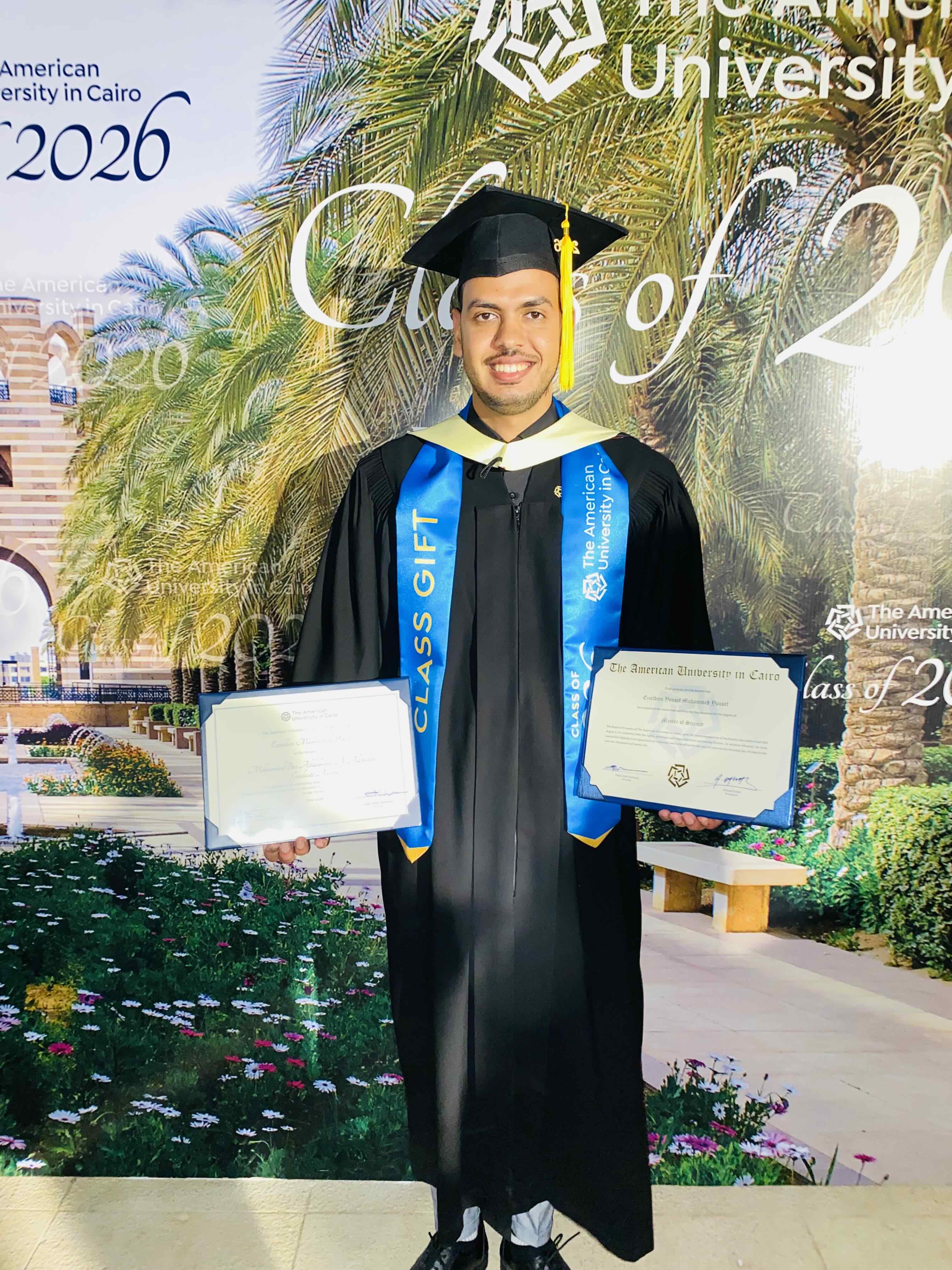
If you ask EzzEldien Yousef, who recently received the Mohammed Bin Abdulkarim A. Allehedan Graduate Award for excellence in science in the June 2026 Commencement Ceremony, what he is most proud of, he won’t start with his impressive accomplishments.
A recipient of Mohammed Bin Abdulkarim A. Allehedan Endowed Fellowship, the master’s student in nanotechnology made the most of his three years at The American University in Cairo, publishing extensively, advancing research in energy storage and positioning himself for the next stage of his academic career.
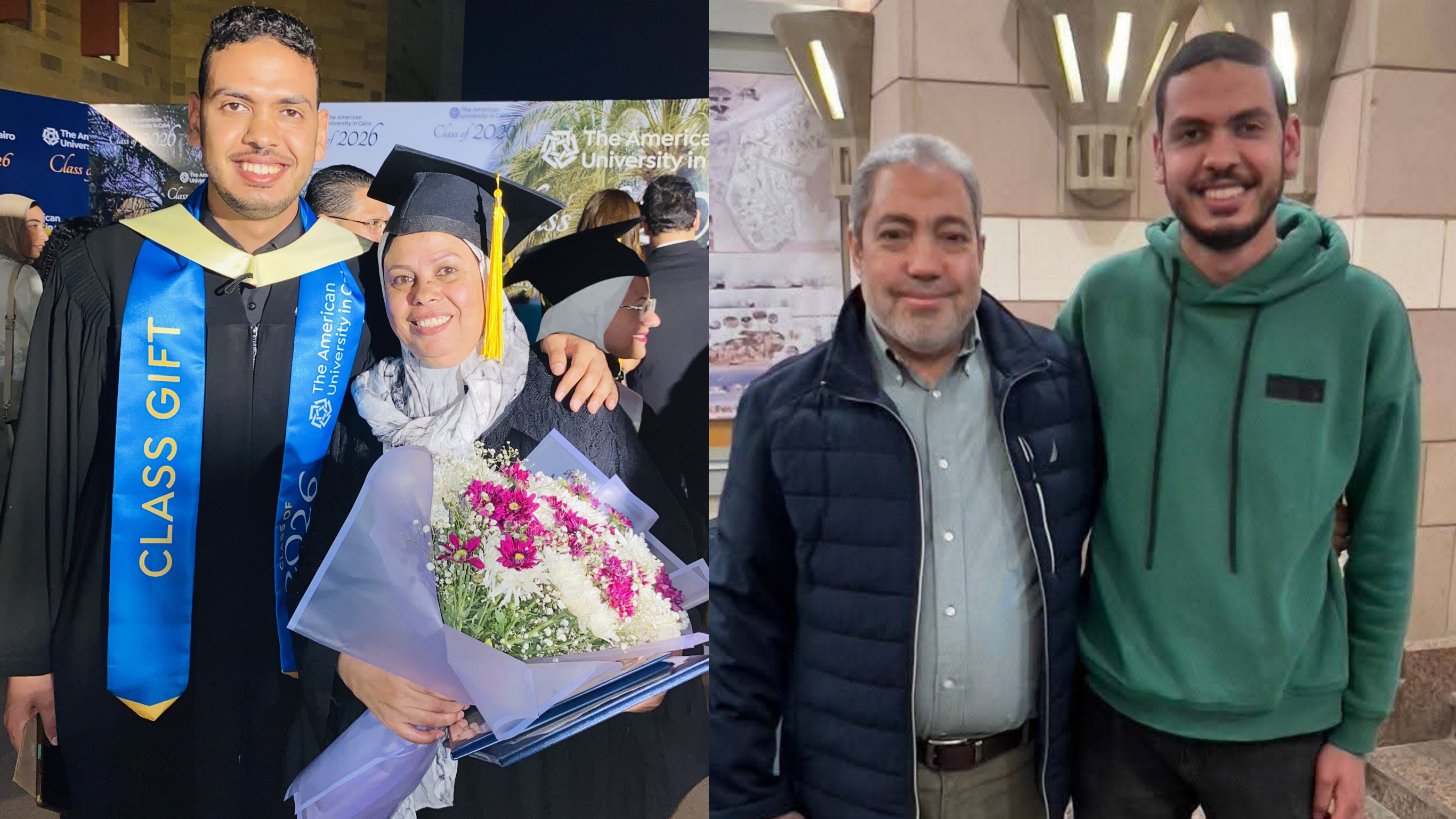
Yet, before he talks about his journey at AUC, he proceeds to praise his network of support throughout his years of studies and research. He starts with the people before getting to the science. From a mother who sacrificed to encourage his education, to mentors, classmates and donors, his is a story of opportunity and hard work multiplied through the investment of others.
Growing up in Suez governorate, his earliest champion was his mother. To motivate her son, she created a system of rewards tied to academic achievement — a computer, internet access, a mobile phone, all earned through strong grades. Looking back, EzzEldien understands exactly what those gifts represented.
“She is saving money just to encourage me,” he said. “She is not spending even on herself because she wants me to be a successful person.”
That investment paid off. Years later, EzzEldien earned his bachelor’s degree in engineering physics from Suez University. But then, he found himself at a crossroads, as a professor he had hoped to continue working with had left Egypt, disrupting his plans for graduate research. So, he started reaching out, contacting faculty members across the country, looking for a new direction.
One of those emails was to Nageh Allam, professor of physics at AUC's School of Sciences and Engineering. “I loved professor Nageh’s research profile, and when I contacted him, he responded quickly. I didn't expect that,” EzzEldien recalled.
From Allam’s side, EzzEldien also left a strong impression. “I still remember receiving EzzEldien’s first email. What began as a simple inquiry quickly revealed a student with exceptional enthusiasm and determination. It has been gratifying to watch that initial curiosity develop into a successful research career marked by excellence and perseverance.”
That exchange led EzzEldien to apply to AUC. With only a month to prepare for the required IELTS exam, he threw himself into studying. He was soon admitted to the master’s program in nanotechnology and joined the Energy Materials Laboratory (EML), where he found more than a new academic home.
“I found that the education here is better,” he said. “You have projects, you have final exams, you have activities, you have a lot of things to do, and you are applying what you are learning, and you are widening your horizons.”
It changed how he thought about research. Under Allam's mentorship, he learned to start with a problem and work backward toward a solution instead of relying on trial and error. “He is not just an advisor to me; he was like a father or a brother, and he sees students as his priority. It was a great environment to work in.”
His research focused on advanced materials for energy storage, particularly polymer electrolytes used in supercapacitors. These devices complement batteries by charging rapidly and delivering energy quickly, making them valuable across a range of applications, from consumer electronics to electric vehicles.
His master’s thesis, “Tuning Ion Mobility and Molecular Confinement in High-Performance Polymer Electrolytes for Energy Storage,” explored ways to improve the stability, efficiency and durability of these systems. He has published two papers in Q1 journals: in one study, he and his collaborators developed a hydrogel electrolyte that extended device cycling stability from roughly 80 cycles to more than 10,000. In another, they developed a polymer electrolyte that improved electrochemical stability, reduced self-discharge and enabled operation in freezing temperatures.
For Allam, watching EzzEldien’s transition from a motivated student into an independent researcher was one of the most rewarding moments as an advisor and a mentor. “Seeing him take ownership of his research projects, moving beyond simply conducting experiments to critically analyzing results, proposing new ideas, and contributing creatively to the scientific process,” he said. “That growth demonstrated that he had developed the mindset of a true researcher, and it was clear that he had the potential to make meaningful contributions to his field.”
Yet for all his achievements at a young age, EzzEldien speaks about the people around him with the same enthusiasm he brings to the science itself.
At the EML, he describes a research culture where students share knowledge freely and take pride in each other's success. “My colleagues Abdelrahman Ismail and Ahmed Agour taught me electrochemistry when I was moving into unfamiliar territory.” Close friend and colleague Abdallah Akar later put EzzEldien's name forward above his own during a PhD selection process. “You can't imagine how helpful and collaborative they are. This is how the people here are. This environment changed my mind about university and studying. I love this place, I love spending time in the lab, and I am having fun doing research here,” he said.
That spirit carried beyond the lab. As co-founder and vice president of the Innovative Nanotechnology Club, EzzEldien developed leadership skills and helped organize activities for fellow students. Faculty and staff guided him through academic requirements and helped him make the most of available opportunities.
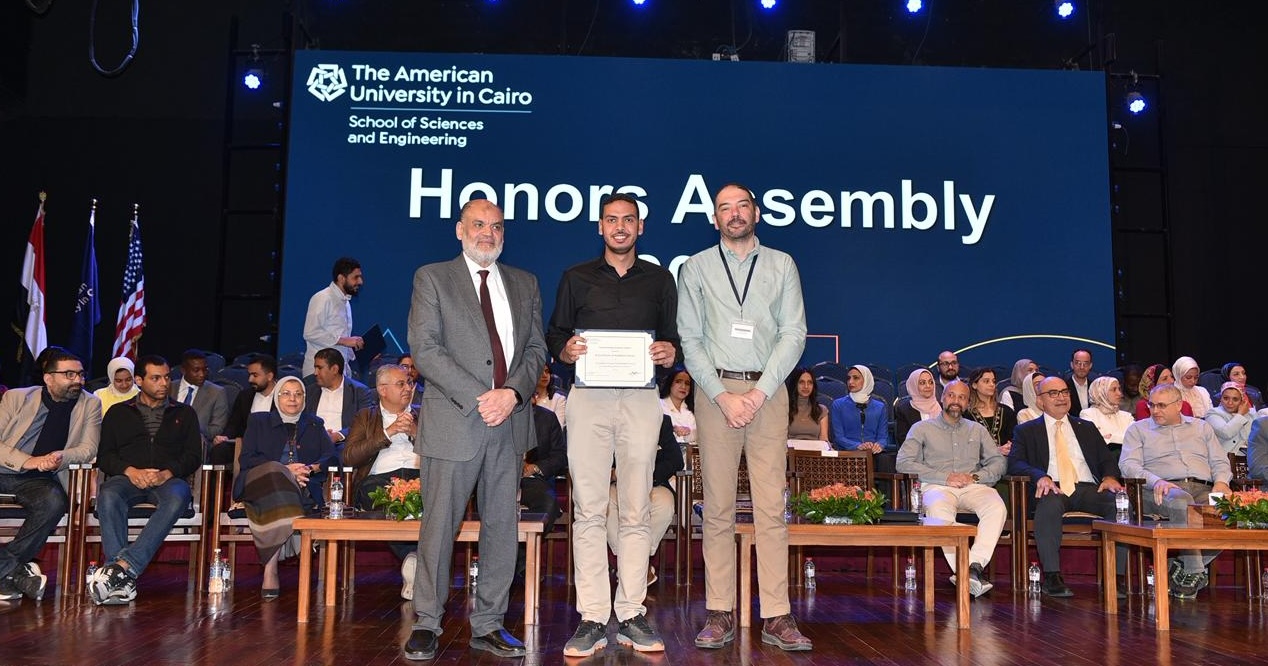
Among the most meaningful was the Mohammed Bin Abdulkarim A. Allehedan Endowed Fellowship, which provided additional funding that allowed him to accelerate his studies and complete his degree ahead of schedule.
“[The fellowship] is giving the chance to students all over Egypt to join a reputable university and continue their work. I really appreciate it and am thankful to the donor for giving me the opportunity to continue my studies here,” EzzEldien says. Receiving the Mohammed Bin Abdulkarim A. Allehedan Graduate Award this spring brought that chapter full circle. “I didn’t expect to win this award, and it encouraged me to continue my research work even though I have finished my degree. It made me feel that my research is seen.”
Allam also stressed what such fellowships and awards mean not just for EzzEldien, but also for future students. “The Mohammed Bin Abdulkarim A. Allehedan Fellowship and Graduate Award have been tremendously meaningful for EzzEldien's academic and professional journey,” he said. “Beyond the financial support, these recognitions serve as a powerful affirmation of a student’s hard work, talent and potential. Such support enables promising researchers to focus more fully on their studies and research while providing them with the confidence that their efforts are valued and recognized.”
Looking ahead, EzzEldien remains inspired by those who invested in his success. Among them, he is particularly grateful to Karim Seddik, professor of electronics and communications engineering and associate dean of graduate studies at the School of Sciences and Engineering, for his support throughout his studies. He also credits Allam as a lasting influence, admiring not only his research accomplishments but also his genuine commitment to his students. That example has quietly shaped EzzEldien's own aspirations. Though as a child, EzzEldien always worked with a prize in mind, his gift isn’t personal anymore.
“My final prize would be to help the students. It is all about giving back to the community, and I believe this is what fellowships and awards are meant to do,” he said.