Home page
ع

Heat Waves: A New Normal?

August 31, 2022
Sun shining over a river, representing global warming and climate change

From Palmdale, California to Dazhou, China and all continents in between, unprecedented temperatures this summer have impacted the health of our loved ones and wreaked havoc on water, food and energy supplies around the world.

News@AUC spoke with Seham Elmrayed, a pediatric epidemiologist and instructor at AUC's Institute of Global Health and Human Ecology, about the impact of heat waves and how communities can support vulnerable populations during a spike in temperature. 

Here’s what she had to say:

Whether you spent this summer in Africa, North America or elsewhere, you have likely experienced record-breaking heat waves. Unfortunately, excessive heat warnings have become a lived reality in most places worldwide. In fact, his summer may be among the coolest we have left to experience. 

Heat waves, which refer to periods of high temperatures and high humidity, are a direct consequence of climate change. According to the World Health Organization, heat waves constitute one of the most dangerous natural hazards for human beings. Future projections indicate that extended and extreme heat waves will occur more frequently in the upcoming years.

Heat waves can have various societal impacts by heavily burdening health care systems as well as energy and water sources. Globally, the number of people exposed to heat waves has been exponentially increasing over the last few decades, thus increasing heat-related health complications and deaths. 

While immediate efforts should focus on how we can best prepare for heat waves and mitigate their adverse effects on our health and well-being by improving individual and societal resilience, it is crucial that serious measures are taken to address the root causes of this global challenge. 

To best support vulnerable populations during heat waves, the health care sector should ensure the adequate provision of primary care services as well as assembling mobile clinics in affected areas. Additionally, raising public awareness of heat-related illnesses and promoting protective practices — such as increased fluid consumption and staying out of the sun during critical periods (usually defined as between 11 am to 3 pm) — are key in mitigating the health risks imposed by heat waves. 

Other effective public health strategies include heat wave early warning systems (HEWS), which can enable health and social workers to provide timely care for those in need and improve individual capacity in preparing for the avoidable devastating consequences of heat waves. 

Between 1901-2013, the rate of temperature increase per decade in Egypt was at 0.1°C. Over the past three decades, this has substantially increased to an annual rate of 0.5°C. The warming trend is projected to continue across the country. Recent reports estimate that annual mean temperatures will rise by around 1°C by 2030 and to over 1.6°C by 2050. 

As the host of this year’s United Nations Conference of Parties on Climate Change (COP27), Egypt and other participating countries have an opportunity to formulate and engage in effective climate mitigation strategies. 
Share

Hani Sewilam Appointed Egypt's Minister of Water Resources and Irrigation

Devon Murray
August 14, 2022
Hani Sewilam
Hani Sewilam

Hani Sewilam, professor at AUC’s Institute of Global Health and Human Ecology and director of the Center for Applied Research on the Environment and Sustainability (CARES), has been appointed Egypt’s minister of water resources and irrigation.

The appointment comes amid a major cabinet reshuffle that took place on Saturday during an emergency session initiated by President Abdel Fattah El-Sisi.

Sewilam brings with him three decades of experience in sustainable development, water resource management, water-energy-food nexus, desalination and capacity building — all of which will serve him in boosting Egypt’s resilience to water stress.

“I’m looking forward to making use of our innovative research results to face water scarcity on the ground and contribute to securing the Egyptian water resources needed for achieving Egypt’s Vision 2030 for sustainable development,” he said.

In addition to his roles at AUC, Sewilam also currently works at RWTH Aachen University in Germany as the academic director of the Department of Engineering Hydrology and executive director of the UNESCO Chair on Hydrological Changes and Water Resources Management. He is the lead scientist at the Center of Excellence for Water, and holds a PhD in water resource management from RWTH Aachen and a Master of Science in irrigation management from Southampton University.

He was also recently awarded the 2022 Water Energy Food Ecosystem (WEFE) Nexus prize by the Partnership for Research and Innovation in the Mediterranean Area, known as PRIMA.

#MakingAUCProud

Share

Enter the CAVE

Elizabeth Lepro
June 22, 2022
Male wearing virtual reality glasses

Students and alumni engage with the digital future through AUC’s VR lab.

Hesham Ismail ’04, ’07 wanted to document an afternoon riding electric scooters with his wife in downtown Los Angeles, California, but he couldn’t take his hands off the handlebars to reach for his phone. Instead, he said, “Hey Facebook, take a video!” and the Ray-Ban sunglasses he was wearing began to record. 

Smart glasses like the Ray-Ban Stories —  a partnership between the eyewear company and Meta — are becoming a reality, thanks to engineers like Ismail. The AUC grad is an engineering manager on the Developer Infrastructure team of Meta’s Reality Labs. In layman’s terms, his team provides the tools and lays the foundation that helps other engineers develop Ray-Ban Stories, along with Oculus Quest VR headsets and Meta’s Metaverse.

To read the full article, click here.

Share

Finding the Superpower Within

Devon Murray
June 22, 2022
Girl standing in the middle of a garden

A comic character developed by an AUC student to raise public health awareness is becoming an official pharmaceutical mascot.

While working as an intern at Alexandria University hospital, Sara Nasr, a graduate student at AUC’s Institute of Global Health and Human Ecology (I-GHHE), witnessed constant misfortunes. However, the young physician-in-training found herself particularly touched by the stories of children suffering from hemophilia.

“Not only were they burdened with their sickness, but they also had to deal with the way the community views them,” Nasr explained.

Hemophilia is a rare bleeding disorder commonly caused by missing or defective factor VIII (8), a clotting protein found in blood. Due to the stigma attached to the disorder, many children suffering from hemophilia are kept under strict surveillance and have their activities limited for fear of injury. Nasr noted that some parents were even afraid to touch their children.

To read the full article, click here.

Share

‘Mostakbal’ of Urbanism

Devon Murray
June 22, 2022
Professor explaining about buildings to students

Students are rethinking traditional concepts in designing architectural plans for a green town in Egypt.

On a windy afternoon in February, AUC students from the Urban Design and Landscape Architecture course, taught by Momen El-Husseiny, assistant professor in the Department of Architecture, piled out of a bus and onto the sandy grounds of Mostakbal (Future) City — one of Cairo’s up-and-coming satellite cities located in the desert about 55 kilometers east of Tahrir Square. 

Humming with a mixture of excitement and confusion, the students looked around at the barren lot that would soon be home to one group’s masterplan for Egypt’s first-of-its-kind college town, Bloomfields.

To read the full article, click here.

Share

Creativity with Compassion

Katie Marie
June 22, 2022
Group of people standing in a circle

Human-centered design thinking approach is a core part of the AUC educational experience.

By integrating design thinking into the curriculum, AUC is teaching students to approach complicated problems with a sense of empathy, creativity and resilience, explained Hoda Mostafa, professor of practice and director of the University’s Center for Learning and Teaching (CLT).

Design thinking is a methodology used by Fortune 500 companies, including Apple and J.P. Morgan, to transform their way of operating and develop innovative, customer-centric products and services. International development institutions, such as the World Food Programme and UNESCO, have employed it to create policies and programs that effectively address poverty, gender inequality and other complex global challenges.

To read the full article, click here.

Share

Metaverse: Pervasive or Invasive?

Elizabeth Lepro
June 22, 2022
A face wearing glasses and surrounded by colored squares

Bringing technology to life carries with it privacy and societal implications.

Here are some of the technologies AUC students have contributed to in just the last several years: a self-navigating wheelchair, applications that route traffic more intelligently and a smart mirror capable of determining a person’s vitals.

Sherif Aly ’96, professor and chair of the Department of Computer Science and Engineering, pointed out that this is only the beginning when it comes to pervasive computing systems enabled by artificial intelligence. “Years of innovation could be happening in days by virtue of how fast those kinds of systems are thinking and innovating,” Aly said. “It’s very likely that you start seeing stuff that showed up in science fiction movies turning yet again into science facts. You could be literally wearing your VR headset and say, ‘Hey Meta, can you replay memories of my fifth birthday with my friends?’”

To read the full article, click here.

Share

AUC Launches Climate Change Initiative

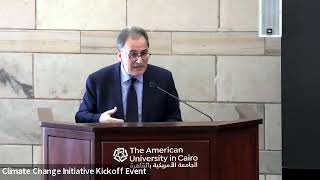
Mahmoud Mohieldin speaks at AUC's Climate Change Initiative launch event
Dalia Al Nimr
June 29, 2022

Launched last week, AUC’s Climate Change Initiative capitalizes on AUC’s contributions to national and international efforts in tackling one of the greatest challenges of our time. The initiative includes research, student activities, teaching and learning, outreach, tracking and reducing our carbon footprint, writing school textbooks on climate change and providing climate change solutions in specific contexts within the country.

“Our aim in this initiative is to reinforce AUC’s role as an active academic hub on climate change and sustainable development in Egypt and the region, as well as an active contributor to global efforts addressing climate change challenges,” said President Ahmad Dallal. “Of course, COP27, hosted in Egypt in November, provides an incentive to catalyze AUC’s climate change initiative.”

Dallal outlined the initiative’s five main areas of focus that are fully aligned with national and regional climate change and sustainability priorities:

  1. Water-related issues
  2. Green architecture and sustainable urban development
  3. Green finance
  4. Global health
  5. Energy transition

These areas of focus also overlap with a number of “cross-cutting issues” ––adaptation to climate change, resilience of communities, mitigation measures, education and a just transition –– that are relevant to Asia and the region. “We encourage a multidisciplinary approach in addressing challenges, including policy, regulatory frameworks, financing, scientific research and social science aspects,” said Dallal.

UN Climate Change High-Level Champion for Egypt and Executive Director of the International Monetary Fund Mahmoud Mohieldin, who was the keynote speaker at the event, highlighted five distinctive features of COP27, which AUC will participate in next fall:

  • A holistic approach to climate change

“We cannot ignore poverty, hunger, job creation and an inclusive approach to the whole [climate change] agenda, including the impact of climate change on children, youth and women."

  • Implementation of previous promises outlined in the climate change agenda and action plan

“We don’t need new frameworks; we just need to apply what we have. If there is a good idea, let’s projectize it. You [AUC] have good ideas, and you have been teaching about them, so [the focus now is] how to apply them on your scale, with the hope that this could be scaled up or replicated somewhere else.”

  • For the first time in the history of COPs, there is an alignment between the COP agenda, G13 and the rest of the SDGs [UN Sustainable Development Goals], with five major events to correlate the promise of finance coming from different institutions with the pipeline of projects, especially those focusing on mitigation, decarbonization and race to zero.

“This is a very practical approach based on a country-platform design, with five regional roundtables [across the world] – and I’m inviting you to participate in any capacity you wish. … It’s not just about Egypt and the local community. It’s about the region, Arab countries, the Mediterranean, Africa  and beyond.”

  • Localization (bottom-up approach): For the first time, Egypt’s 27 governorates will be participating through their big, small and medium enterprises, startups, as well as women-led community development initiatives in a two-month competition to choose the project that offers the smartest and greenest solutions, after which a team of national winners will be selected.
    ​​​

“It’s not about the competition; it’s about [showcasing] the talents and skills in the governorates, and it’s a chance to demonstrate what they’re doing. … It is customary for rich countries to host big conferences to be attended by 30,000 plus participants, [including] heads of state, but ordinary people would always wonder, ‘What's in it for us? Why do we have this conference?’ And this is legitimate.” 
 

  • Finance through partnerships, investments, international financial institutions, as well as public and private sector funding

“Without finance and investments, without the resources available to us –– not just financial resources, but technology and knowledge [as well] – nothing will really progress, and many of these ideas may end up with frustration. There will be some serious discussion about [funding] opportunities." 


Share