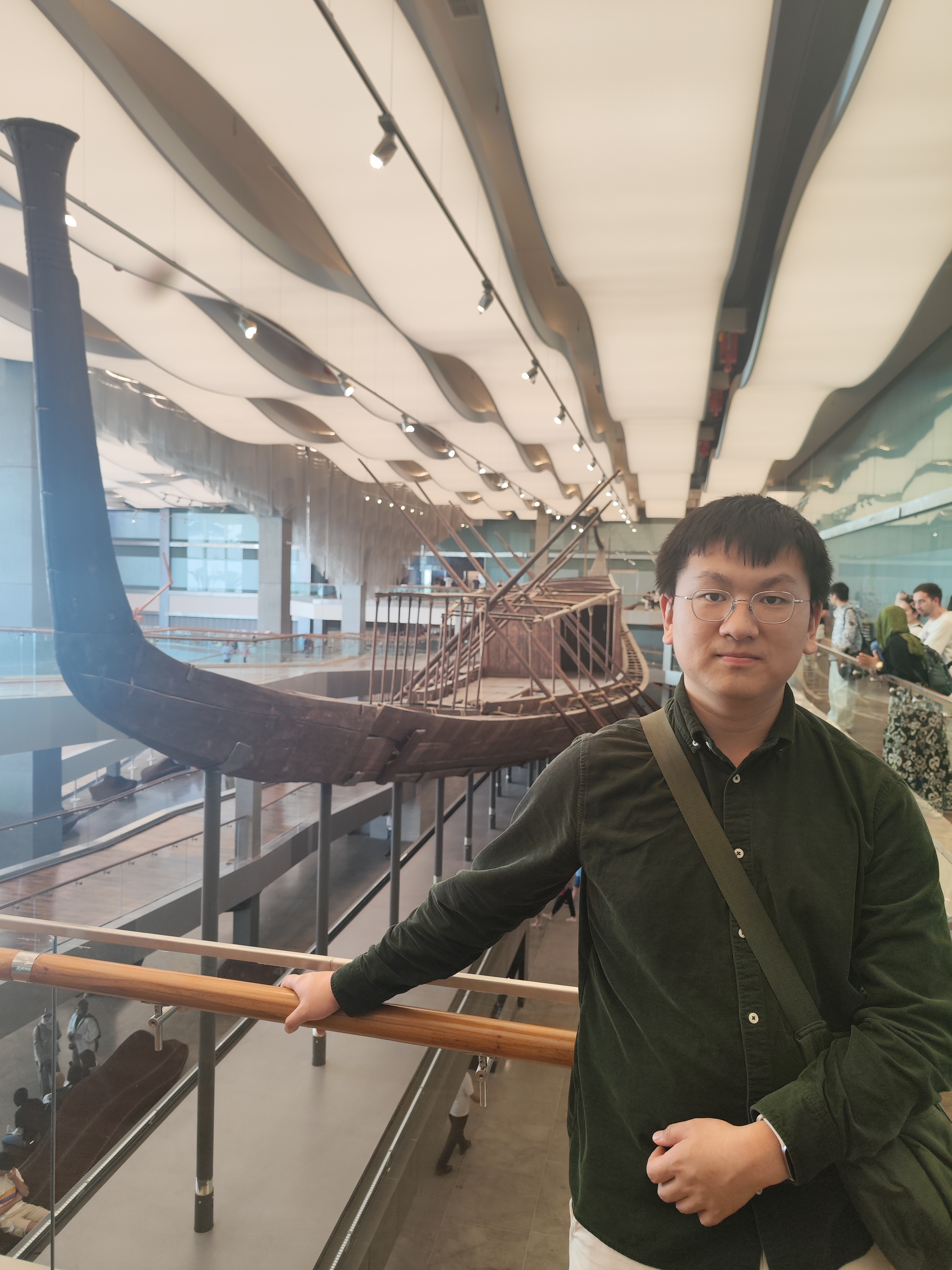
Following History Across Continents
As a child, Jingwei recalls he wasn’t particularly interested in history: “I drifted from one passing interest to the next, and I didn’t have a particular fascination with history,” he says. “Honestly, I probably couldn’t even have told you what ‘history’ meant back then.”
Looking back, he believes his grandmother’s stories quietly planted a seed. “It wasn’t until my BA studies in Tianjin, China, that I started to develop a more realistic understanding of what history is, and that’s really when the interest started to grow.”
That interest brought him more than 7,000 kilometers from home to Egypt, where he is pursuing a master’s degree in Egyptology at The American University in Cairo, supported by the Bernard and Lisa Selz Endowed Fellowship in Egyptology.
“It was my first time going abroad, and that really added to my excitement and fear at the same time,” he recalls.
The biggest adjustment, he found, was more mental than physical. “I used to be a fairly introverted person and would get easily nervous when it came to socializing or public speaking. After spending several semesters living and studying in Egypt, I started to feel less fearful and became a bit more confident. I think that’s largely because I’ve made good friends here, and because AUC has such an accommodating and welcoming atmosphere.”
The change extended into the classroom. “Courses at AUC, especially at the graduate level, call for strong independent thinking, communication skills in both speaking and writing, and cooperation with colleagues — all quite different from the learning mode I was used to back in China. For that reason, the experience at AUC has been genuinely profound and transformative for me.”
Studying in Egypt has also opened doors that would be hard to find elsewhere. “Studying Egyptology in Egypt, and specifically at AUC, remains a real privilege. Compared with other places in the world, it’s so much easier here to access the museums and the sites of the ancient monuments in person. This advantage is fully embraced by the course design in AUC’s Egyptology department, where a field trip or on-site study session is built into almost every course.”
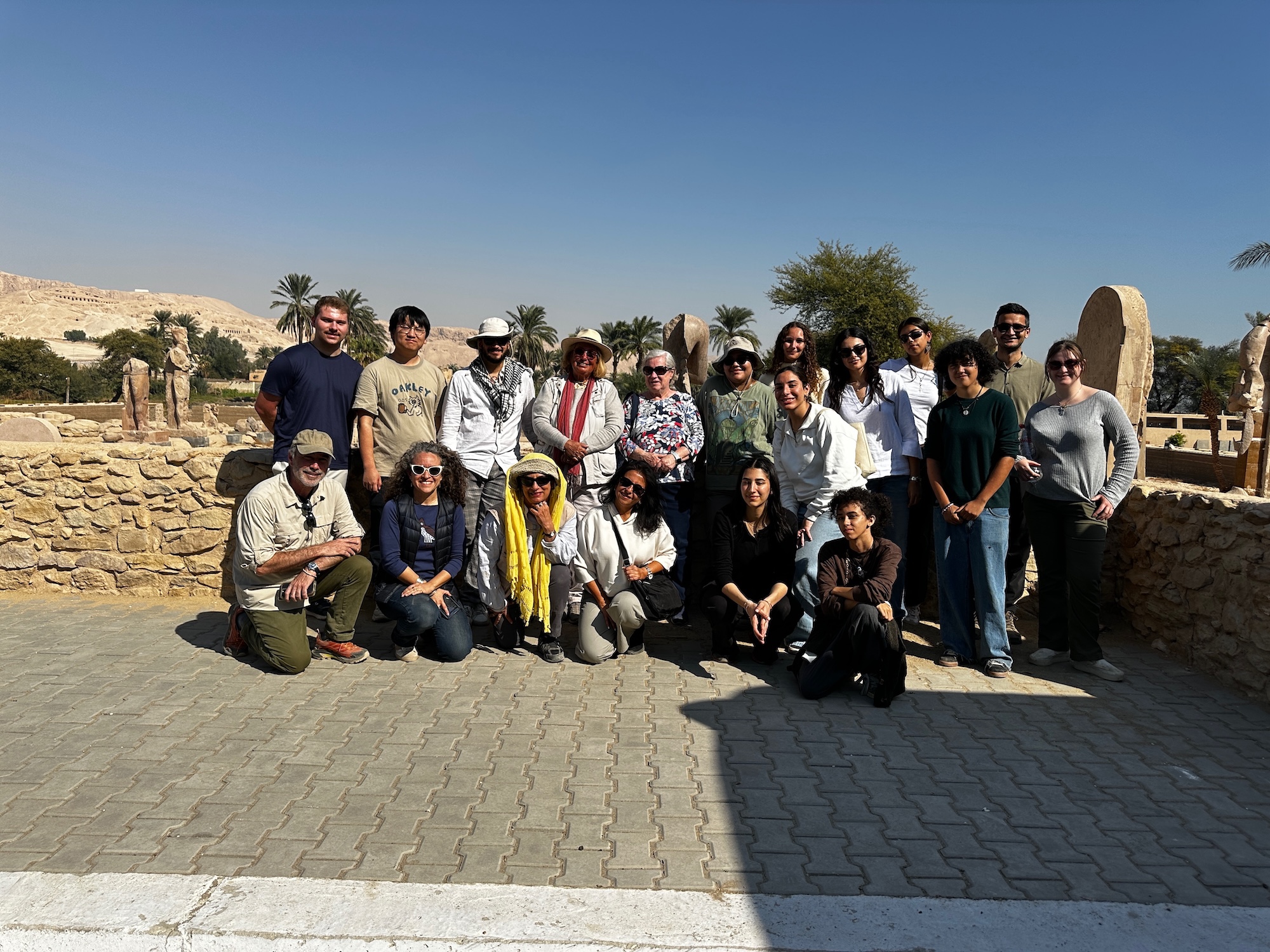
He has visited Saqqara, Luxor, Wadi El Natrun, Fayyoum and Cairo’s major museums, attended workshops at leading research institutions, and learned from internationally recognized Egyptologists such as Distinguished University Professor Salima Ikram and Visiting Professor W. Raymond Johnson.
Yet what fascinates him most is not kings or monuments, but ordinary people. That became clear to him during a field trip in the winter of 2024 to Deir El-Medina, on Luxor’s West Bank.
“It once served as the workmen’s village that housed the artisans who built the royal tombs from the 18th to the 20th Dynasty, together with their families,” he explains. “The settlement itself was abandoned in antiquity and doesn’t leave much to see today.”
The village has disappeared, but what its people left behind captivated Jingwei. “What stayed with me were the tombs the workmen built for themselves on the surrounding hillsides, beautifully decorated, along with the huge number of papyri and ostraca they left behind, many of which were inscribed or decorated. Because of all that has been left, scholars have been able to conjecture and reconstruct their daily lives.”
“Walking along the ancient settlement felt inspirational. It is both challenging and rewarding to try to imagine their everyday life unfolding before you. For someone studying history, it’s always thought-provoking to wonder how they actually lived, what was their happiness and sorrow, and how different, or similar, that might be from our own lives today.”
Having grown up in China, another civilization with thousands of years of recorded history, Jingwei arrived in Egypt with an appreciation for the complexity of the past.
“I think the biggest lesson I’ve learned from thinking about these two civilizations, or ancient civilizations in general, is that they’re both distant and familiar to us at the same time,” he says. “For modern Chinese people and modern Egyptians alike, these old civilizations can feel equally remote. It would be problematic to think of them as homogeneous or continuous, because so much has changed across their histories.”
For him, what matters most is what has survived. “The artifacts, the languages, the customs, the foodways and so on still quietly live on with us in some form and keep giving us a sense of who we are.”
That is also why he believes cultural heritage should be accessible to everyone. “I think China and Egypt have both made great efforts to define and protect their cultural heritage through legislation and public education,” he says. “But I think a shared challenge remains for both countries: telling a story about their own cultural heritage that is both coherent and engaging to a wider public.”
If he could introduce one aspect of ancient Egypt to audiences back home, he already knows where he would begin. “I would probably introduce the ancient Egyptian language and writing systems to people in China. Both ancient Egypt and ancient China developed sophisticated writing systems for their languages. A lot of people in China are already enchanted by ancient Egyptian hieroglyphs because of their apparent similarity to ancient Chinese script. Clarifying the similarities and differences between them would encourage further interest in ancient Egypt and its cultural legacy, and it would also inspire comparative thinking.”
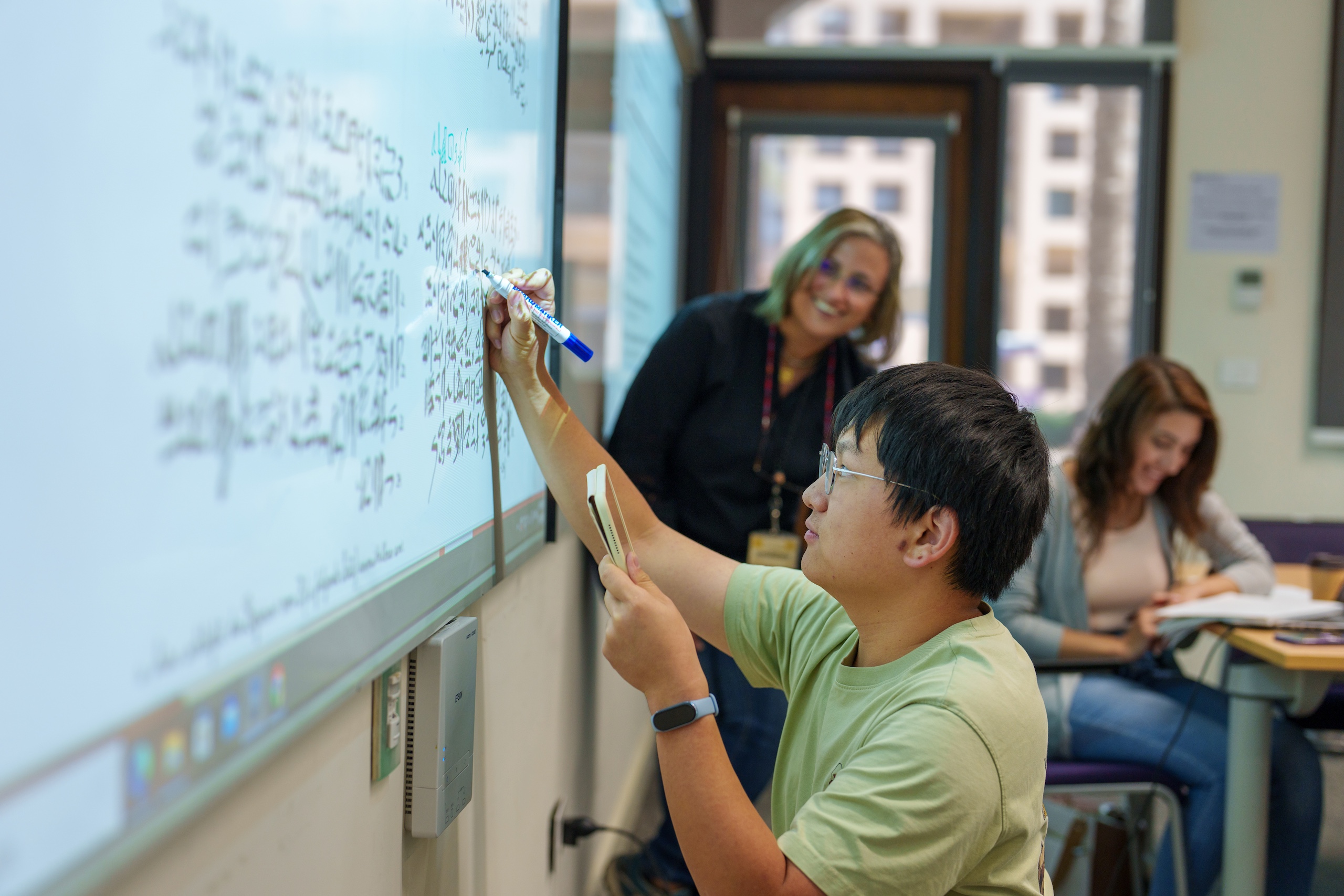
His own research explores a darker side of ancient Egyptian life: enmity. “I’m interested in how the ancient Egyptians expressed hostility, not only toward enemies on the battlefield, but also toward supernatural entities or forces they conceived of as malevolent,” he says. “How did the ancient Egyptians treat, or wish to react to, the hostile beings of their time? They left behind a great deal of textual and graphical evidence, which I hope to draw on in attempting to answer these questions.”
Throughout, the Selz Fellowship has allowed him to concentrate on that work. “The fellowship has eased my financial pressure in multiple ways while I am pursuing my studies in Egypt,” he says. “With the financial support from the fellowship, I have been able to focus on my studies and not be bothered with financial stress during my stay at AUC.”
For Jingwei, AUC is also where he has been growing as a scholar. “It is a venue where I learn to develop myself as an independent, responsible and honest researcher.”
Having completed his course work with a satisfying GPA, Jingwei is now focusing on his thesis. He hopes to go on to pursue a PhD in Egyptology, sharing stories of the past with others, just as his grandmother once shared stories with him.
Established in 2019, the Bernard and Lisa Selz Endowed Fellowship in Egyptology supports Egyptian and international graduate students pursuing a Master of Arts in Egyptology and Coptology at AUC. The fellowship currently supports two students and has supported five others since its founding.
If you are interested in establishing a scholarship or fellowship at AUC, email advancement@aucegypt.edu.