Five students from the AUC School of Business won first place in the national 2022 Map the System competition in late April, competing against six other teams comprising 30 undergraduate and graduate students. Their project was also named an Excellent Undergraduate Project in the global competition, which took place in the UK this spring.
Map the System is a global competition of the Skoll Centre for Social Entrepreneurship, delivered in partnership with educational institutions around the world, including AUC.
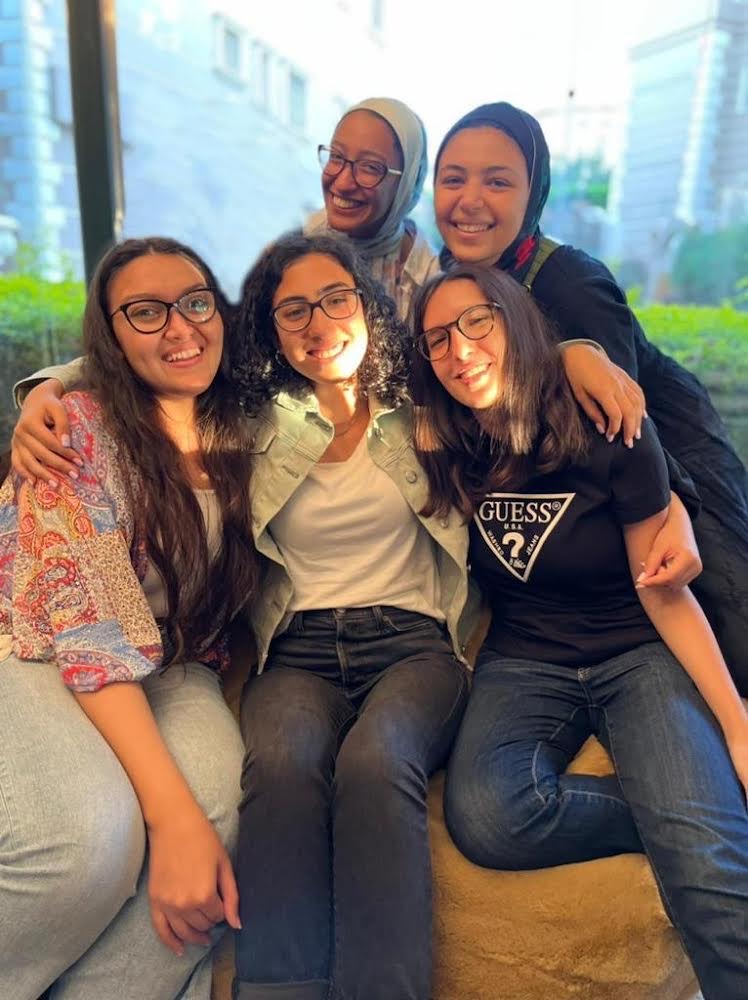
Reem El Saka, Jessica Botros, Alia El Soudany, Hana Hassan and Laila El Gindy took first place with their project, “The Social and Economic Challenges Affecting the Livelihood of Women in the Informal Sector in Cairo".
El Saka, Botros, El Soudany, Hassan and El Gindy
The competition challenges participants to explore social or environmental issues using systems thinking as a guiding approach.
“Map the System provided us with a mix of thrilling and exceptional learning experiences,” El Saka commented. “We were given the opportunity to research and systematically think of a challenge hindering our environment.”
Systems thinking itself involves analyzing issues by examining the interconnectedness of different factors within an issue, rather than focusing on a single factor.
Examining the experiences and perspectives of Egyptian women participating in the country’s informal sector, the group’s project identifies possible gaps and areas in need of improvement.
With limited data and literature available on the topic, the team was “eager to go the extra mile to grasp the elemental dynamics in the Egyptian system elevating this problem, by connecting with influential stakeholders and governmental entities,” said El Gindy.
“We wanted to approach the problem of the informal sector from an objective standpoint — one that does not antagonize women for causing spillover issues in society,” explained Hassan. “We trusted that digging deeper into the causes of such a problem could be more profound than what general research shows.”
Each group member echoed satisfaction with their experience with Map the System, from conducting research to presenting their findings.
“What was attractive about this specific competition was not the ultimate goal of reaching solutions, but rather interpreting the complexity of a broken system and portraying the absent evidence-based interventions which led to the failure of previous efforts combating the informal sector and inequality,” added Botros.
El Soudany was pleased that the competition prompted her to think deeply and critically about societal problems.
When the winners were announced, the group was overcome with joy. “All the sleepless nights paid off when we won first place,” a team statement read. “It was this moment where we felt like stepping into what a real milestone feels like.”
The team will move on to the global competition in June, where they will compete against 64 other finalist teams at the University of Oxford.
“Winning first place locally does not mean that our learning journey in the competition has ended, because a different, enlightening phase will follow,” said the statement. “We expect to live a remarkable experience under the true sense of responsibility of representing AUC.”
The team encouraged other AUC students to join major competitions such as Map the System.
“Just as we thought we couldn’t make it to where we are now, seizing every chance to grow personally and professionally is always worth the chaotic frustration of stepping out of your comfort zone. One must have the resilience and spirit to explore what is given and hidden — this will give you the key to making any new experience as fruitful as it could be.”
The competition encompasses the efforts of the AUC School of Business to create generations of sustainability-oriented market leaders to instigate change across markets.
This year, it was hosted by the John D. Gerhart Center for Philanthropy, Civic Engagement and Responsible Business of the AUC School of Business in coordination with the Assistant Provost Office for Innovative Learning Experience.
Just five years after joining the AUC Venture Lab as a budding startup, Swvl has made its debut on the Nasdaq –– the first Egyptian unicorn, first V-Lab graduate and first North African tech startup to list on the U.S. stock exchange.
Entering the exchange next to other tech giants with a valuation of $1.5 billion, the fast-growing transportation company is also the second in the Middle East to list on Nasdaq via a SPAC (Special Purpose Action Committee) merger, following Anghami. The company merged in July of last year with Queen’s Gambit Growth Capital, a SPAC that boasts being 100% female-led.
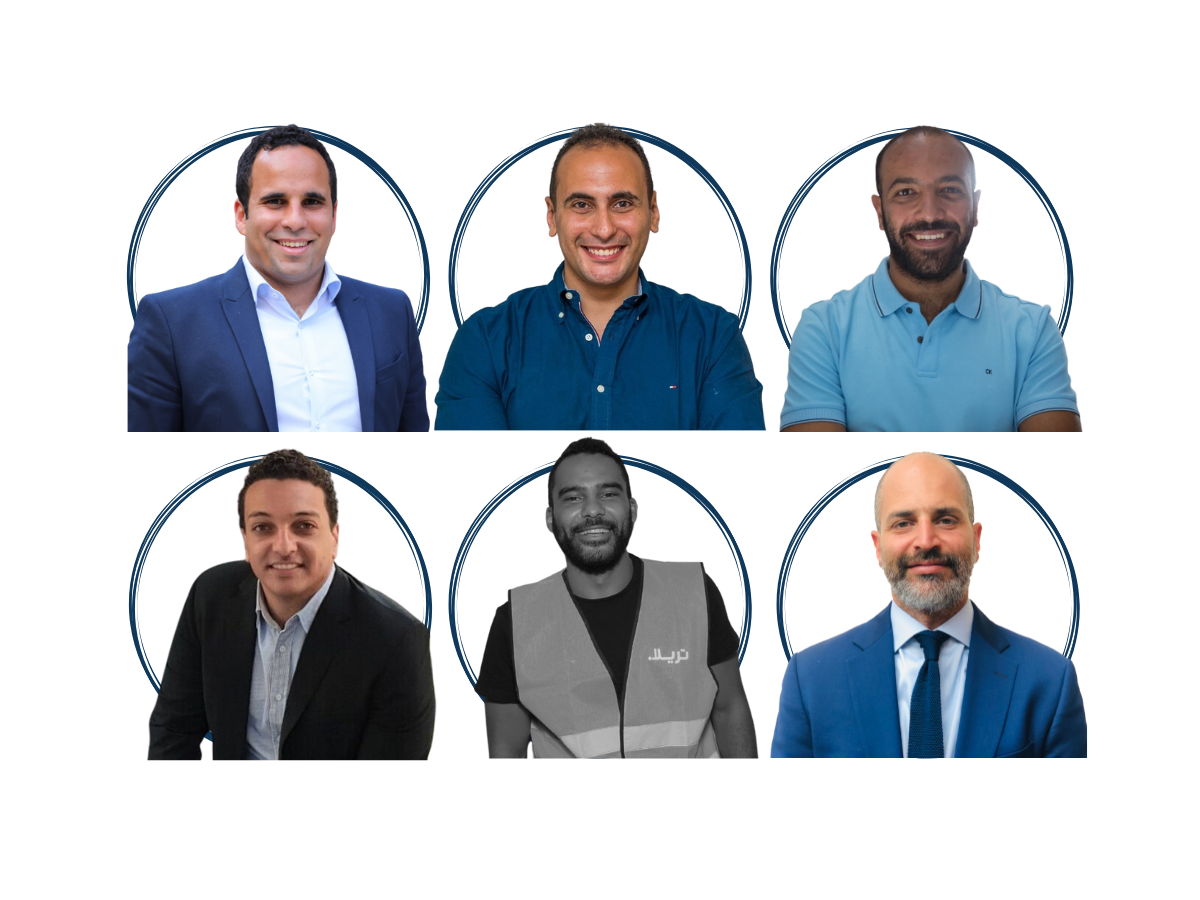
Founded by Mostafa Kandil '15, Ahmed Sabbah and Mahmoud Nouh, Swvl set out to improve public transportation in Egypt through tech-enabled ridesharing services. The company now operates in 115 cities in 18 countries across Latin America, Europe, Africa and Asia.
"We are very excited to see Swvl's team reach this inspiring milestone,” said Ayman Ismail ’95, ’97, founding director of the V-Lab and associate professor and Abdul Latif Jameel Endowed Chair in Entrepreneurship. “At AUC Venture Lab, we take pride in having been part of Swvl's early journey and continue to be committed to being a catalyst for growth and to empowering more inspiring founders during their journeys. [Swvl is] “an inspiration to many entrepreneurs and one that paves the way for an entire generation of tech startups.”
Kandil began his studies as a petroleum engineering student at AUC but ended up seeking a more dynamic path, as he was always keen on exploring the business world. In 2017, Swvl joined AUC Venture Lab, Egypt’s first University-based accelerator and incubator which offers acceleration programs to high-growth, innovation-driven tech startups.
In August 201, when Swvl announced that it would list on the Nasdaq, Kandil said, "I’m proud to say that being an AUC student was the start of the journey that brought me to this moment in my life."
Accelerated by the V-Lab in Cycle 8, the team was able to launch the application before graduating from the cycle. The startup has seen impressive growth since its launch, crossing Egypt’s borders and establishing roots abroad. Kandil was named — along with co-founders Nouh and Sabbah — among Forbes Middle East’s Top Arab 30 under 30 in 2018.
To date, the V-Lab has graduated over 300 graduate startups that have gained EGP 3 billion in investments and created 10,000 jobs, leaving a lasting impact on the greater community and regional development ecosystem. In 2021, the lab was recognized as the Best Accelerator/Incubator Program in North Africa by the Global Startup Awards.
AUC’s Mina Sami, assistant professor of Economics, and Wael Abdallah, assistant professor of Finance, have published a first-of-its-kind report on Africa’s crypto boom, aptly entitled “Does Cryptocurrency Hurt African Firms?”
A lack of data around cryptocurrency in Africa, coupled with ever-increasing public interest, earned Sami and Abdallah recognition as among the top 10% of SSRN authors in the MENA region.
Their latest report, published in February 2022, shows that cryptocurrency negatively impacts African micro-entities, particularly those in “less competitive” sectors such as energy, financial, industrial, and consumer services. “Each 10% growth in the cryptocurrency market cap reduces the market value of African firms by 0.76%,” Sami and Abdallah’s paper outlines.
It also finds that cryptocurrency trading in Africa has a particularly adverse effect on firms that are less experienced and highly indebted.
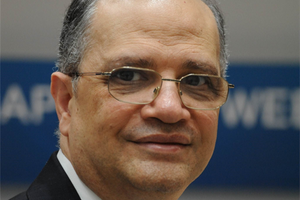
Mina Sami and Wael Abdallah
Additionally, Sami and Abdallah outline how macroeconomic factors and companies’ internal policies are part of the adverse landscape created by the crypto boom. Even with cryptocurrency banned in many African countries, this fails to protect companies in less competitive sectors.
The reason for this, Sami argues, lies in behavioral finance. “The pain of loss is higher than satisfaction from gains,” he affirms; consequently, with some sectors underperforming as the coronavirus pandemic shook businesses and economies globally, investors are looking for alternatives.
In much of the world, including developing economies, the answer became crypto.
The crypto boom is particularly worth watching in MENA and Africa as it may, on the surface, seem at odds with low financial inclusion levels plaguing emerging and developing markets in the same geographic vicinity—a shocking 57% of Africa’s population is unbanked.
Despite the parallels in many of these emerging markets, they are far from being a monolith. According to global data, 2.6% of Africa’s population are crypto users, although this figure is calculated through median ranges, and is not necessarily representative of every market in Africa. Egypt’s crypto users stand at 1.7 million, a massive number despite the stigma and skepticism with which the public widely views crypto and digital currencies, and as the Central Bank of Egypt does not yet allow crypto trading. Another commendable market is Kenya, ranking fourth globally with 8.5% of the country’s population being crypto users.
Sami and Abdallah see that crypto’s popularity is poised to grow even more. “I believe there will be great growth in Africa’s crypto markets in the next year. People are unbanked and the stock market has high transaction costs, while cryptocurrency is decentralized and transaction costs are low…So the trend is very likely to grow in Africa, especially with the prospect of inflation and depreciating currencies in much of the continent; this makes crypto very attractive for traders…a safe haven,” Sami explains, grouping crypto with more traditional safe haven assets like gold and crude oil.
While Sami and Abdallah don’t offer a solid answer as to whether crypto should be legalized in more African markets, they do say that their findings call for an excruciating need for further innovation—this, they say, is the one prime aspect that might mitigate the adverse effect crypto growth has on African micro-entities.
“Firms must be more competitive in the market,” Sami affirmed, quoting Robert Solow, winner of a Nobel Prize in Economics, in saying, “What guarantees country-level economic growth in the long-term is innovation.”
He continued: “Real estate and IT thrive [in Africa] because they innovate, whilst in other sectors productivity is very low—something that we need to boost. Entrepreneurs in Africa are not well guided or backed with enough knowledge, which makes companies [especially SMEs] less productive.”
Speaking on the paper’s recognition and ranking, Sami said, “This opens a new area for research, encouraging researchers and academics to work on these topics. People living here in the region, or outside, need information and research about this market.”
In a rapidly changing world, there is no one easily digestible answer to tackle the threats posed by shifting market trends and novel prospective assets. Sami and Abdallah’s new report shows just that; with all the merits that crypto offers investors, and all the promise it holds in Africa, this comes at massive cost for conventional institutions and a host of less-than-lucrative sectors.
“The role of the government should be to increase innovation and improve regulation in the traditional financial markets, in order to compete with cryptocurrency,” concludes Abdallah. “In improving the efficiency of our financial markets, we must be more transparent and pass regulations that facilitate investment flows.”
These lessons will not only capitalize on crypto’s promise—despite most cryptocurrencies posing a generally high risk level—but also potentially reap wider gains for economies at large.