Home page
ع Search AUC

AUC Introduces New Translation Minor, Science Specializations

AUC students sit at desks in a classroom with a green wall behind them
Katie Marie
September 4, 2023

AUC is kicking off the semester with new academic programs: the University’s first minor in translation studies, biology specializations in biotechnology as well as ecology and conservation, in addition to computer science and engineering specializations in embedded systems and artificial intelligence.

Offered by the Department of Applied Linguistics, the new translation studies minor is geared toward students from any major, according to Reem Bassiouney, professor and department chair. “Training in translation will broaden career opportunities for students in any field, from business and social sciences to medicine and engineering,” she said. “In today's world, there isn’t any business or sector that does not require some form of translation services. However, you can’t do it well without understanding the relationship between language and society, as well as the tools of translation science.”

The minor is open to all undergraduate students at AUC and consists of five courses: two in linguistics and three specifically focused on translation. “To be a good translator, you need to develop some background in linguistics, which is the study of language, its structure and syntax,” explained Bassiouney. “Linguistics helps us understand the importance of language, how it shapes our social world and the way we relate to one another.” 

Students will be able to choose from several new offerings covering the theory of translation as well as skill-based courses on subjects including document translation, specialized courses for specific types of documents and simultaneous translation.  

Other departments within AUC have also adjusted their offerings ahead of the new school year with the aim of better preparing students for career success. 

The Department of Biology is now offering two new specializations for its Bachelor of Science in biology: one in biotechnology and another in ecology and conservation. These specializations will replace previous concentrations in marine biology as well; as molecular and cell biology. 

“This program restructuring was driven by our dedication to offering a curriculum that includes the latest and most applicable biological disciplines,” said Ahmed Moustafa, professor and chair of the Department of Biology. “The new specializations seamlessly complement the foundational knowledge in our biology program. They empower students to grasp the real-world applications of these subject areas within the biological sciences. This not only enriches their academic perspective but also broadens their career horizons, positioning them as top contenders for roles in research, industry and conservation.”

Additionally, the Computer Science and Engineering Department will now offer specializations in embedded systems and artificial intelligence for its Bachelor of Science programs to cater to the rapidly evolving and expanding field, creating a need for new skills and expertise in the workforce.

“These specializations are increasingly sought out by employers both in Egypt and abroad,” said Sherif Aly ‘91, professor and department chair. “We have been offering courses in both areas for some time, but the specializations formalize these two tracks within our programs. They will now be listed on student degrees upon graduation, providing them with an additional credential as they enter the workforce.”

Share

A City for All: Gender as a Lens for Design

A graphic of women walking in a park in front of a city skyline.
August 22, 2023
A graphic of women walking in a park in front of a city skyline.

“Navigating a massive city such as Cairo encompasses a wide array of challenges and gender inequalities, from walking in the streets and riding public transportation to dealing with physical and social limitations,  as well as the absence of public space. These are all encounters that raise questions about harassment and women's rights. Students should reimagine how this can be different,” said Momen El-Husseiny, assistant professor in the Department of Architecture. 

This is what students in the new course, Gender as a Design Lens,  sought to do –– find solutions to pressing social challenges such as public space sexual harassment, designing women-only areas in health clubs and mosques, and improving the livability of places on campus and in Cairo.

The course divided students into groups and helped them develop a design thinking exercise, where they reflected on a particular challenge they experienced. Course instructors were El-Husseiny; Helen Rizzo, associate professor of sociology; and Magda Mostafa, professor of design in the Department of Architecture.

“This was a great opportunity to bring these fields together in conversation with gender studies and expose the students to design thinking,” said Rizzo, explaining how Cairo's complex problems require interdisciplinary solutions. 

Mostafa hopes the course broadens student understanding of the role gender identity plays in multiple facets. “Academic disciplines engage with the notion of gender in different ways and at different levels,” she said. “For example, biology works to try and find quantifiable measures rooted in science that define gender. Sociology engages with gender as a social construct, and design engages with gender as user experiences and identities. The more students understand and can engage in multiple understandings of gender and its correlation with problem solving, the better they will be equipped to make a meaningful, equitable and just impact on the world.”

This multidisciplinarity enabled students to approach projects with a structured and methodical approach. “I was introduced to various concepts related to gender and design, which broadened my understanding of the subject matter and its impact on society,” said Heidi Mohamed, mechanical engineering senior. “But the most thrilling aspect of the course was collaborating with students from diverse academic backgrounds and conducting interviews with individuals on campus whom I may not have had the opportunity to interact with otherwise.”

Maureen Salama, sociology senior, found value in learning that there isn’t a single way to develop a good solution for a given situation. “Empathy allowed us to consider as many people as possible and thus create more inclusive designs,” she said. “However, it’s important to remember that as time goes by, the way stakeholders interact with a design implemented may change over time. We see this happen often when small changes are made to spaces we use daily or the redesign of entire physical spaces.”

The course covered various topics, including gender, access and a sense of safety in public space; mapping gender and public space in the AUC campus and Cairo; gender through a biological lens; and women and mosque design. The course also featured prominent guest speakers. “Each guest lecturer brought their expertise and thus allowed for conversations to go in ways I wouldn’t necessarily expect,” said student Maureen Salama. 

El-Husseiny hopes this course empowers students to break norms, barriers and taboos while engaging in problem solving given the existing social, cultural and economic constraints. “Together, we can develop a meaningful, purposeful, effective and sustainable change,” he said. “Cairo is a mosaic of interrelated fields, and we need to enable our students to be well equipped with a future that will be more dynamic and interdisciplinary.”

Share

Georgetown Students Investigate Cultural Heritage at AUC, Cairo

people on a felucca boat on the Nile, smiling as the sun sets behind them
Devon Murray
August 6, 2023

Students from AUC and Georgetown University collaborated on a joint course last spring exploring Egyptian cultural heritage and the role that organizations and governments play in protecting and preserving history. 

“Egypt has such a long history, and it is a country at the forefront of showcasing its history and heritage to its own people and tourists,” stated Rochelle Davis (YAB ‘88, ‘89, CASA ‘92), associate professor at Georgetown’s Edmund A. Walsh School of Foreign Service. “As a former year-abroad student and Center for Arabic Study Abroad fellow at AUC, I knew the caliber of teaching here, and it seemed like an exciting connection to make with Georgetown students.” 

Egypt is a natural choice for exploring cultural heritage. The country has seven properties inscribed on UNESCO’s world heritage list, from Saint Catherine in the Sinai Peninsula to Abu Simbel in the south near Sudan’s border. Additionally, there are 34 sites on the organization’s tentative list.  a group of people stand on the street in downtown Cairo, with a woman pointing at a building

But what constitutes cultural heritage?

Culture and heritage are abstract concepts, which makes the process of defining a specific property as “cultural heritage” difficult. This course aimed to understand who gets to decide what is cultural heritage and what social and political implications these decisions have. 

“Cultural heritage doesn’t just exist as such — It exists, but has to acquire the label of ‘“cultural heritage’” — part of what we will investigate is how the cultural heritage categorization goes through processes of codification and adoption,” reads the course description. “Global, national, and local agendas and efforts are part of these processes, as are international bodies and law, as well as state and civil society agendas.”

By providing an academic framework to this abstract question, the class asked students to address the roles of tourism and museums, changing environments and climate change, political forces, wars, ideologies and how people advocate for or against defining specific places as cultural heritage.two women stand in a gallery looking at a display of Arabic calligraphy

Bahia Shehab (MA ’09), professor of practice in AUC’s Department of the Arts and course leader, emphasized the courses experiential learning opportunities, such as museum visits, concerts and lectures from Egyptian visionaries — like architect May Al-Ibrahsy and Professor Hoda Elsadda, co-founder of the Women and Memory forum. “We wanted to expose students to culture in Egypt and the Arab world from different perspectives,” she said, “in hopes that they would understand how rich and multifaceted Arab culture is.”

For the students, “The course provided a platform for comparing cultures on a more comprehensive and relevant level,” reflected Nour Hassan ‘23, a graphic design major. “With the Georgetown students, we were able to delve further into our culture and see it from the perspective of an outsider.” 

The course culminated in a two-part final project. Georgetown students produced a grant proposal asking for funding to protect a certain cultural heritage project. AUC students then turned the proposal into a visual pitch booklet that aims to entice an external organization to invest in the project. 

In addition to a written project, Georgetown students also visited Egypt to see these cultural heritage properties in person. “The trip was fantastic,” stated Davis. “Egyptians are legendary for their warmth and generosity and it was so wonderful for my students to experience that.” 

Photos courtesy of Rochelle Davis

Share

AUC’s Rare Van Leo Collection on Display at UCLA Hammer Museum

Inside of the Hammer Museum, displaying photographs taken by Van Leo on white walls
Dalia Al Nimr
July 30, 2023

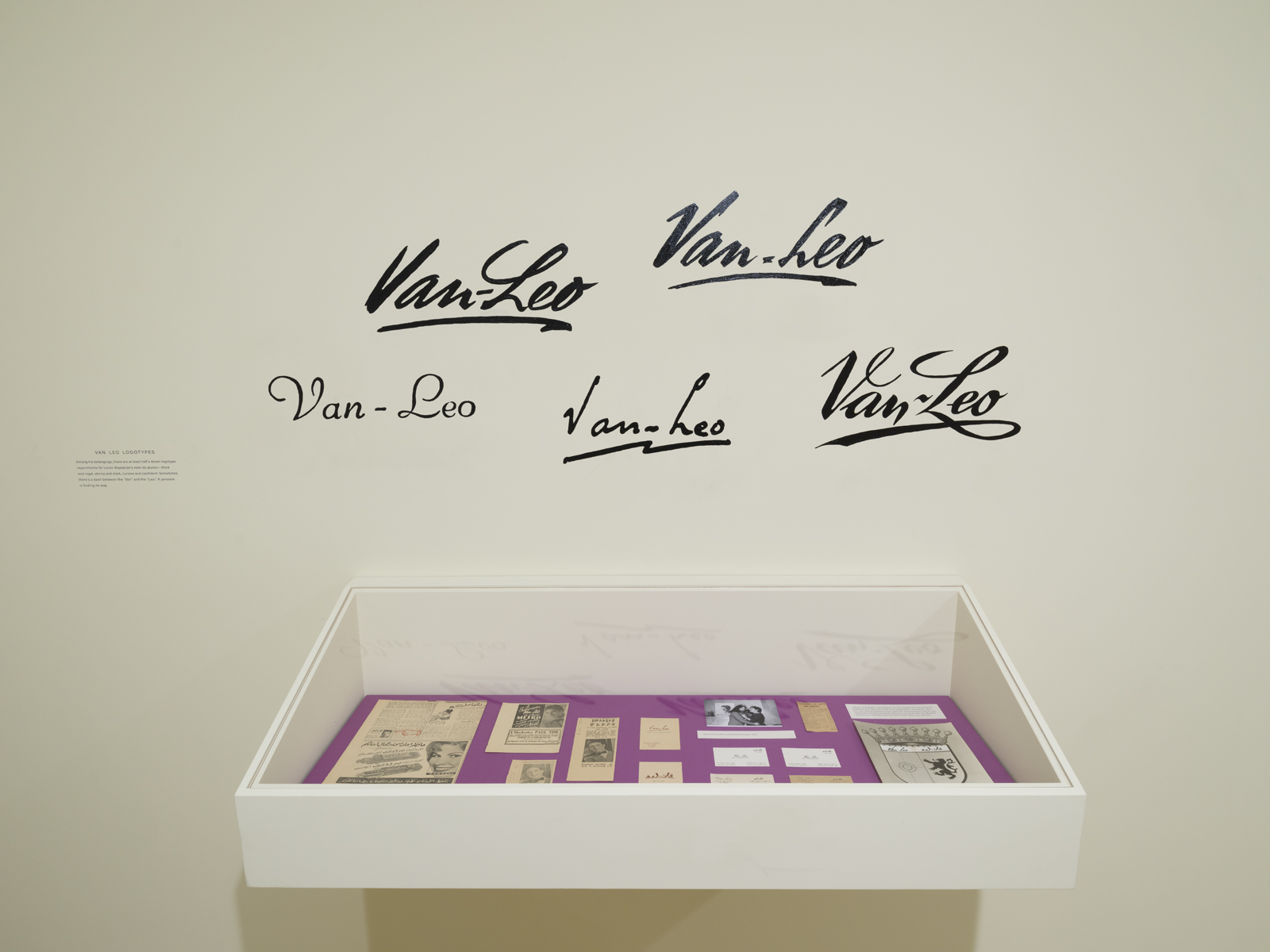
The first international survey of work by the late Armenian-Egyptian studio photographer Van Leo is currently on display in the Hammer Museum at the University of California, Los Angeles as a collaboration between the museum and AUC’s Rare Books and Special Collections Library, which holds the Van Leo collection, with additional collaborative support from the Arab Image Foundation in Beirut. Becoming Van Leo is showing until November 5 and includes ephemera and some photographs printed from negatives for the first time. 

“This exhibition at the Hammer Museum is the highest-profile showing of Van Leo's work to date — a retrospective of his art and life — and therefore brings international attention both to Van Leo's work and legacy but also the tremendous holdings of the Rare Books and Special Library at AUC,” said Negar Azimi, the exhibition’s curator. 

Three years prior to his death, in 1998, Van-Leo bequeathed his collection to AUC, where it has since been housed at the Rare Books and Special Collections Library. Last year, AUC celebrated the artist’s 100th birthday with a first-of-its-kind 3D exhibit, and this year, it has partnered with the Hammer Museum on Becoming Van Leo. 

"Over the past decades, the AUC Library has been keen to partner with museums and reputable organizations across the globe, including Institut du Monde Arabe in Paris, Brighton Photo Biennial and  Deutsche Architecktur-Museum in Frankfurt," said Lamia Eid '82, '92, interim dean of AUC's Libraries and Learning Technologies. "Our aim has been to be a key partner in the creation of innovative exhibitions, using the rich and unique collections of  AUC's Rare Books and Special Collections Library. I’m positive that the Becoming Van Leo exhibit is a resounding success, bringing together people who appreciate the significance of Van Leo’s unique work. It is surely a celebration of a great photographer and a testament of  collaborative efforts by team members from both AUC and the Hammer Museum."

As stated on the Becoming Van Leo webpage, “The exhibition traces Van Leo’s career from his earliest encounters with the camera in the 1930s, in which he used friends and family as models, through his experiments in self-portraiture of the 1940s and 1950s, and onward to his studio work, which extended into the 1990s.” The exhibition also includes Van Leo’s personal items, including letters, books, magazine clippings, personal notes, immigration forms to the United States and Canada, bills, correspondence with girlfriends, applications to the Art Center School in Los Angeles, a video interview by the artist Akram Zaatari and a series of never-before-seen 16mm films of the artist’s family. 
Van Leo Photo

“It is extraordinary to have access to not only an artist’s work but also his ‘life scraps,’ which is to say the tremendous well of ephemera that Van Leo amassed and kept, from letters to business cards to childhood mementos,” said Azimi. “Van Leo was a complicated, compelling artist who in many ways was ahead of his time. His work belies facile distinctions between art and craft, East and West.”

Becoming Van Leo has been described in the media as “compelling and deeply personal,” and visitors to the exhibition have been “very enthusiastic,” as Azimi noted. 

Behind-the-scenes work was "a complex process that involved countless hours of communication, discussion, planning and preparations by members of both institutions," said Eid. "Sharing collections from AUC's Rare Books and Special Collections Library, reaching out to different communities, engaging visitors, promoting Egyptian culture and heritage beyond AUC, furthering research and scholarship, and enriching the visitor experience are critical goals that we constantly strive to achieve."

As Ann Philbin, director of the Hammer Museum, noted, “This exhibition is an opportunity to introduce Van Leo’s extraordinary oeuvre to people outside Cairo, where his archive is housed, and to take a more in-depth look at his influences and impact. Dedicated to working in black and white film, Van Leo’s photographs are dramatic, moving, and through his lens, the ordinary became extraordinary.”

Van Leo photo
Van Leo photo

Photos courtesy of the Hammer Museum

Share
