Assessment of Program Learning Outcomes Process
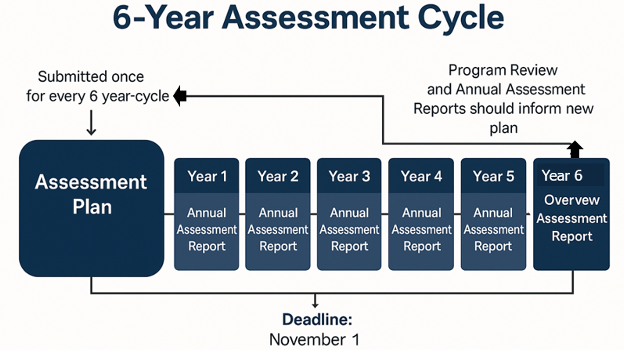
Academic programs follow a six-year assessment cycle. All programs are required to annually report on their results and show how results are used to improve the effectiveness of their programs.
Purpose
The AUC academic assessment process requires all academic programs to submit their academic assessment plans upon completion of their program review- once every six years. In addition to the six-year plan, all programs are required to submit annual assessment reports, analyse and reflect on their results, evaluate the extent to which intended learning outcomes are being achieved, and clearly articulate how findings will be used to support continuous improvement.
Components of the academic assessment include defining a program’s mission, developing clearly defined learning outcomes, monitoring progress toward those outcomes, communicating results and using those results to guide improvements.
The AP-AA assessment team conducts gap analyses and quality reviews annually to ensure the effectiveness of the assessment process.
All programs enter their data periodically on the University’s planning and assessment software Compliance Assist, which serves as the repository for all assessment plans and reports.
Timing
Each program must submit an assessment plan at the beginning of every assessment cycle (6 years), providing updates if necessary in the annual assessment report.
Assessment Plan Components
Programs are only required to submit an assessment plan every six years; however, updates (if any) should be provided within the annual assessment report. The following elements are included in the assessment plan:
Mission Statement
Briefly describe how the program will support the University’s mission.
1. Program Learning Outcomes
State the main learning outcomes (most important) of the program. At least 3-5 student learning outcomes should be identified for each academic degree program. Learning outcomes should be specific, measurable, ambitious, realistic, and time-bound. Each student-learning outcome should be associated with at least one program goal.
2. Learning Opportunities
State what courses or experiences provide students with the opportunities to achieve this learning outcome.
3. Assessment Methods/Measures
List the direct and indirect methods you will use to measure how well students are achieving these outcomes.
4. Target levels/benchmarks
Describe the desired level of performance or criteria that represents success at achieving your outcome.
5. When assessment will be conducted and reviewed
Discuss when data will be collected and reviewed.
Assessment Report Components
Programs must submit annual assessment reports based on their approved assessment plans. When reporting on your results, the following elements are included in the report:
1. Assessment plan verification
Include any updates (if any) to the assessment plan. Programs should review their existing assessment plan to determine whether revisions to the plan are required based on the findings.
2. Achievement of target levels/benchmarks
State to what extent students have met the previously established target levels/benchmarks.
3. When the assessment was conducted and reviewed
State when data was collected and reviewed.
4. Results/Findings
Report on the most important results and findings.
5. Analysis and Action Plan
Explain how results will be used to improve the program and how they will be communicated. Also, explain what changes were recommended to improve the program and when they will be implemented.
Timeline
- March: Programs submit assessment plans (for upcoming assessment cycle)
- November: Programs submit assessment reports (on the previous year) and any updates (if any) to assessment plans.
- September through August: Programs conduct the assessment process.