
Keeping AI in Check: Humans 'on the Loop'
As AI is becoming a core part of academic research and writing, two Academy of Liberal Arts instructors explore the question: How can humans stay in control?
For Rania Jabr, senior instructor II in the Department of English Language Instruction and Laila ElSerty, instructor in the Department of Rhetoric and Composition, the answer is a “human on the loop” approach, in which students use AI as an assistant while they retain responsibility throughout the research process for guiding, assessing and making decisions about what AI produces.
The humans on the loop approach defines the extent of human involvement in automated processes. To be “in the loop” indicates that humans are directly involved in every decision and step, while “on the loop” refers to humans taking on a supervisory role in which they intervene to evaluate, revise and guide the process. In AI research and writing, the students remain active participants at every stage, from crafting and refining prompts to finding relevant sources and evaluating evidence, all the way through to constructing their final arguments.
"The long-term goal is to give students agency. We want them to be in control of the process."
“Instead of focusing on humans as being in the loop, a concept used in automation and engineering, here it’s the opposite. The human is the responsible agent, and AI is the assistant,” ElSerty said.
JJabr and ElSerty’s research, titled “The Research Cycle with AI in the Loop,” explores how to effectively prompt Perplexity for research-based writing while following a human on the loop approach.” Students learn to structure prompts by defining the role they want AI to take, providing context, creating a task, setting limitations and then refining the prompt based on the results. Their presentation won second place at AUC’s Research and Creativity Convention (RCC) in the AI Spotlight category in 2026.
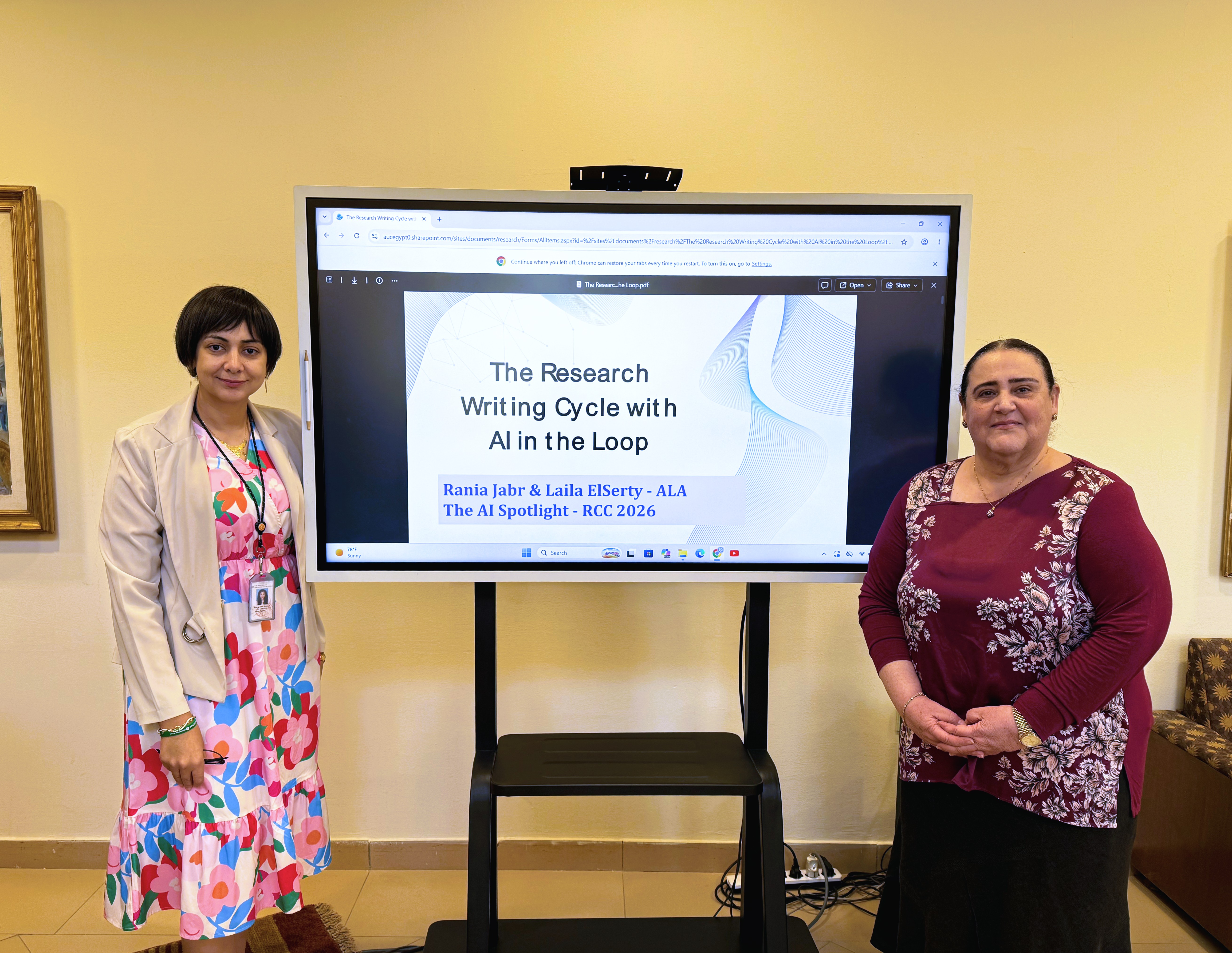
“The focus is on academic integrity, AI literacy, finding and evaluating sources, receiving evidence and then incorporating AI use into these stages of the writing process,” Jabr said.
When integrating this into the classroom, students must learn to critically think about AI output. “I have to first teach students how to think, analyze, question and debate because these are things AI cannot do. It cannot judge or conduct an ethical assessment,” Jabr said. “The burden of teaching this is on us educators.”
"Instead of focusing on humans as being in the loop, a concept used in automation and engineering, here it’s the opposite. The human is the responsible agent, and AI is the assistant."
This utilization of AI promotes efficient and effective research, according to the researchers, while remaining simple, structured and flexible for students to adapt and develop as they need while retaining ownership of their work.
Ultimately Jabr and ElSerty hope to equip students with the skills to responsibly handle AI in their courses and future careers.“The long-term goal is to give students agency. We want them to be in control of the process,” Jabr said.
As for the next steps in this project, Jabr and ElSerty plan to collect feedback from students on their experiences with AI and encourage them to present their research at AUC’s RCC 2027. They also hope to explore other ways to incorporate the human on the loop approach into academia, including the use of AI in creating slides, spreadsheets and infographics.
“We want to teach students to continually ask questions. This is the thing: The human mind needs to constantly ask, examine and assess – not just with AI but with life as a whole,” Jabr said.
To learn more about faculty research involving AI, find AUC’s AI resource webpage here.
