From AUC to Spain: Students Present Research on New AI Model
AUC computer science students present their undergraduate thesis project at the 2026 IEEE Conference on Artificial Intelligence in Granada, Spain.
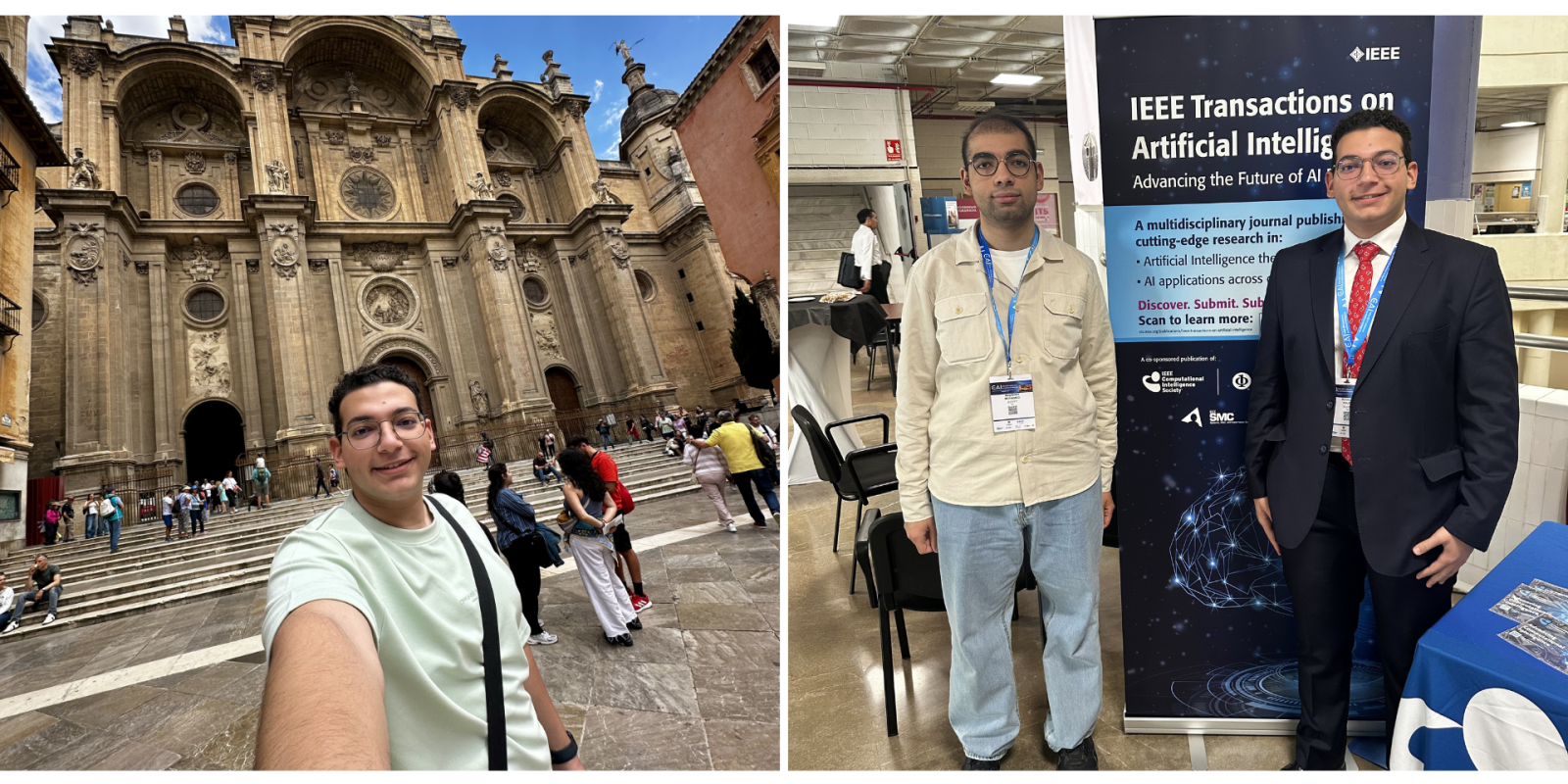
Amid industry professionals and seasoned academics, AUC students Kirolous Fouty and MagdElDin Mohamed were the youngest participants at the 2026 IEEE Conference on Artificial Intelligence in Granada, Spain.
“At the conference, people were shocked that the research we had done was for a bachelor’s thesis,” Fouty shared. “They were really proud of the work we were able to accomplish at such an early stage.”
The two computer engineering majors represented AUC at the conference, presenting their senior thesis research on developing a Large Language Model (LLM) that is both efficient and compact. Fellow students Andrew Aziz, Mohamed Abbas, Shaza Ali and Tarek Kassab were also part of the project.
“What impressed me most about this team is that they challenged the assumption that better AI must always mean larger AI," said Cherif Salama, professor in the Department of Computer Science and Engineering and faculty thesis adviser. "Through a disciplined, table-first reasoning pipeline, they built a highly efficient model that outperformed much larger state-of-the-art systems in chart question answering. That achievement is both technically meaningful and educationally inspiring because it shows that undergraduate research can contribute original ideas to one of the most active areas of AI.”
“What impressed me most about this team is that they challenged the assumption that better AI must always mean larger AI.”
AI industry trends have recently led to bigger and bigger models, which use massive amounts of energy and tend to ‘hallucinate’ or make up data. The computer engineering students used smart engineering to make a more effective model, developing a new kind of pipeline that first extracts the structural data and then feeds that text into the reasoning engine.
“What sets our model apart is its sheer efficiency,” Fouty said. “We proved that you can deliver world-class, high-precision analytics using standard, consumer-grade hardware instead of million-dollar server farms.”
The students knew they had something special on their hands: not just a great senior project, but also publishable research. “We didn’t want to just do a standard school project; we wanted to build something that could compete on a global stage,” Fouty added.
Once in Granada, the pair packed their days at the conference full of networking, panels and discussions with global researchers, while still sneaking in some time to explore Andalusia. “We made a point to balance our time,” Fouty explained. “We were fully locked into the technical sessions and networking during the day, but in the evenings, we stepped out to experience the city. Walking through the historic streets of Granada, taking in the incredible architecture and experiencing the local culture were the perfect ways to recharge after being surrounded by heavy AI research all day.”
The highlight of the trip was their research presentation, followed by a rigorous questioning period by professional researchers. “We were naturally a bit nervous stepping up to the podium, but our extensive rehearsals truly paid off,” Fouty shared. “The audience was highly engaged, and our presentation sparked several insightful discussions covering everything from our datasets and chart languages to our fine-tuning processes and inference times. Hearing genuine praise and validation from such an elite crowd of global researchers was an incredibly proud moment for our entire team.”
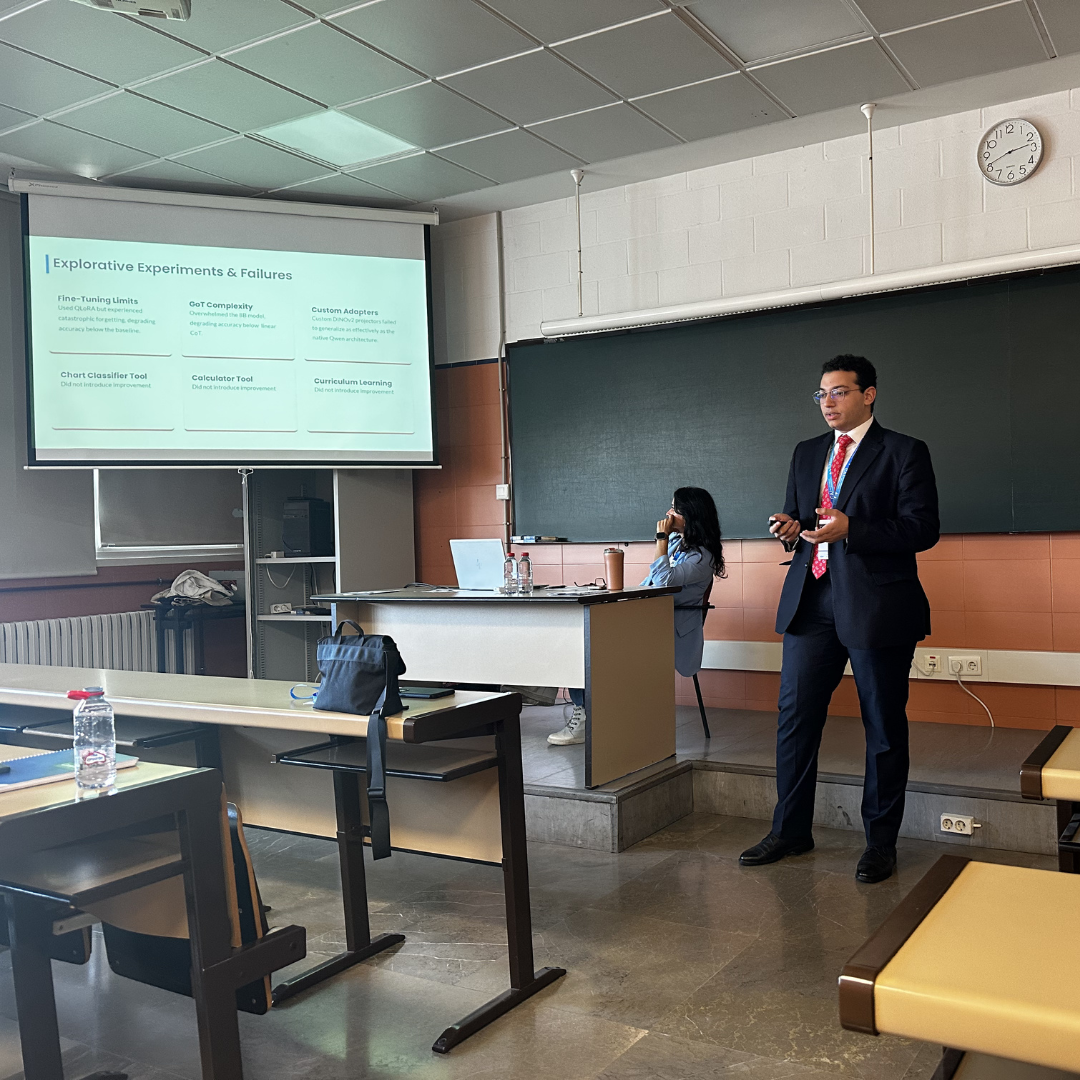
Following the conference, the students’ paper is set to be published in the IEEE Xplore digital library, which is a huge academic milestone for graduating seniors.
“Professionally, this research opened incredible doors and connections for my goal of becoming an applied scientist,” Fouty stated. “For AI research as a whole, our project helped drive home an important message: The future of AI isn't just about building massive, energy-draining models. By proving that a model 10 times smaller can take the number one spot globally just through better architecture, we are showing that cutting-edge AI can be accessible, sustainable and resource-efficient.”
