
AI in Healthcare: AUC Is Egypt’s First Hub for the Harvard Health Systems Innovation Lab Hackathon
From April 10 to 11, AUC will serve as a hub for the international Harvard Health Systems Innovation Lab Hackathon to leverage AI in healthcare systems.
For the first time in Egypt, AUC will host a hub for the 2026 Harvard Health Systems Innovation Lab (HSIL) Hackathon, exploring the use of AI in healthcare.
“For the six editions prior to this year, we had no representation from Egypt or anywhere else in North Africa, and we think that there's a lot to capitalize on at AUC and in the Egyptian community that can help advance healthcare problems,” said Seham Elmrayed, assistant professor at AUC’s Institute of Global Health and Human Ecology and hackathon task force lead.
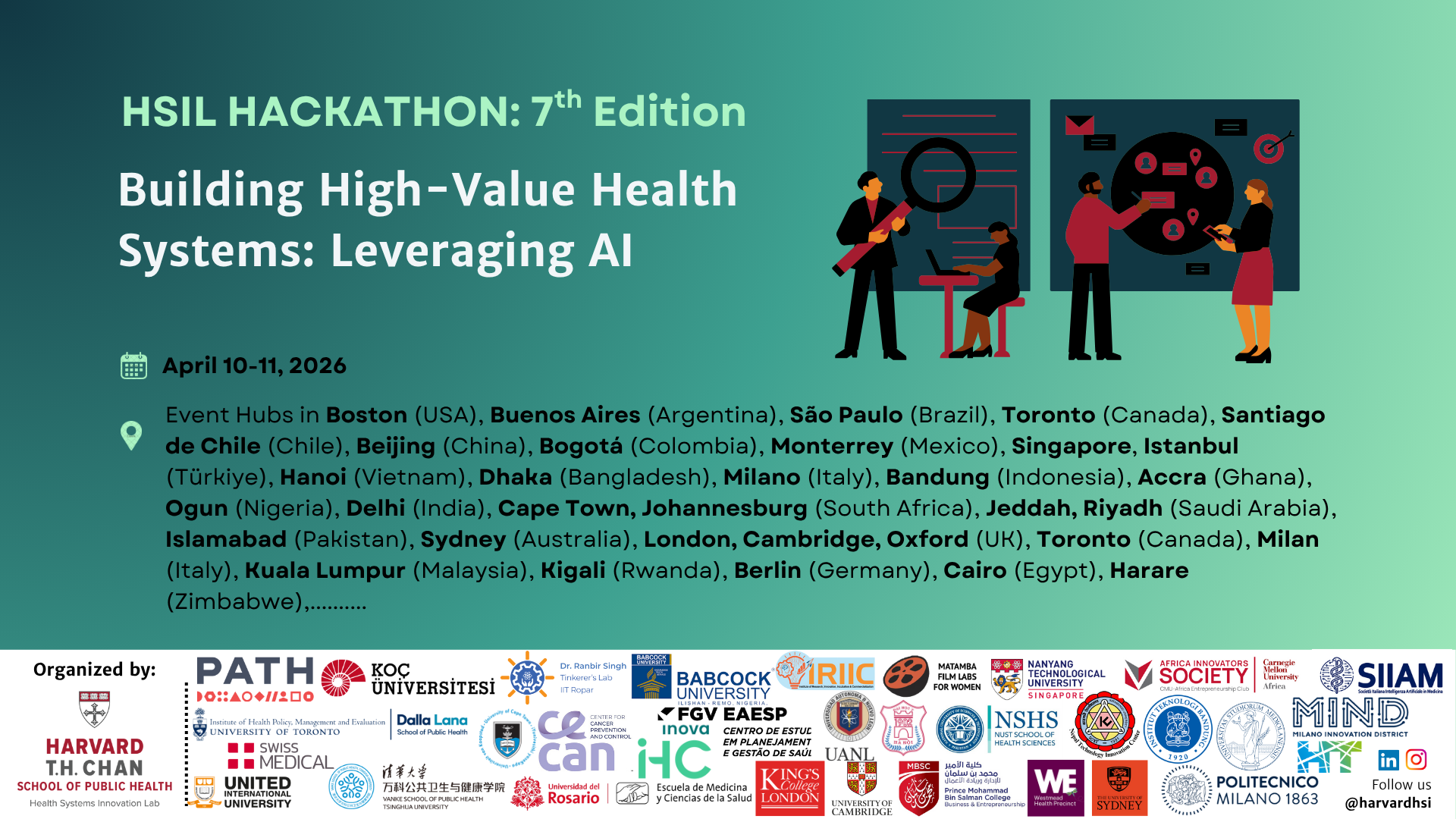
Innovators across five continents and 41 institutions will brainstorm and design functional prototypes to address global challenges facing health systems under this year’s theme “Building High-Value Health Systems: Leveraging AI.” Interested participants can apply through AUC as a hub until March 23, 2026.
The hackathon will be held from April 10 to 11 and winning teams will be invited into the HSIL Venture Incubation Program, an eight-week remote bootcamp offering structured educational sessions, mentorship and access to investors — culminating in a Global Demo Day.
“The American University in Cairo brings an interdisciplinary ecosystem, making it the right choice to collaborate on this great initiative.,” said HSIL Hackathon lead Alem Aminu Osman. “Egypt was selected as a partner country due to its strategic role in the region, its rapidly evolving digital health landscape and its opportunity to address complex health system challenges at scale. The goal is to foster locally grounded solutions with regional relevance, while integrating Egypt into a broader global innovation network across 50+ hubs.”
Since 2018, the HSIL Hackathon has convened clinicians, engineers, economists and professionals around the world to develop solutions to global challenges in health systems.
Through the support of the School of Sciences and Engineering, Elmrayed spent last summer at Harvard studying the application of AI in healthcare and convening with leading minds in the field. Elmrayed now teaches a graduate class on AI introduction and applications in healthcare, and says the experience pushed her to bring the hackathon to AUC.
“I think the hub complements this vision we have at AUC and the School of Sciences and Engineering, where we want to bring real-world problems to the class. We think of our students as the workforce that can help lead such changes because the disruptions in the healthcare system and every other system are unprecedented. “You don’t want that gap between what you teach and what you apply,” Elmrayed says.
Elmrayed notes that artificial intelligence has already begun to support healthcare professionals in synthesizing large quantities of data. As health systems worldwide are burdened with challenges like workforce burnout, AI can produce predictive insights and classify diseases to make healthcare interventions more timely and effective. Even with new technologies, the focus remains on decision making and proper application.
“AI technologies do not equal clinical significance, application or clinical performance,” Elmrayed says. “You have to think through the application. You have to think through adaptability.”
Egypt’s role as a hub allows innovators to share ideas and translate these technologies into a local context.
“Healthcare systems are shared globally, but they manifest in locally defined or context-dependent ways,” Elmrayed says. “Unless you have local innovation, you're not going to be able to translate any of these AI advancements and technologies into something meaningful to serve the communities we want to serve.”
