AI-enabled biochip for rapid cancer, disease detection
AUC researchers have spent more than a decade trying to turn tiny electrical signals from cells into an inexpensive early warning system for disease.
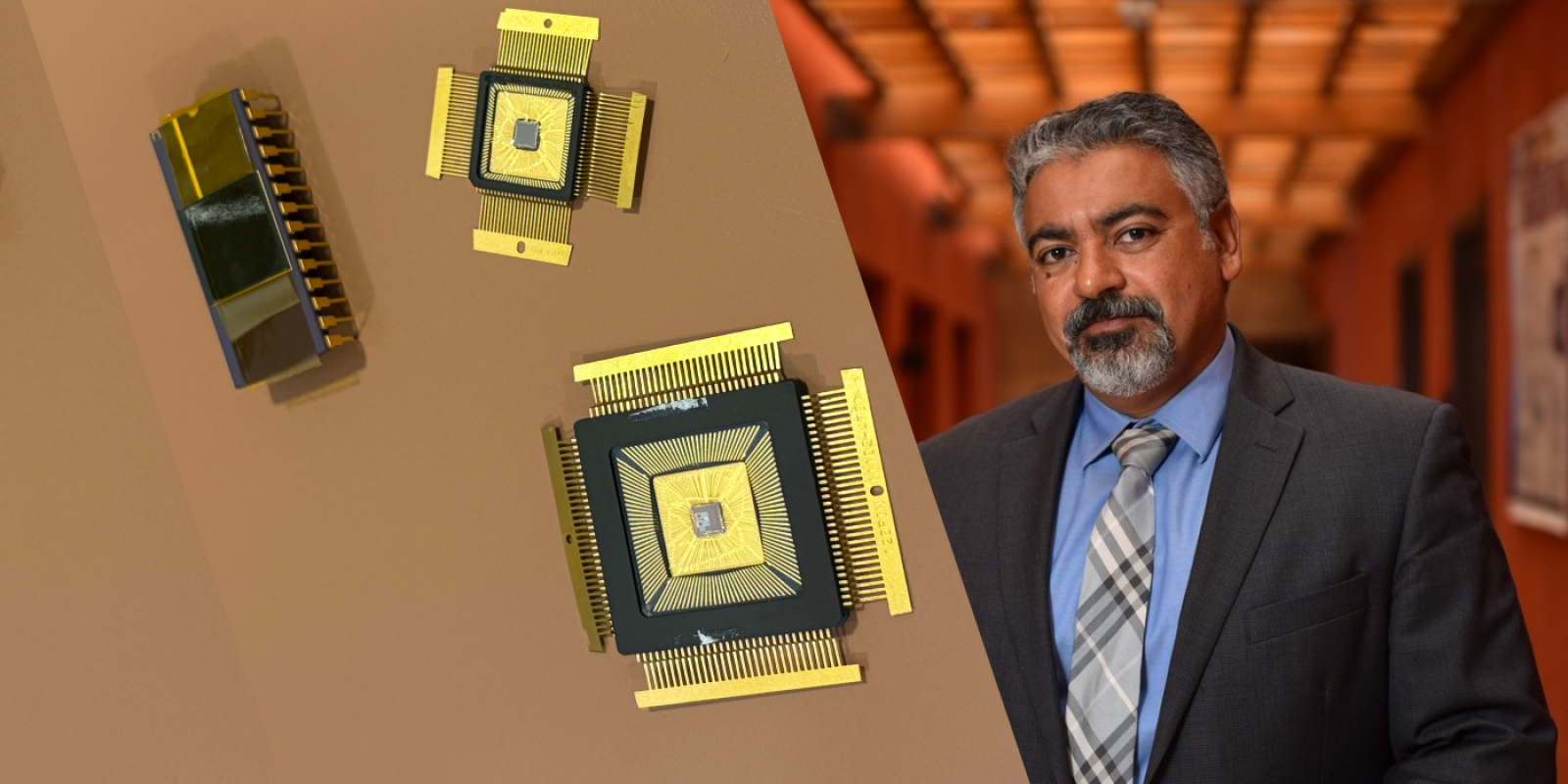
A thin, gold-colored chip at AUC’s Center of Nanoelectronics and Devices, is etched with microscopic electrical sensors and a small chamber designed to hold a drop of biological fluid. The idea behind it is deceptively simple: Instead of sending every patient to a hospital for a battery of expensive tests, what if a disposable piece chip could perform an initial screening in seconds?
Researchers at AUC have developed an artificial intelligence-enabled biochip that could provide rapid, low-cost pre-screening for deadly diseases, including leukemia, liver disorders, hepatitis C and malaria. While currently a proof of concept, the project demonstrates significant diagnostic efficacy within a rapidly advancing, AI-driven precision medicine landscape.
The interdisciplinary research began around a decade ago and has since involved tens of thousands of samples. The team drew on expertise across AUC and collaborate with medical institutions that provide biological samples for testing, including Ain Shams University Hospital, Children’s Cancer Hospital 57357 and Zewail City of Science, Technology and Innovation in Egypt, as well as Khalifa University in the United Arab Emirates and Carnegie Mellon University Africa in Rwanda which performed the majority of AI tests.
"If we have affordable methods, we can screen, monitor and provide medical services for anyone from a rural area to outside a village."
Led by Yehea Ismail, chair of the Department of Electronics and Communications Engineering and director of AUC’s Center for Nanoelectronics and Devices, the technology combines microelectronic sensors, microfluidics and artificial intelligence to identify physical and electrical characteristics of cells.
A New Approach to Disease Screening
Unlike conventional diagnostic systems that may require large and expensive laboratory equipment, the AUC biochip is designed as a small, disposable platform that could eventually be manufactured at low cost and used closer to where patients receive care.
“After COVID 19, the whole world realized the importance of rapid tests. Rapid tests are very important in airports, rural areas and central capitals,” said Reda Abdelbaset, co-principal investigator and research fellow at AUC. “Even Egypt spent many years suffering from high percentages of viruses and liver disorders such as liver cancer. If we have affordable methods, we can screen, monitor and provide medical services for anyone from a rural area to outside a village.”
The technology has attracted interest beyond academia. During an entrepreneurship workshop at the Massachusetts Institute of Technology, the project drew the attention of potential investors and entrepreneurs, leading to an offer involving millions of dollars to pursue its development and commercialization.
“There are sensors, there is electronics design, there is AI, there are dielectrophoresis—modeling itself and simulating these multi-physics systems with fluid dynamics, cells, electromagnetics. At AUC we have built the tool suite to do this."
The chip uses electrical signals and artificial intelligence to identify patterns in cells that may indicate disease. Rather than detecting tumors in medical scans, it measures physical and electrical properties of cells as they pass through microscopic structures on its surface. These properties, including cell size, mass, movement and electrical conductivity, alter the signals in measurable ways.
Machine-learning models analyze these changes to distinguish between healthy and potentially diseased samples and identify patterns associated with particular conditions. “We feed these features into an AI training algorithm, which analyzes large numbers of samples and builds a neural network capable of distinguishing between cancerous and non-cancerous conditions, as well as identifying different types of cancer, such as lung or skin cancer. The data comes from sensors that detect physical characteristics rather than chemical properties. As the AI is trained on more samples, its ability to make accurate diagnoses improves,” said Ismail.
Without AI researchers achieved around 80% accuracy. With AI, they achieved around 91% of accuracy for blood serum samples, according to Abdelbaset.
The team has also explored using AI to distinguish between healthy samples and samples associated with different stages of metabolic dysfunction-associated steatotic liver disease (MASLD), a condition linked to an increased risk of liver cancer. The system is designed as a pre-screening tool, not a replacement for clinical diagnosis. Its models prioritize sensitivity over specificity, favoring false positives over false negatives so that uncertain or potentially diseased samples can be referred for further testing rather than incorrectly classified as healthy.
Developing the technology requires expertise across several disciplines, including sensor development, electronics, AI and dielectrophoresis: a technique that uses electric fields to manipulate cells. “There are sensors, there is electronics design, there is AI, there are dielectrophoresis—modeling itself and simulating these multi-physics systems with fluid dynamics, cells, electromagnetics. At AUC we have built the tool suite to do this,” said Ismail.
Laboratory Research Paired with Artificial Intelligence
The potential value of the technology lies partly in its ability to bring preliminary screening closer to patients.
In many health systems, advanced diagnostic equipment is concentrated in major hospitals and specialized laboratories. A low-cost screening platform could eventually help identify patients who require additional testing while reducing unnecessary referrals and easing pressure on centralized diagnostic services.
Egypt faces an exceptionally high burden of liver cancer. Precise diagnostic instruments serve as the indispensable first line of defense in reducing patient mortality across Egypt. Africa bears the overwhelming majority of the global malaria burden, accounting for approximately 94% to 96% of all malaria cases and 95% to 97% of all malaria deaths worldwide.
“The stage of malaria someone has can jump from mild to severe within just one day. Any delays in a day will incur additional costs and lead to a very simple disease developing to a severe stage of malaria,” said Abdelbaset.
The researchers estimate that a mass-produced chip could potentially cost between 10 and 50 cents to manufacture, with packaging bringing the total cost to approximately $1. The system would also require a separate reader capable of processing the chip’s electrical signals and transmitting results to a computer, phone or physician.
AUC’s research infrastructure has played an important role in developing and testing the technology. The University has provided laboratory equipment, measurement facilities, academic computer-aided design tools and support for undergraduate research projects, including a malaria-focused biochip project supported by AUC’s Bartlet undergraduate research grant.
Despite its progress, the biochip remains a proof of concept rather than a production-ready medical device. Additional research is needed to establish reliability across different temperatures and manufacturing conditions, demonstrate repeatability, expand the available datasets and complete the testing required for regulatory approval. “For industry and mass production, we care about many things like protecting our devices from different environments, temperature, high temperature, maybe electromagnetics,” said Abdelbaset.
Commercialization would also require sustained funding, a dedicated development team and expertise in manufacturing and business development.
For Ismail, Abdelbaset and their collaborators, the research demonstrates the potential of combining nanoelectronics and artificial intelligence to address major challenges in global health.
The long-term vision is a diagnostic platform that is small, inexpensive and accessible enough to bring sophisticated disease screening beyond centralized laboratories — while connecting patients who need definitive diagnoses with the hospitals and specialists equipped to provide them.
