Familiar Face, New Leadership
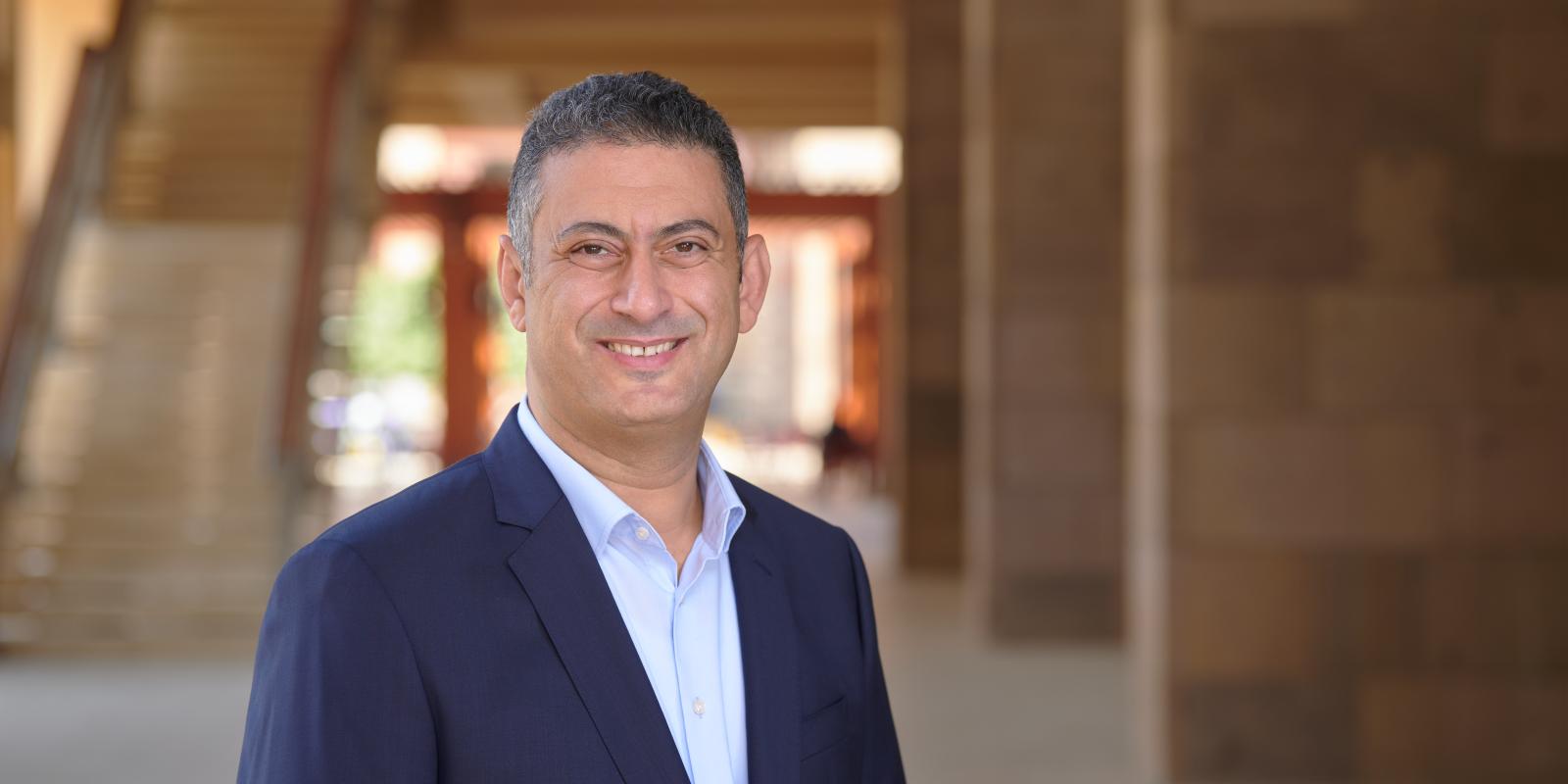
Ayman Ismail ՚95, ՚97 is AUC’s new associate provost for innovation and entrepreneurship, leading efforts to strengthen the University’s entrepreneurial ecosystem while building new pathways for deep-tech ventures and promoting research commercialization.
“Entrepreneurship is part of AUC’s DNA,” said Ismail. “Historically, we’ve been producing entrepreneurs, and over the last 15 years, we started systematically adding entrepreneurship to our curricula, majors and courses."
Ismail intends to extend this entrepreneurship further outward. "We want to bring our entrepreneurial DNA outward to serve the community, fuel innovation and bring real-life experience from industry to our educational process. It’s a two-way interaction,” he said.
Newly established, the Office of the Associate Provost for Innovation and Entrepreneurship is “dedicated to advancing innovation, entrepreneurship, and research impact across the University,” as Provost Ehab Abdel-Rahman described in his email to the AUC community.
“We're already plugged into the network. We're plugged into the startups. We're plugged into the industry. And we are the leading educational institution.”
While the office and position are new, they are not unlike the work Ismail was already completing during his time as AUC faculty, where he served as founding director of the AUC Venture Lab, director of the Center for Entrepreneurship and Innovation and founding director of AUC’s Innovation Hub.
Ismail’s current focus is on increasing the connections between these existing resources, the Technology Transfer Office, researchers and the AUC schools of learning. “Our goal is to elevate AUC’s profile of entrepreneurship and innovation so that we’re thinking about it campus-wide, rather than as different individual initiatives,” Ismail explained.
Still, Ismail’s favorite part of the job is community engagement. “More than half of my time is spent talking with entrepreneurs, researchers, students and alumni about what they're building: products, investments, partnerships, growth and getting into new markets,” he said. “That's the most exciting part of the job, and that will remain the same.”
Ismail’s career path toward this role began during his time as a student at AUC, where he graduated with a bachelor’s in engineering and an MBA. He received a master’s in city planning and a PhD in international economic development from the Massachusetts Institute of Technology. Ismail spent time as a consultant, co-founding Enovio Consulting and working with prominent business organizations such as the World Bank and McKinsey and Company. In 2011, Ismail returned to AUC as assistant professor and as the Abdul Latif Jameel Endowed Chair of Entrepreneurship, where he has been leading and teaching entrepreneurship and innovation. He is also an angel investor in and advisor to several startups, and is a board member in several venture capital funds and fintech institutions, including Egypt’s first digital bank.
Developing the TRI-Lab
Among Ismail’s responsibilities is leading the Technology, Research and Innovation Lab (TRI-Lab), a part of AUC’s campus expansion project. A 12,150 square-meter structure, the TRI-Lab is a “new technology, research and innovation facility” that will “bring research, innovation, experimentation and commercialization under one roof, creating a space to translate research into industry partnerships and startups, particularly deep-tech ventures.”
The TRI-Lab will consist of diverse spaces, according to Ismail. One of which, the makerspace, will maintain machines that accelerate people’s ability to prototype and build tangible products. Other areas will include a substantial computational facility for people to develop digital products and a large co-working space for startups, industry, faculty and students to work and collaborate with one another.
"Entrepreneurship is part of AUC’s DNA."
This multilevel collaboration is a massive goal for the University. “We expect to have the place buzzing with innovators and entrepreneurs,” Ismail said. “We also want to see a lot of businesses co-creating and collaborating over real research and innovation on campus. The goal is to bring industry on campus to work with faculty and students on real projects in the TRI-Lab.”
In the long term, Ismail hopes to see mass innovation as a result of the TRI-Lab, which will “strengthen AUC’s entrepreneurial DNA and deepen our impact” by creating more startups and companies founded by AUC graduates. Ismail believes that the TRI-Lab can be a launching point in which AUC students can bring change to everything, from global and regional economic growth to jobs, competitiveness and exports.
A Futuristic Outlook
In an age where technology changes daily, the Office of the Associate Provost for Innovation and Entrepreneurship prepares for a technological future grounded in business, engineering and science.
Synergizing all the concepts of the TRI-Lab with real-world corporations and businesses is a key effort. “We're already plugged into the network,” Ismail said. “We're plugged into the startups. We're plugged into the industry. And we are the leading educational institution”
This synergy not only comes from combinations of students, faculty and corporations, but also from interdisciplinary fields of study. “If you're building a business, you're solving someone's problem. You have to think about consumer behavior and the social dimension. You're going to market with all the business knowledge. You also need the technical skills to bring it to life. If you're building something around AI, you need to think about AI ethics and responsible use,” Ismail said.
This becomes the definition of the synergy that Ismail seeks to establish. “Engineering, business, social sciences and ethics have to come together when you're building an organization. It is at the core of interdisciplinarity,” Ismail said.
Ismail is dedicated to helping AUC set the precedent for what innovation can be in the region and beyond. “We'll experiment, learn, make all the mistakes and try different things,” he said. “And then whatever model we come up with, five or 10 years down the road, we want this to be a model that 10 or 20 other universities in Egypt and in the region will say: We love this model, and we want to do it ourselves.”
