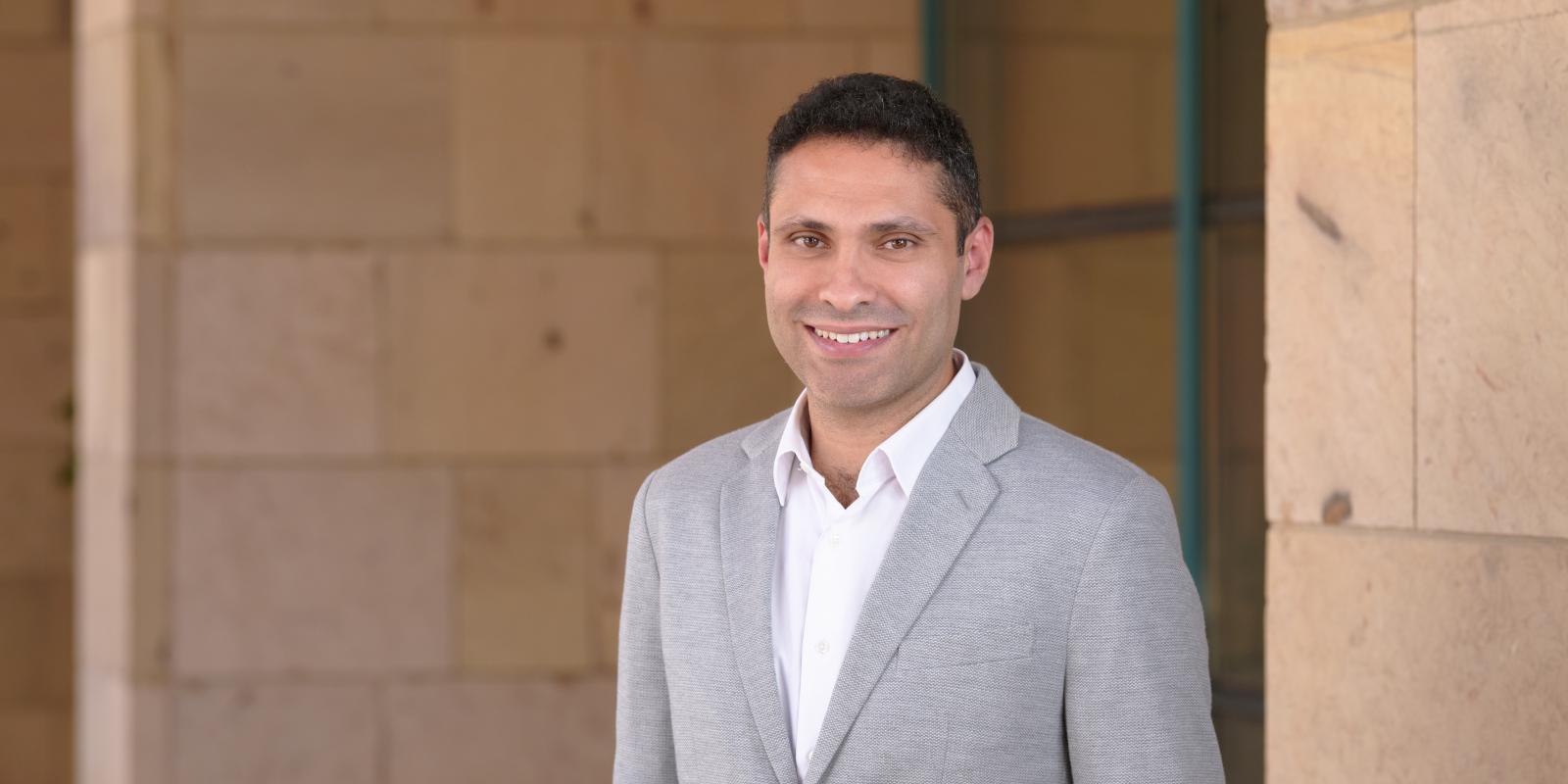
An Enhanced Vision of Education: Karim Wissa
Karim Wissa, assistant provost of innovative learning experiences, enters AUC with a clear vision of what education and innovation can be.
Karim Wissa, AUC’s assistant provost of innovative learning experiences and professor of practice in the Center for Learning and Teaching, envisions a future of interdisciplinary learning led by technological innovation that will enable students to tackle global challenges.
In his role as assistant provost, Wissa seeks to promote interdisciplinary knowledge and skills to students so that they can tackle real-world problems with practical solutions.
“The challenges we increasingly face require many fields of knowledge to solve: politics, economics, engineering, philosophy, history, anthropology, you name it. They call for bold combinations of ideas, and they’re always evolving,” Wissa said. “We want students to blend their passions and skills in ways that let them build the futures they dream of.”
Drawing on his experience working at Duke University, University of North Carolina and University of Waterloo, Wissa brings over 15 years of professional experience in higher education. At the University of Waterloo, he served as the director of research innovation and knowledge mobilization, director of institutional programs, director of education and outreach, and as a faculty member in the Faculty of Health.
"I want students to know that education can be a chance to combine what they love, chart their own course and shape their future; learning is empowering.”
His work at AUC begins with the “Future Competencies Framework,” a project which began before Wissa’s arrival. The framework maps the student experience and enables educators and administrators to have a full understanding of what the AUC student experience is like. “The Future Competencies Framework helps students see everything they’re building across their classes and campus life. Once pulled together, it lets every student connect their skills, passions and ambitions into a path that’s uniquely theirs,” Wissa explained.
When fully mapped out, Wissa’s next step is to adapt it into practical measures to steer students toward the interdisciplinary skills they need for their futures. “I love the research part, which asks: What new dilemmas are emerging, and what skills will let students turn their passions into real impact?” Wissa said.
From there, the work expands into a series of new initiatives. “We have a long-term vision for establishing a whole ecosystem of tools that can create logistical infrastructure to develop an education that will continue to be responsive to the problems of the moment,” Wissa said. “We want every student to leave with the confidence to take on any challenge the world gives them.”
“As the world changes, education gets to change with it, and that’s an exciting place to be.”
According to Wissa, these initiatives will take students beyond the classroom. One idea connects coursework to real challenges facing local communities, letting students test their ideas where they matter most.
“Together, we can build a campus where students’ ideas meet real opportunities,” Wissa said.
This element of technological innovation is also a large part of Wissa’s work as assistant provost and is influential in reaching his goals for education at AUC. Wissa works heavily with AI integration and advancing educational technologies to “future-proof” the AUC curriculum.
“The way our education is organized grew out of specific historical conditions, and those conditions are shifting fast. Every day brings new technologies that give students more ways to create, explore and lead,” Wissa said. “As the world changes, education gets to change with it, and that’s an exciting place to be.”
When looking at his work through the student perspective, Wissa's vision goes further, seeing education as an opportunity for more than a degree, but rather as a means to address the issues that society encounters. “Sometimes it’s hard to see how what you’re learning in class connects to the causes and passions you care about,” Wissa said. “We hope to help students find those connections through real experience, so their degree becomes a launchpad for the change they want to make.”
"I love the research part, which asks: What new dilemmas are emerging, and what skills will let students turn their passions into real impact?”
Wissa is excited with the possibilities AUC has to offer. “AUC is already doing so much of the kind of education students light up for: problem-oriented, hands-on and interdisciplinary. I’m here to help it grow even further,” Wissa said.
This problem-focused, interdisciplinary style of education is what Wissa hopes to encourage in students throughout his time at AUC. “I want students to know that education can be a chance to combine what they love, chart their own course and shape their future; learning is empowering,” Wissa said.
Get to Know Karim Wissa
What is your favorite film?
I can think of a film I just watched called Asal Iswid. Black Honey is the translation. It's the story of someone who leaves Egypt when they're really young, and then is excited to reconnect with a home they feel as though they’ve lost, only to realize they’ve romanticized an idea of Egypt that exists more in their memory than reality. It's the kind of comedy that plays really well in that difference.
What is your favorite food?
I really love sushi and kofta.
What do you like to do in your free time?
I love to learn new skills and I love to build things. I also love working with my hands.
Do you have a favorite memory as a student?
I took a class called Literary Theory, and it blew my mind. It taught me to think about the world around me, the world of symbols and signs, in a way that I hadn't really thought about. It was just one of those ‘aha’ moments that change the way you think and how you see the world. It opened up a whole field of knowledge to me that I didn't know existed.
Another big one is hanging out with my friends after classes and having philosophical discussions with them. I got to feel important because, when you're a student, you can feel insignificant, like just another person in the classroom. Your friends help you feel like you are important to them. Discussing big questions with them was very formative.
What is something that most people don’t know about you?
I like playing video games with my kids. I have a 10-year-old, and we play these co-op player games. They’re fun.
If there was one global issue you could solve, what would it be?
Resource scarcity. If we could solve resource scarcity, I think the world would be a different place. It's an all-encompassing umbrella.
