Home page
ع Search AUC
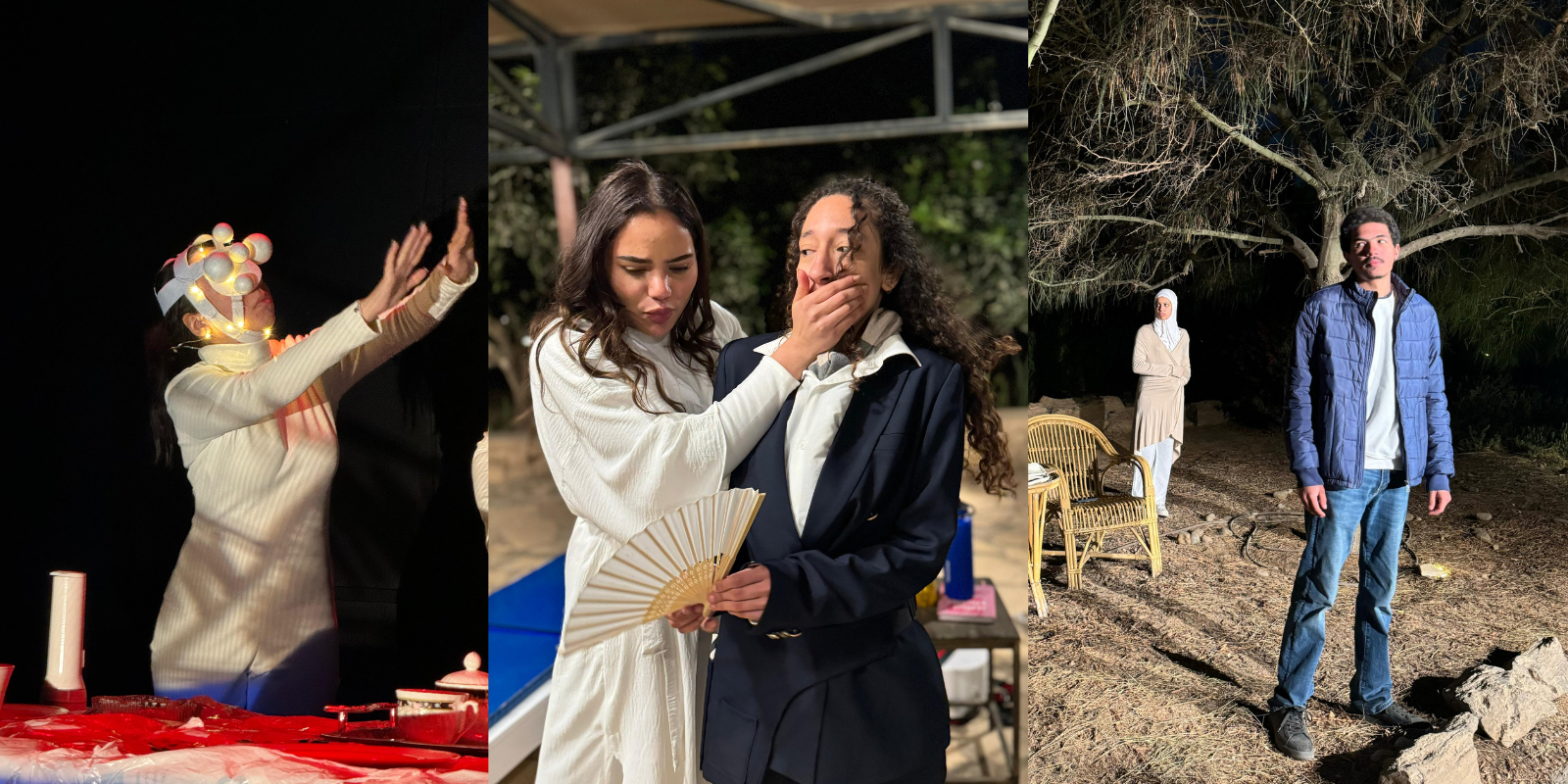
Actors perform in the AUC garden across three scenes

Da Zanbokom: An AUC Climate Play About Egypt

Celeste Abourjeili February 12, 2025
Student Experience

As major climate issues continue to affect people across Egypt’s diverse regions, Jillian Campana, theater professor and associate dean for undergraduate studies and research, developed a set of plays that reflect these environmental realities. The plays will be performed across AUC’s garden on February 12, 13, 16 and 17, with free entry each night. 

Da Zanbokom (It Is Our Fault) consists of five short plays, each set in a different location in Egypt and dealing with a distinct environmental issue affecting the country. Topics range from water scarcity in Aswan and flooding in Alexandria to pollution in the Red Sea and gentrification in Port Said. 

Meanwhile, the plays probe the audience to reflect on their role in climate change. “There are small things we can all do every day to help, but most of us don’t take any action because we mistakenly think only major innovations will make a difference,” said Campana.

Campana was inspired to pursue this project because she believes her role as an artist gives her a unique ability to humanize data in a way that regular people can relate to. “While scientists provide crucial data and technological innovations, solving this global challenge requires collaboration across disciplines. Artists, humanists, policymakers, educators, community leaders and activists all play vital roles. Artists, in particular, are able to humanize the data in a way that connects to everyday people,” she said.

“We hope that by watching the performances, audiences will consider their own behaviors and practices and reflect upon ways they can help educate those around them to engage in more sustainable behaviors.”

Over the summer, Campana worked with experts to identify major climate issues that affect people in different regions across Egypt. She then commissioned 10 new plays, five of which will be performed at AUC in the upcoming shows, exploring how these environmental issues impact daily life. The playwrights, including Campana, collaborated with AUC faculty members Anwar ElNaser, Fayrouz Ashour, Ramy Aly and Rania Siam to understand the depth and specificity of these issues and how they impact daily life. 

The play is site-specific, meaning that the locations of the plays mirror the settings of the stories. Audiences will gather in the School of Humanities and Social Sciences plaza between 6:30 and 7:00 pm on the nights of the shows. They will be assigned, in small groups, to a specific guide who will walk them to each location and provide details about the stories along the way. 

“We hope that by watching the performances, audiences will consider their own behaviors and practices and reflect upon ways they can help educate those around them to engage in more sustainable behaviors,” Campana said. “For the 43 students, many faculty and alumni involved in Da Zambokom it certainly has made an impact already!”


The five plays are:

  • Just When You Thought It Was Safe to Go Back in the Winter (English)
  • Snowball in Heaven (English)
  • Very Environmental (Arabic)
  • The Nile in Cairo Is Green (Arabic)
  • The Graduation (Arabic and English)
Related stories

A man is crouched in the water planting. A large shrub is behind him
September 29, 2026

AUC to Lead Climate Training Program for Africa

AUC is partnering with Egypt’s Ministry of Water Resources and Irrigation to implement a climate leadership program for Africa, training 100 African professionals from more than 22 countries across the continent in water management and climate-smart agriculture."AUC has the academic and research expertise, as well as capacity-building and program-management capabilities, to bring all the elements of the project together."The program, known as Building Climate Leadership Excellence for African Resilience (BCLEAR), is funded through an AUC grant from the William and Flora Hewlett Foundation. As the implementing partner, AUC is the entity responsible for overall management of the program in collaboration with the ministry's Nile Water Affairs Sector.The training will comprise three modules: Water-Energy-Food Nexus, Training of Trainers, and Crop Water Management—with sessions held in Egypt, Uganda and Rwanda. As part of the agreement, AUC will lead the content development and delivery of the Water-Energy-Food Nexus and Training of Trainers modules in each country, while the Crop Water Management module will be adapted and delivered by implementing partners to reflect the local climate and country context. In Cairo, the ministry’s Nile Water Affairs Sector, through the Regional Training Center for Water Resources and Irrigation, will serve as the local implementing partner. Hossam El Zayat, deputy director and senior manager of projects at AUC’s Center for Applied Research on the Environment and Sustainability, which manages the BCLEAR project, said the University’s role is to manage the implementation of the program and consolidate the program’s academic and research components.“AUC has the academic and research expertise, as well as capacity-building and program-management capabilities, to bring all the elements of the project together,” said El Zayat. “We are not just training professionals to work in the market. There is an educational element. We are training future trainers. We are preparing educators because AUC is by definition an educational institution.”Four cohorts are planned, with the first scheduled for October 2026 and the final one for April 2027. Under the program’s monitoring and evaluation plan, each of the 100 participants will commit to training at least 20 additional people after returning home, potentially extending the program’s reach to nearly 2,000 people."We are training future trainers."“In Egypt, we have a set of challenges different from what you find in other countries like Rwanda or Uganda,” said El Zayat. “Most of our agricultural challenges revolve around the optimization of water consumption and management.” Developing urban agriculture solutions in the face of water and food scarcity is the core of the expertise at CARES. AUC will contribute resources to the training from various disciplines, mainly the School of Sciences and Engineering.AUC’s partnership with the ministry gives the program access to its regional networks and training infrastructure, while allowing local partners in Uganda and Rwanda to tailor part of the curriculum to conditions in their respective countries.“Africa has not been receiving adequate support to tackle its climate challenges,” said El Zayat. “This program helps address this need by uplifting African professionals and bridging the gap between theoretical knowledge and practical skills to ultimately enhance livelihoods across the continent, including Egypt."
Science and Tech
An image of a eco-friendly city with windmills on a grassy landscape
November 4, 2025

From Policy to Planet: Shahjahan Bhuiyan’s Vision for Sustainable Governance

As developing nations face increased and disproportionate threats of climate change, Professor Shahjahan Bhuiyan’s research found that public administration efforts need to be tailored to the specific infrastructure of development. With growing international environmental insecurity, sustainability must work in tandem with development conscious governance. Together with Jose Puppim de Oliveira, Bhuiyan co-edited a special issue of Urban Climate titled “Cities and Climate Change in Developing Countries.” “This issue reflects our passion for the topic,” Bhuiyan said. “The papers included in the issue, individually and collectively, improve our understanding of the diverse impacts of climate change and highlight the responses and solutions that cities have adopted to address these challenges.”As climate change continues to threaten our world, a perspective that assesses the moral imperative to solving the environmental crisis is crucial. While audiences might not initially consider the climate crisis a matter for public administration, Bhuiyan argues that without a holistic, public-sensitive approach, long-lasting, equitable change is unlikely.“Climate change poses a serious threat to humanity, impacting food security, natural ecosystems, freshwater supply, and health,” he said. “Governance plays a role in all these elements, and so we must focus on how to improve the quality of governance.”Bhuiyan found that climate change solutions must be sensitive to a city’s level of development, with approaches changing for centers still undergoing urbanization. There is an extra challenge for developing countries, as they have to discover sustainable solutions alongside building fundamental public administration systems, such as waste management and transportation infrastructure. However, this also means that developing nations have more opportunities to include climate-conscious policies in their strategic plans and programs. Instead of having to rework their whole system, developing nations can urbanize with climate solutions in mind.“Advancing the urban climate agenda in developing countries is based largely on linking climate change to the achievement of the Sustainable Development Goals, as these countries often struggle to provide basic services and face numerous 'wicked' problems,” Bhuiyan said, explaining the increased struggle for developing nations.  It is imperative that developing countries work with climate-forward solutions in mind, as they have a higher vulnerability to climate change. Bhuiyan said: “A number of African cities —  including Cairo — are undergoing rapid urbanization and are doing so with climate based solutions in mind, such as urban agriculture and institutional reliance on sustainable energy.”  “A number of African cities —  including Cairo — are undergoing rapid urbanization and are doing so with climate based solutions in mind, such as urban agriculture and institutional reliance on sustainable energy.” Bhuiyan’s research builds off of the work of 27th Conference of the Parties (COP 27), hosted in Egypt, as well as the Symposium on Cities and Climate Change in Developing Countries, hosted by AUC’s School of Global Affairs and Public Policy. These conferences gave academics and industry leaders the platform to understand the differences in climate-smart solutions needed from developing and developed nations. Bhuiyan worked with colleagues to compile these findings into a research paper and make recommendations for climate-smart development.Bhuiyan has been researching public administration for almost three decades, studying how the governance of a country impacts its people and its international relationship. His research has focused on a number of countries, from Bangladesh to Kazakhstan to Egypt. He has learned the ways good governance can positively impact people’s lives and wants his legacy to be helping people implement good governance. “Governments have an ethical duty to stop climate change,” he professed. “And as researchers, we can help guide them.”By using lessons learned from countries that have successfully implemented climate mitigation strategies, Bhuiyan is helping to develop policy solutions to support a climate-smart future. Information sharing through conferences such as COP 27 and the Symposium on Cities and Climate Change in Developing Countries is one way to improve policy research.“The Global North and Global South have a duty to share information,” he said, addressing the importance of collaboration. “As societies continue to develop, all we need is transparency, rule of law and good governance. With this, we can work together as an international community to improve the human condition.”“As societies continue to develop, all we need is transparency, rule of law and good governance. With this, we can work together as an international community to improve the human condition.”
Global Connections
A student sits in a chair in an outside classroom surrounded by greenery.
November 3, 2025

AUC Student Aspires to Use Architecture to Solve Global Challenges

With the support of the new Kerr Family Scholarship, AUC freshman Malak Hashem is on her path to becoming an architect whose buildings will address challenges to sustainability faced by communities worldwide. “We have a lot of global challenges, like pollution and the use of nonrenewable resources,  so I chose architecture in order to solve these global issues. My current interest is in sustainability and net-zero building. I hope, with my knowledge, that I can help a lot of people and communities in installing these methods so that we can maintain a stable and sustainable environment,” Hashem says.Hashem’s studies at AUC were made possible through the newly founded Kerr Family Scholarship, which partially supports an undergraduate student from freshman year until graduation based on their academic merit and financial need. A lifelong passion for drawing, crafting and sculpting led Hashem to study historical art, where she discovered the beauty of geometric Islamic architecture and the grandeur of ornamented Baroque ceilings. This blend of beauty and function inspired Hashem to major in architecture, a discipline she says “can’t be replaced with AI because humans are the only ones capable of being creative.”  "I became interested in architecture because it's a mix of both worlds, art and also practicality. It's something that can help people around the world with."The University’s New Cairo campus is the perfect place for an aspiring architect to study. The low-lying Andalusian-inspired campus gardens provide crucial greenery and shade, recirculating water to minimize waste amid Egypt’s water shortage. Summer winds usher its cool moist air into the heart of campus, which spreads through internal courtyards and windcatchers, reducing the need for air conditioning. Hashem’s dream is to use sustainable energy in her future buildings to dull the blow of the water crisis. “I hope with my knowledge that I can support a lot of people and help communities in installing these methods so that we can maintain a stable and sustainable environment,” Hashem says.On a campus built brick by brick to encourage connection and prioritize sustainability, Hashem has found a likeminded community. Conversations with seniors in her major have made her excited to take an architecture theory class, which analyzes the historical purposes behind structures and offers new opportunities to explore the architecture that inspires her. AUC’s Core Curriculum has also exposed her to new topics at a deeper level, such as the study of beauty in the rhetoric and composition department. “I got to learn about beauty as a really important concept that is deeply rooted in every aspect of our life, and it doesn’t have to do with appearances or social media trends,” Hashem says.With opportunities to address the world’s greatest challenges, Hashem is taking classes across disciplines— business, psychology, sociology— to develop as an architect and person, in preparation to create a more beautiful and sustainable world.“I won’t just stop at undergraduate. I will also do my best in order to attain more knowledge through my graduate studies, so that one day I could achieve my dream to build communities that are sustainable,” she affirms.
Student Experience
Share