AUC and Back Again: One Student's Journey from Study Abroad to Master’s
Sophie Termaat shares her journey from study abroad to master's, learning about the Middle East from the heart of the region.
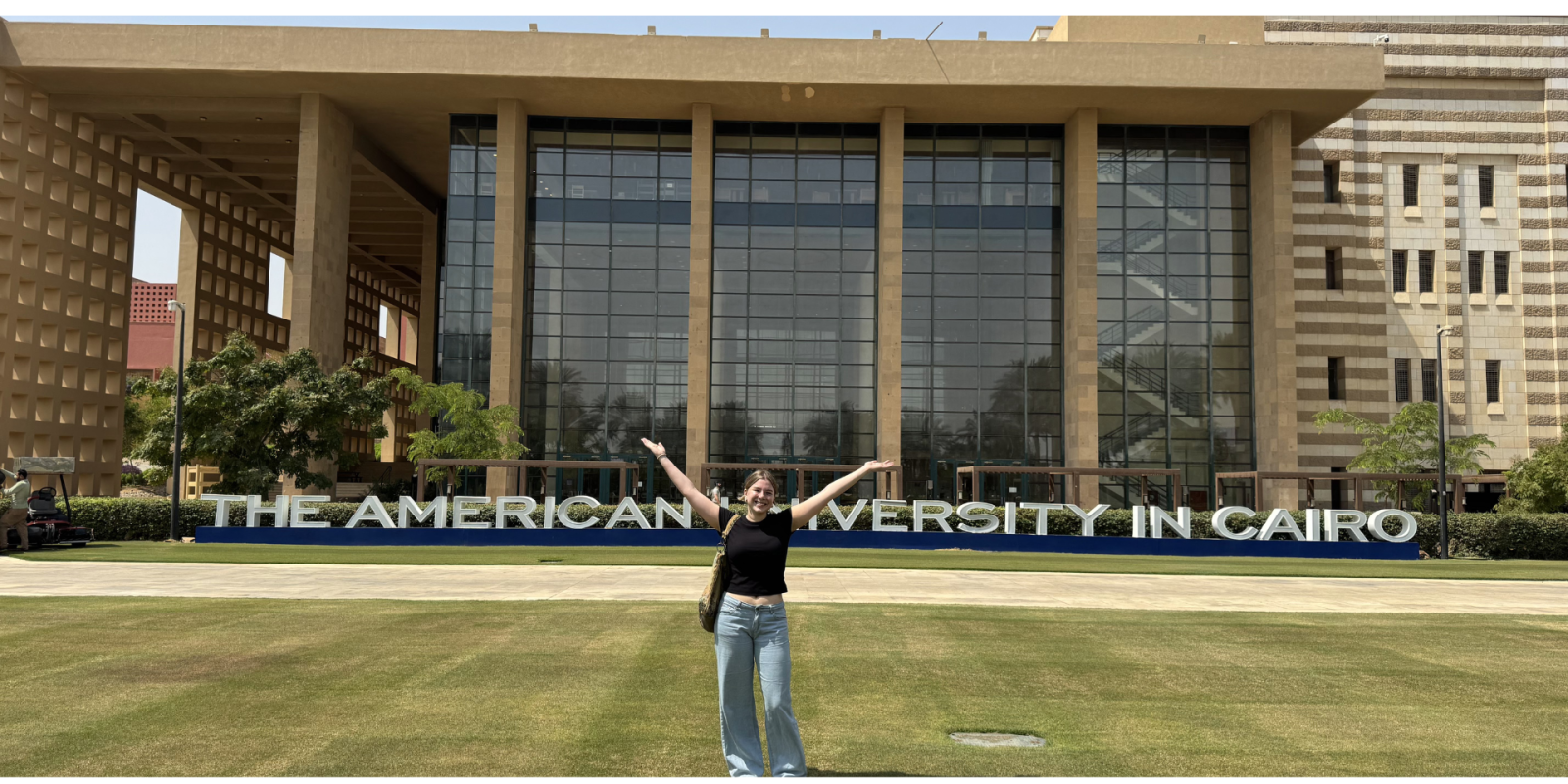
When Sophie Termaat first stepped onto the AUC campus in the Spring of 2024, she had no idea that the place where she was studying abroad would soon become her home. An undergraduate at Boston College, Sophie’s semester at AUC was transformative for her international relations studies. In fact, it was so impactful that she returned to AUC in Fall 2025 to pursue a master’s in comparative Middle East politics and society (CMEPS).
“Within the first couple weeks of being at AUC, I knew that I wanted to come back. So when I was looking at different master's programs, this one was clearly the best fit,” Termaat shared.
The CMEPS program is a partnership between AUC and the Institute of Political Science at Eberhard Karls Universität Tübingen in Germany. The first year of the program is entirely at AUC, followed by a third semester in Germany, and a fourth back in Egypt. Termaat appreciates the comparative lens, and also the opportunity to be back in the region she fell in love with while living in Dubai as a kid and then again during her study abroad at AUC.
“I always wanted to come back to the region because of the people and culture,” she stated. “AUC was the perfect fit, and my study abroad confirmed that it was the ideal place to continue my academic journey.”
“I always wanted to come back to the region because of the people and culture. AUC was the perfect fit, and my study abroad confirmed that it was the ideal place to continue my academic journey.”
Like many study-abroad students, Termaat found her place at AUC, making close friends within the international student community and traveling extensively throughout Egypt. She explained how excited she was when she first got to Egypt in 2024: “I didn’t sleep! There was so much to do.” Some of the highlights of her AUC experience included joining Student Union trips throughout Egypt, attending on-campus lectures from visiting professors, and enjoying the campus atmosphere (especially the pool!), which together made her study-abroad semester unforgettable.
After she settled into life in Cairo, she realized that living in Egypt not only enriched her understanding of Islamic culture, but also her academic scope. “I got to meet people from so many backgrounds and through AUC, I genuinely grew in my intellect.”
“My study abroad showed me that I get a very different education here than in the U.S., not just because of the topics that are covered, but also the diversity of the student body,” Termaat expressed. “I don't only learn from the professors, but also from the students and their experiences. We touched on a lot of things that just weren't really discussed in my undergrad, but are super important for the field. Learning Middle Eastern studies in the Middle East by Middle Eastern professors has definitely made me grow as a student and as a person.”
Life as a master’s student is definitely different from that of an undergraduate. For one, the community of learners around Termaat is incredibly dedicated, which continues to deepen her experience. “Everyone in my classes is getting their master’s because they genuinely want to learn,” she explained. “Also, everyone has their own niche at this point. So whether it's authoritarianism or sectarianism, we all have the things that we're good at, which is nice because we can share with and learn from each other.”
Termaat has developed her own niche, which is American interventionism, imperial power structures and their unintended effects on sectarian dynamics and regional security in the Middle East. These areas blend her background and perspectives while contributing needed research to the field of Middle East studies. Her passion for her work shines through, as she discussed state formation and the economic lens of security studies.
“It's really important to decolonize our thinking when we talk about the Middle East. As an American, I think the content that I learned in undergrad was as accurate as it might have been, but it wasn't portraying the region holistically,” Termaat elaborated. “Studying the region with faculty whose scholarship is grounded in lived, regional and linguistic expertise offers a very different kind of depth is very different from learning it from a professor who just studied it. It's much more well-rounded and has given me a more holistic and critically grounded education.”
“Studying the region with faculty whose scholarship is grounded in lived, regional and linguistic expertise offers a very different kind of depth is very different from learning it from a professor who just studied it. It's much more well-rounded and has given me a more holistic and critically grounded education.”
Termaat’s initial study-abroad experience helped her understand these gaps in her education and gave her the resources to patch those gaps. Through both formal lessons and informal conversations with colleagues, she was able to add depth to her understanding of the Arab world, and is now continuing to do so everyday.
“There are so many opportunities in Egypt and through AUC,” she affirmed. “For all students who come to study here, not just those interested in Middle East politics, take those opportunities, go on as many adventures as possible and continue to let yourself be challenged.”
