Home page
ع

Intensive English Courses for Undergraduates
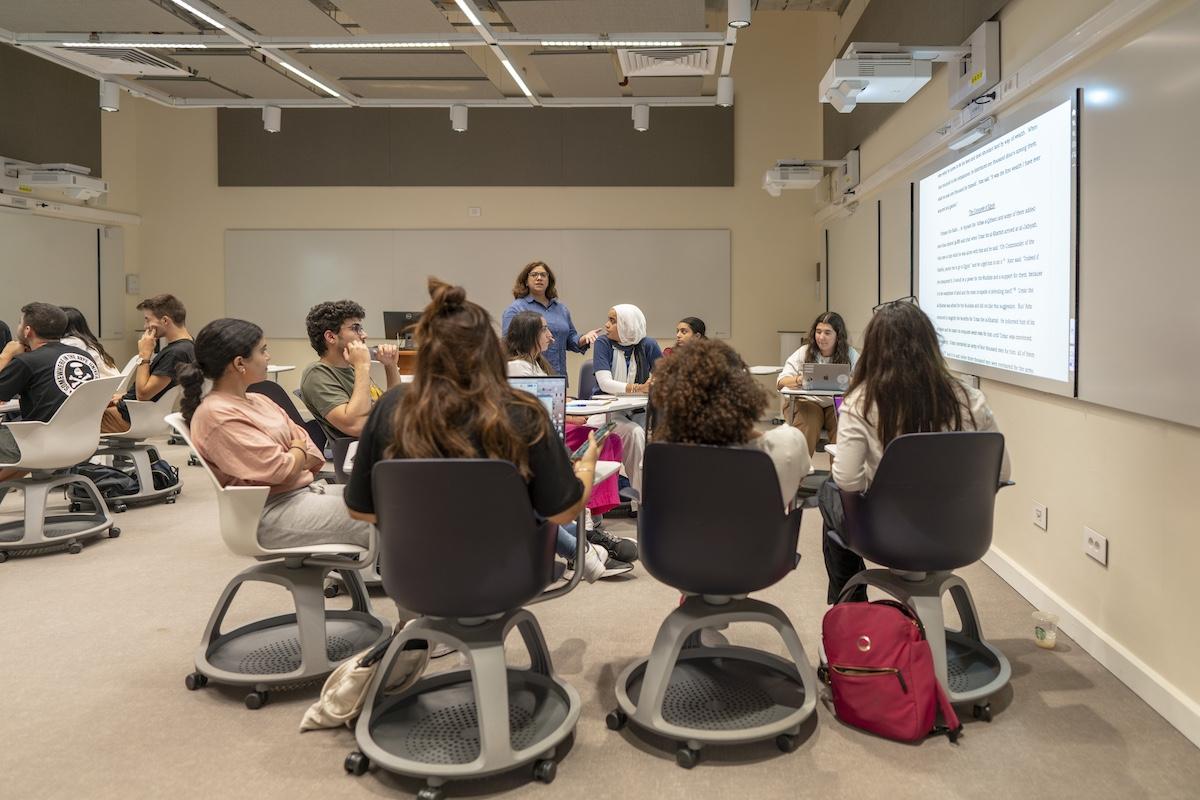
Students participate in a discussion-based class in a modern AUC smart classroom with projected materials.

The Intensive English Courses for Undergraduates include ELIN 0101 (Intermediate English) and ELIN 0102 (Advanced English). Students are placed in one of the two levels according to their scores on the International English Language Testing System (IELTS) or Test of English as a Foreign Language Internet-Based Test (TOEFL-iBT) or Duolingo English Test

Here are the cut-off scores set by the University.

Students in the Intensive English Courses for Undergraduates take five hours of classes a day. Because of the intensive nature of the classes, regular attendance and active involvement are major factors in a student’s success. It is very difficult and often impossible to make up for what has been missed.

Course Learning Outcomes

By the end of ELIN 0101/ELIN 0102, students will be able to:

  • Interact with academic content: reading, writing, listening, speaking
  • Demonstrate ability to think critically and problem solve
  • Utilize information and digital literacy skills
  • Demonstrate behavior and attitudes appropriate to a university environment

Goals

  • Apply the skills and strategies of a successful reader
  • Read critically

Course Objectives for Reading and Vocabulary

This course will develop the students’ ability to:

  • Skim for main idea(s)
  • Scan for details
  • Use graphic organizers to understand a text better
  • Develop reading speed
  • Build academic vocabulary
  • Make use of contextual clues to infer meanings of unfamiliar words from context
  • Summarize and paraphrase information in a text
  • Distinguish main ideas from specific details
  • Distinguish facts from opinions
  • Make inferences and predictions based on comprehension of a text
  • Identify the author’s purpose and tone
  • Discuss and respond to the content of the text orally and in writing
  • Utilize digital literacy tools to develop reading and vocabulary skills
  • Reflect on and evaluate learning and performance and set goals for progress
  • Demonstrate behavior and attitudes appropriate to a university environment (work collaboratively, manage time, be prepared, comply with academic integrity rules)

Student Learning Outcomes

Given an academic reading passage, the student will be able to:

  • Identify the main idea(s) in the text
  • Identify specific details
  • Distinguish main idea(s) from supporting detail
  • Distinguish fact from opinion
  • Make inferences and predictions based on information in the text
  • Infer meanings of unfamiliar words
  • Identify the author’s purpose and tone
  • Transfer information in the text into a graphic organizer
  • Produce academic vocabulary appropriately orally and in writing
  • Summarize/paraphrase information in a text 

Goals

  • Understand and apply the conventions of academic writing in English.

Course Objectives Writing and Grammar

This course will develop the students’ ability to:

  • Write effective and coherent paragraphs
  • Comprehend the overall and internal organization of an academic essay
  • write an effective thesis statement
  • Use pre-writing strategies to plan writing
  • Generate ideas from sources to develop content
  • Develop coherent content and support with relevant details
  • Write a 4-5 paragraph expository/take-a-stand academic essay
  • Write a 500-word response to a provocative reading passage
  • Give critical peer feedback
  • Use peer and teacher feedback to edit writing
  • Build academic vocabulary
  • Use a variety of accurate sentence structures
  • Use grammatical structures accurately
  • Utilize digital literacy tools to develop writing and grammar skills
  • Reflect on and evaluate learning and performance and set goals for progress
  • Demonstrate behavior and attitudes appropriate to a university environment (work collaboratively, manage time, be prepared, comply with academic integrity rules)

Student Learning Outcomes

Given a writing prompt, the student will be able to:

  • Write a paragraph with a topic sentence, support, and concluding sentence
  • Produce coherent and unified paragraphs with adequate support and detail
  • Write an effective introduction and conclusion
  • Write a thesis statement that addresses the writing prompt
  • Produce a well-organized academic essay
  • Produce appropriate vocabulary and correct word forms
  • Use a variety of accurate sentence structures
  • Produce accurate grammatical structures
  • Demonstrate control of mechanics

Goals

  • Apply the skills and strategies of a successful listener

Course Objectives for Listening

This course will develop the students’ ability to:

  • Take organized notes on lectures and listening passages
  • Identify and distinguish main ideas from supporting details
  • Make use of contextual clues to infer meanings of unfamiliar words from context
  • Identify speaker’s purpose and tone
  • Make inferences and predictions about spoken discourse
  • Utilize digital literacy tools to develop listening skills
  • Reflect on and evaluate learning and performance and set goals for progress
  • Demonstrate behavior and attitudes appropriate to a university environment (work collaboratively, manage time, be prepared, comply with academic integrity rules)
  • Given an oral lecture or a listening comprehension passage, the student will be able to:
    • Take notes and make use of them in answering questions about the passage
    • Distinguish relevant from irrelevant information
    • Identify the topic and main idea
    • Comprehend relationships between ideas
    • Discuss and respond to the content of a lecture or listening passage orally and/or in writing
    • Make inferences and predictions about spoken discourse

Goals

  • Apply the skills and strategies of a successful speaker

Course Objectives for Speaking and Oral Presentation

This course will develop the students’ ability to:

  • Discuss and respond to the content of a reading or listening passage
  • Use communication strategies to participate in group and class discussions
  • Select, compile, and synthesize information for an oral presentation
  • Use search tools to locate appropriate sources
  • Evaluate and select sources for relevance
  • Paraphrase and cite sources
  • Use vocabulary appropriately
  • Use grammatical structures appropriately
  • Deliver an effective oral presentation
  • Present information using digital tools
  • Reflect on and evaluate learning and performance and set goals for progress
  • Demonstrate behavior and attitudes appropriate to a university environment (work collaboratively, manage time, be prepared, comply with academic integrity rules)

Student Learning Outcomes

  • Given a topic to research and present in class, the student will be able to:
    • Focus the topic
    • Apply research procedures
    • Locate and select relevant information
    • Take notes, paraphrase, synthesize and organize information
    • Produce appropriate vocabulary
    • Produce accurate grammatical forms
    • Give an oral presentation in class using effective delivery strategies

Goals

  • Apply the skills of problem-solving
  • Work in groups

Course Objectives for Project-based problem solving

This course will develop the students’ ability to:

  • Work collaboratively with others
  • Communicate effectively
  • Take responsibility for completing tasks
  • Create group goals and strategies to complete tasks
  • Reach consensus in decision making
  • Solve problems
  • Manage time
  • Utilize digital literacy tools to develop collaborative skills
  • Reflect on and evaluate learning and performance, and set goals for progress
  • Demonstrate behavior and attitudes appropriate to a university environment (be prepared, comply with academic integrity rules)

Student Learning Outcomes

  • Given a real-world problem, the student will be able to:
    • Work collaboratively
    • Divide tasks
    • Conduct interviews and observations
    • Identify the problem
    • Explore possible solutions
    • Represent a solution in the form of a prototype
    • Give, receive and apply feedback
    • Give a presentation reporting on the process and the prototype
    • Write a thoughtful reflection on an experience