Edward Said Memorial Lecture: Global Realignments and the Prospects for a Livable World
Join the memorial lecture by Noam Chomsky, professor of Linguist and Public Intellectual, discussing global realignments and the prospects for a livable world.
A new study co-authored by Salima Ikram (YAB '86) suggests that ancient Egyptians were capable of treating and rehabilitating patients who suffered from strokes.
An international team of Egyptologists from the United States, Spain and Egypt, including AUC’s own Salima Ikram (YAB ’86), has discovered an ancient Egyptian female mummy who suffered a stroke — the oldest documented stroke case in the scientific medical literature.
Studied macroscopically and radiographically on site, the mummy was found to be aged 25-40 (probably closer to 40), belonging to a woman of the 25thDynasty who died some 2,700 years ago. She appears to have suffered a right cerebral stroke, causing brain damage, and left hemiplegia (paralysis on one side of the body). Radiological examination shows that the paralysis occurred once bone growth was completed, when the woman was 23 to 25 years old, but significantly before her death — which means that she lived with the disease for a long period of time while receiving care and support from those around her.
“This tells us that strokes have a long history and that even in antiquity, people survived them, especially as others cared for them to ensure their survival,” said Ikram.
The study, titled “A Possible Stroke Victim from Pharaonic Egypt,” records that the mummy was found in a position not reported before, with one arm extended and the other crossing over the chest with a contracted hand — a key clue to the diagnosis. Mummies during that period had their hands typically either lying alongside their bodies or in a crossed position on the chest. The mummy’s head was angled down, dramatically, with contracted shoulders, which is common with children’s mummies but not with adults. The position of the shoulders, head and flexed arm suggests that the woman was suffering from damage to the right hemisphere of the brain, and the face looking down is typical of strokes, the co-authors explain in the study.
An attempt was made during the mummification process to fix the position of the woman’s head and chest by including two sticks at her back, which gave her a permanent erect posture. She was also provided with a stick or a crutch, which she seemed to have used during her lifetime as a walking aid. The presence of a rare red linen fabric — found in only a few burials — covering the mummy’s head to knees, suggests a higher social status for this mummy.
The team is currently working on other mummies from the Dra Abu el-Naga area near Luxor to see if they suffered from diseases as well.
“We are learning about different diseases that ancient Egyptians suffered from and how they dealt with this both medically as well as in a sociocultural context,” said Ikram.
In their award-winning book, AUC faculty chart the evolution of Arab graphic design.
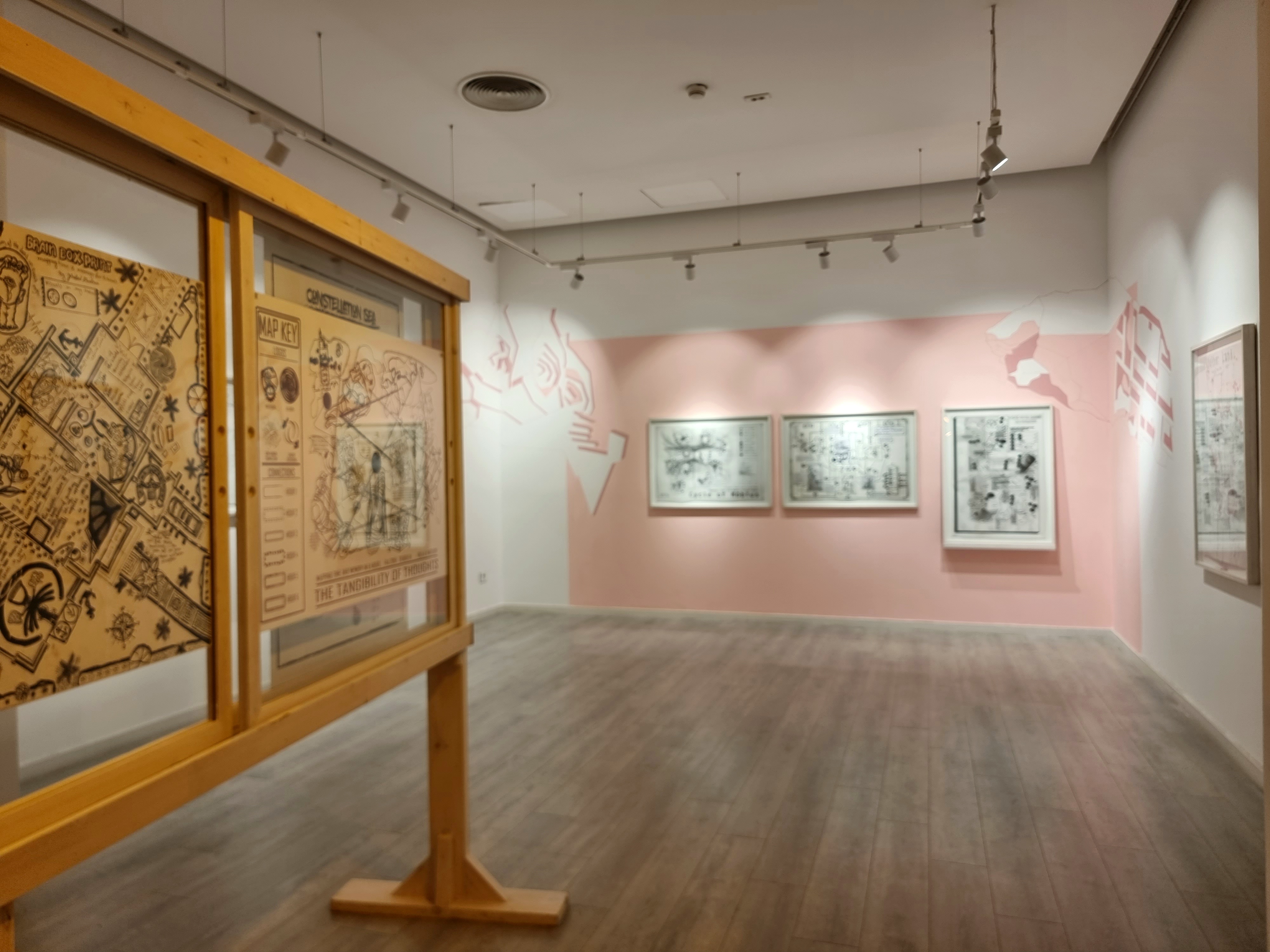
Some of the more than 600 visuals featured in A History of Arab Graphic Design: the anatomy of a horse in crimson and azure, labeled in elegant Arabic calligraphy and preserved on paper for six centuries; tiles in shades of cerulean, turquoise and ultramarine adorning the half-moon entryway of Sheikh Lotfollah Mosque in Isfahan, Iran; an illustrated mermaid hugging a bouquet of paintbrushes on the first-ever Alexandria Biennale poster.
The first-of-its-kind textbook reminds us that for as long as humans have taken up space, we have insisted on decorating it. In doing so, Arab and Islamic artists have drawn, painted and etched a visual record of their history, whether they meant to or not. “Graphic design is part of a visual language that is itself the by-product and reflection of a culture and its society,” co-authors and Department of the Arts faculty Bahia Shehab (MA ’09), professor of practice, and Haytham Nawar, associate professor and chair, write. “We cannot discuss modern Arab graphic design and visual culture without understanding the region’s visual heritage.”
To read the full article, click here.
From pollution to illiteracy, graphic design graduation projects aim to educate, empower and make a difference.
Hessa fe Qessa (A Lesson in a Story) – Salma Elbarbary ’22
With Egypt’s illiteracy rate reaching 27% in 2020, Hessa fe Qessa is an educational app that teaches illiterate individuals how to read, employing an interactive story that discusses relevant social issues. The app includes an audio guide, exercises and an information bank.
Gowa El Hadota (Inside the Tale) – Salma Elbarbary ’22
We live in a visually abundant world where millions of visually impaired children are deprived of daily activities, simply because they were designed with the sighted consumer in mind. Opening the gates to worlds that can be seen through storytelling and sensory stimulating activities, Gowa Al Hadota is a multi-sensory playing experience for visually impaired children aged 6 to 12. The narrated game targets the child’s imagination to unlock a world that can empower them to play and explore their surroundings independently and safely.
To read the full article, click here.
Human-centered design thinking approach is a core part of the AUC educational experience.
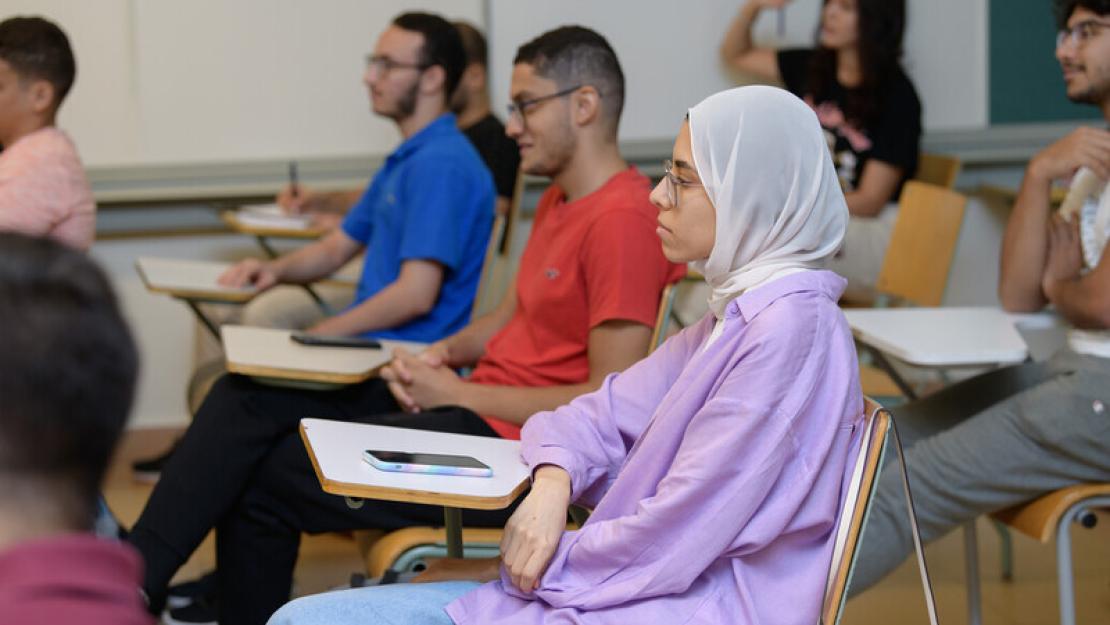
By integrating design thinking into the curriculum, AUC is teaching students to approach complicated problems with a sense of empathy, creativity and resilience, explained Hoda Mostafa, professor of practice and director of the University’s Center for Learning and Teaching (CLT).
Design thinking is a methodology used by Fortune 500 companies, including Apple and J.P. Morgan, to transform their way of operating and develop innovative, customer-centric products and services. International development institutions, such as the World Food Programme and UNESCO, have employed it to create policies and programs that effectively address poverty, gender inequality and other complex global challenges.
To read the full article, click here.
Faculty uses AI and machine learning to create a universal pictographic human language.
Can humans communicate through a single unified language?
Yes, according to Haytham Nawar, associate professor and chair of the Department of the Arts, who is using artificial intelligence and machine learning to develop a universal pictographic language that could bridge divides and enhance cross-cultural understanding.
Why pictographic?
“The idea is that the machine creates a new language based on how humans in the past created pictographic languages, starting from hieroglyphics all the way to emojis,” said Nawar, who has long been interested in scripts and pictographic languages, such as Egyptian hieroglyphs, cuneiform scripts used in the Near East and ancient Chinese writing systems. These image-based languages were humanity’s earliest communication systems, the precursors to the script-based languages we use today.
To read the full article, click here.
AUC’s Board of Trustees has approved the tenure of three faculty members for their commitment to academic excellence and dedication to the proliferation of knowledge at all levels. The recipients are John Meloy (CASA ’85, ’87), dean of the School of Humanities and Social Sciences and professor in the Department of Arab and Islamic Civilizations; Dina Heshmat, assistant professor in the Department of Arab and Islamic Civilizations; and Rasha Allam ’02, ’05, assistant professor and associate chair of the Department of Journalism and Mass Communication.
"The greatness of our University rests squarely on the talents and accomplishments of its faculty," said Provost Ehab Abdel-Rahman. "At AUC, we are blessed with faculty members who engage in groundbreaking research, scholarship and creative work. I am delighted to congratulate this year's tenured faculty who are all prime examples of AUC's commitment to excellence. AUC continues to be fully committed to tenure excellent faculty, [who] together with the many distinguished faculty members, contribute to realize the University's vision of excellence in teaching, research and creativity."
Dina Heshmat
Heshmat’s journey at AUC began in September 2013 when she joined the Department of Arab and Islamic Civilizations as assistant professor of Arabic literature. For Heshmat, teaching garners its own special rewards, namely rich interactions with students and the ability to impact future generations. “One of the things I enjoy most is that by teaching at AUC and interacting with its students, I feel I can make a difference for the new generations,” she said, adding that she is “overjoyed” about receiving tenure.
Building upon the research she has done while working on her book titled Egypt 1919: The Revolution in Literature and Film, a project facilitated by a grant from AUC’s Office of the Associate Provost for Research, Innovation and Creativity, Heshmat is now undertaking an ambitious new research project, for which she was awarded a fellowship at the Nantes Institute for Advanced Study, which is part of the Some Institutes for Advanced Study consortium.
“The project is tentatively titled Gender, Narrative and Nationalist Movement: Auto/biographical Narratives of Women in Egypt 1919. This work aims at retrieving the autobiographical narratives of the nationalist and feminist militants who were active participants in the anti-colonial revolution of 1919 by looking at a wide range of texts they authored, including memoirs, articles, poems, short stories and unpublished letters. I plan to turn the research I am doing for this project into a new book,” Heshmat explained.
John Meloy
Meloy, who is a graduate of AUC’s Center for Arabic Study Abroad, expressed his gratitude for this recognition. “I’m honored to receive tenure. I appreciate the faculty and working with all my colleagues,” he said.
When he first joined AUC in July 2021 as HUSS dean, Meloy emphasized the importance of critical thinking: “The critical skills our students acquire from our various disciplines give them the means to continue learning after they graduate. It’s not so much teaching them what they need to know now, but rather teaching them how to figure out what they need to know and giving them the skills and traits to teach themselves: sharpening critical thinking, cultivating curiosity and creativity, fostering individual and social awareness, and strengthening effective communication.”
With his attention primarily on administrative work at this time, taking the lead in various capacities to strengthen the pillars of a strong liberal arts education, Meloy hopes to get back to pursuing research. “My recent research has been on economic crises in the Mamluk period, how they were understood and how the authorities dealt with them,” he said.
Rasha Allam
Allam joined the University full time in 2016 but has been part of AUC as adjunct faculty since 2005. “I was very happy to hear the news about tenure because it came after years of hard work, commitment and dedication,” reflected Allam, “I appreciate the high standards of education that AUC maintains throughout the years, the University environment as a whole that fosters education both personally and professionally, and certainly the liberal arts education that really distinguishes AUC from any other institution in Egypt.”
For Allam, receiving tenure is a reflection of her continuous efforts to tailor teaching methods that keep students invested in the material taught and encourages them to think critically through case studies from the industry and beyond the classroom, acting as an ambassador for the University while gaining ground in areas that will be significant for her career.
Outside AUC, Allam has served as a consultant to think tanks, media institutions, jounalists, international organizations, as well as public and private universities. These include Egypt’s Presidential Media Office, UNESCO, Supreme Council for Media Regulations, National Press Authority and Al-Masry Al-Youm news organization.
“Working with such well-reputed entities has helped me in creating a strong network with academics and professionals on the regional and international level, where the flag of AUC has always been raised, and it has definitely contributed to the development of my personality as a teacher and researcher,” Allam said.
Allam is currently focusing on expanding her research, especially in the field of media management, as the rapid pace of technological development shapes the media scene like never before. “It is vital to understand the new business and value creation models, as well as ways of adaptation to the consistently changing industry. I am also focusing on research that examines media policies and regulations, especially since we are now witnessing huge changes in the media legislative landscapes, whether in Egypt or the region,” she said.
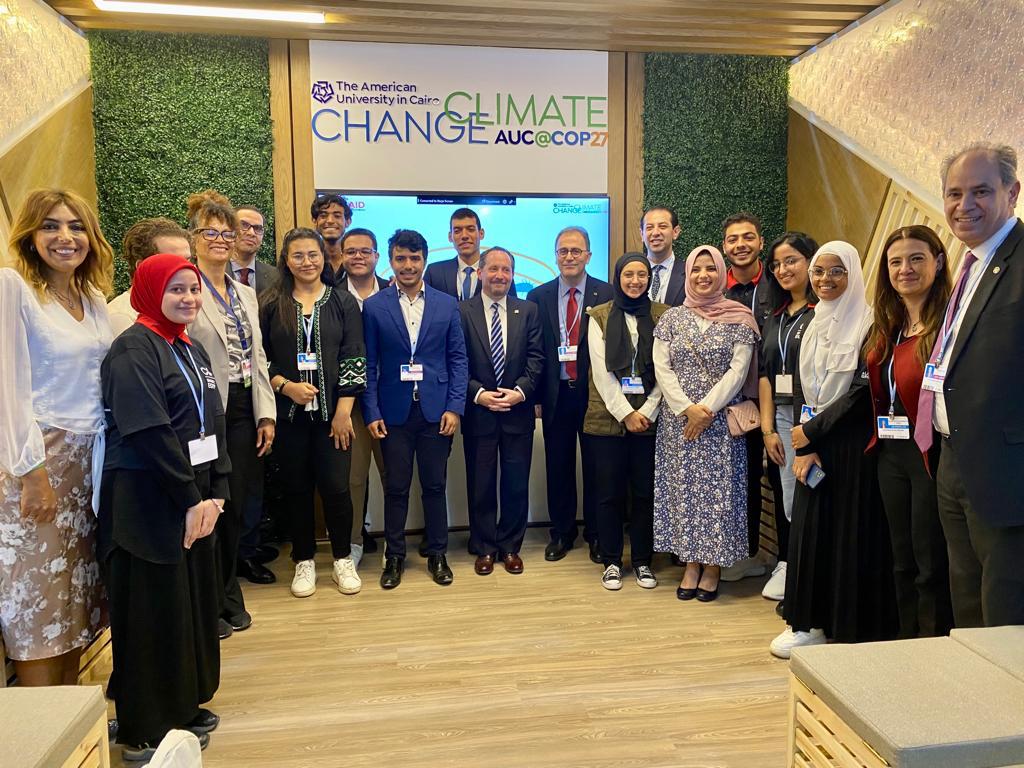
Launched last week, AUC’s Climate Change Initiative capitalizes on AUC’s contributions to national and international efforts in tackling one of the greatest challenges of our time. The initiative includes research, student activities, teaching and learning, outreach, tracking and reducing our carbon footprint, writing school textbooks on climate change and providing climate change solutions in specific contexts within the country.
“Our aim in this initiative is to reinforce AUC’s role as an active academic hub on climate change and sustainable development in Egypt and the region, as well as an active contributor to global efforts addressing climate change challenges,” said President Ahmad Dallal. “Of course, COP27, hosted in Egypt in November, provides an incentive to catalyze AUC’s climate change initiative.”
Dallal outlined the initiative’s five main areas of focus that are fully aligned with national and regional climate change and sustainability priorities:
These areas of focus also overlap with a number of “cross-cutting issues” ––adaptation to climate change, resilience of communities, mitigation measures, education and a just transition –– that are relevant to Asia and the region. “We encourage a multidisciplinary approach in addressing challenges, including policy, regulatory frameworks, financing, scientific research and social science aspects,” said Dallal.
UN Climate Change High-Level Champion for Egypt and Executive Director of the International Monetary Fund Mahmoud Mohieldin, who was the keynote speaker at the event, highlighted five distinctive features of COP27, which AUC will participate in next fall:
“We cannot ignore poverty, hunger, job creation and an inclusive approach to the whole [climate change] agenda, including the impact of climate change on children, youth and women."
“We don’t need new frameworks; we just need to apply what we have. If there is a good idea, let’s projectize it. You [AUC] have good ideas, and you have been teaching about them, so [the focus now is] how to apply them on your scale, with the hope that this could be scaled up or replicated somewhere else.”
“This is a very practical approach based on a country-platform design, with five regional roundtables [across the world] – and I’m inviting you to participate in any capacity you wish. … It’s not just about Egypt and the local community. It’s about the region, Arab countries, the Mediterranean, Africa and beyond.”
“It’s not about the competition; it’s about [showcasing] the talents and skills in the governorates, and it’s a chance to demonstrate what they’re doing. … It is customary for rich countries to host big conferences to be attended by 30,000 plus participants, [including] heads of state, but ordinary people would always wonder, ‘What's in it for us? Why do we have this conference?’ And this is legitimate.”
“Without finance and investments, without the resources available to us –– not just financial resources, but technology and knowledge [as well] – nothing will really progress, and many of these ideas may end up with frustration. There will be some serious discussion about [funding] opportunities."
“Students come to my courses with assumptions about what the Islamic tradition is and is not, and they go away with a broader horizon about the intellectual diversity of the Islamic world; an awareness of its community of interpreters who, generation after generation, refined and reshaped Islamic traditions; and an appreciation for the richness and complexity of the great classics of Islam in the realms of poetry, law, theology, Sufism and ethics,” said Ahmad Khan, assistant professor in AUC’s Department of Arab and Islamic Civilizations.
Khan has been awarded the Arcapita Visiting Professor at Columbia University for Spring 2022, hosted by the Middle East Institute and the Department of Middle Eastern, South Asian and African Studies at Columbia, where he is currently teaching the graduate course, Islamic Thought in an Age of Print.
“It is an honor to be awarded the visiting professorship,” Khan said. “The Arcapita Visiting Professorship has been a fantastic opportunity to think, research and write.”
Khan’s professorship is part of a long-standing and rich history between the two universities. Lisa Anderson, who served as AUC president from 2011 to 2016, and prior to that as AUC’s provost from 2008 to 2010, is currently dean emerita of the School of International and Public Affairs at Columbia. Furthermore, AUC’s current President, Ahmad Dallal, received his PhD in Islamic studies from Columbia.
“I hope to use my appointment at Columbia University to explore opportunities to strengthen the ties between these two universities,” Khan said.
Khan enjoys teaching at Columbia and AUC alike. In his classes, he introduces students to the great classics of Islamic civilization via texts in classical Arabic, exposing them to major thinkers of the Islamic world like Ibn Khaldun, al-Shafi'i, Rabi'a al-Adawiyya and Ibn al-Farid.
“The students at Columbia are in many ways like my students at AUC: bright, curious and dedicated to learning more,” said Khan. “Nowadays, much of my research is shaped by my teaching at AUC. The discussions we have are helping me examine important topics in the field of Islamic studies and civilizations.”
Delving into Islamic Studies
Khan’s research interests stemmed from the interdisciplinary training he received during his PhD at Oxford. There, Khan was able to take a variety of courses in history, literature, poetry, religious thought, and Arabic and Persian classical texts. This led to him having a holistic and diverse range of thoughts and approaches to Islamic studies, history, theology and literature.
This year, his monograph, Heresy and the Formation of Medieval Islamic Orthodoxy: The Making of Sunnism from the Eighth to the Eleventh Centuries, is the first major book in the field dedicated solely to the development of orthodoxy and heresy within Sunni Islam. The work examines conflicting efforts by Muslims during the eighth to 11th centuries, to define heresy and orthodoxy, finally giving way to a tolerant and diverse form of mainstream Sunnism. Khan looks at why and how Sunni Muslims, contrary to popular narratives, handled disputes over religious ideas often without recourse to violence. The book is expected to be published in December by Cambridge University Press.
“In this investigation of discourses of orthodoxy and heresy, we learn how medieval scholars and textual communities were engaged in constant and rapid efforts to develop an indigenous apparatus through which consensuses could be reached about orthodoxy and heresy; how orthodoxy was not a later ‘communal fiction’ but entailed stages and processes that can be identified and were identified by medieval Muslims,” said Khan.
“Above all, we gain insight into how a formidable medieval society and religion negotiated conflict and disagreement without giving birth to a widespread culture of imperial councils, inquisitors and persecutions,” he said.
By the 11th century, Abū Ḥanīfa, Mālik b. Anas, al-Shāfiʿī, and Aḥmad b. Ḥanbal were regarded as representations, par excellence, of medieval Sunni orthodoxy. “As such, the legal schools that coalesced around them became markers of medieval Sunni orthodoxy, and they spawned a religious tradition that is almost unparalleled in its relevance and longevity throughout Islamic history,” said Khan. “The book shows how orthodoxy and heresy in the eighth to 11th centuries may best be understood as processes.”
Working on this book also led Khan to study an array of medieval texts in Arabic and Persian. Many of these texts were edited and printed in the 19th to 21st centuries by modern scholars and editors in the Islamic world. He examined the processes by which these texts were transmitted in modern times, such as in Egypt, and how this helped shape the development of modern Islamic thought. This connection between his research on medieval Islam and Islamic thought in an age of print is explored further in the course Khan is currently teaching at Columbia.
The professor is also currently working on a book, Religion and Empire in Early Islamic Society, which discusses how Islamic law and its legal culture played a role in shaping early Islamic societies in regions like Iraq, Khorasan and Egypt, and is expected to be completed in 2023. Alongside these projects, Khan’s research includes the study of Quranic interpretation, the role of women in hadith learning, and Sufism.
The larger context of today’s society cannot be ignored when discussing Islamic studies. “The current sociopolitical context [of the global war on terror and sensitivities related to Islamic extremism] has resulted in major misrepresentations of Islamic traditions both from the inside and outside,” he said.