Home page
ع

IMF, AUC Wrap Up First MENA Economic Research Conference

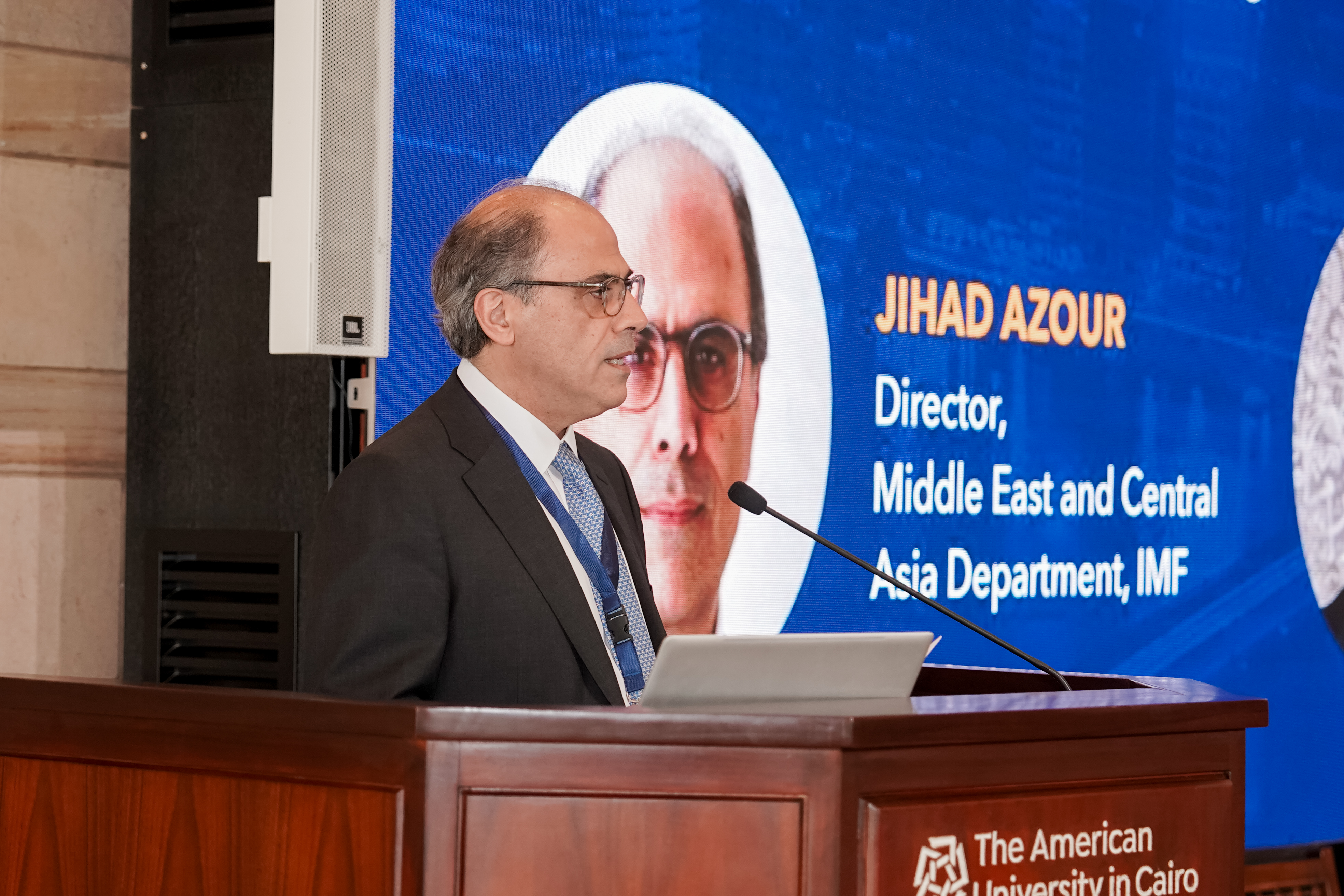
IMF Director Jihad Azour speaking at an AUC podium
June 11, 2025

Following two days of high-level dialogue and expert analysis, the inaugural IMF MENA Economic Annual Research Conference co-organized by the International Monetary Fund and AUC, concluded with a strong call for coordinated, evidence-based policy responses to the region’s old and new pressing economic challenges. 

Held on May 18–19, 2025, the conference served as a critical platform for advancing rigorous research tailored to the realities of the Middle East and North Africa. It brought together global policymakers, academics, government officials and thought leaders to bridge the discussion on global economic issues with regional realities. The event marked a first-of-its-kind collaboration between the IMF and a leading University in the region, reflecting a shared commitment to deepening the link between academic research and policy development. 

 "This is about generating ideas that are globally informed but deeply rooted in the realities of our region."

Jihad Azour, director of the IMF’s Middle East and Central Asia Department, noted that trade tensions and increasing uncertainty affecting the global economy, alongside ongoing regional conflicts and climate risks, are creating new layers of complexities for MENA policymakers. Azour called for building a regional platform for dialogue and exchange of ideas that connects MENA to world-class research centers to provide reliable analysis and develop workable and innovative policy responses to old and new economic issues facing the region. “We are deeply grateful to President Ahmad Dallal and AUC for their commitment to fostering dialogue, research and policy innovation in the region,” Azour said.

AUC President Ahmad Dallal highlighted the event’s role as a vital platform in fostering collaboration between governments, academia and the private sector. "This is about generating ideas that are globally informed but deeply rooted in the realities of our region," Dallal noted.

Dallal affirmed that this type of multi-stakeholder engagement is at the heart of AUC’s mission and reflects the University’s commitment to research, education and open dialogue as drivers of stability, resilience and inclusive growth.

“We are deeply grateful to President Ahmad Dallal and AUC for their commitment to fostering dialogue, research and policy innovation in the region."

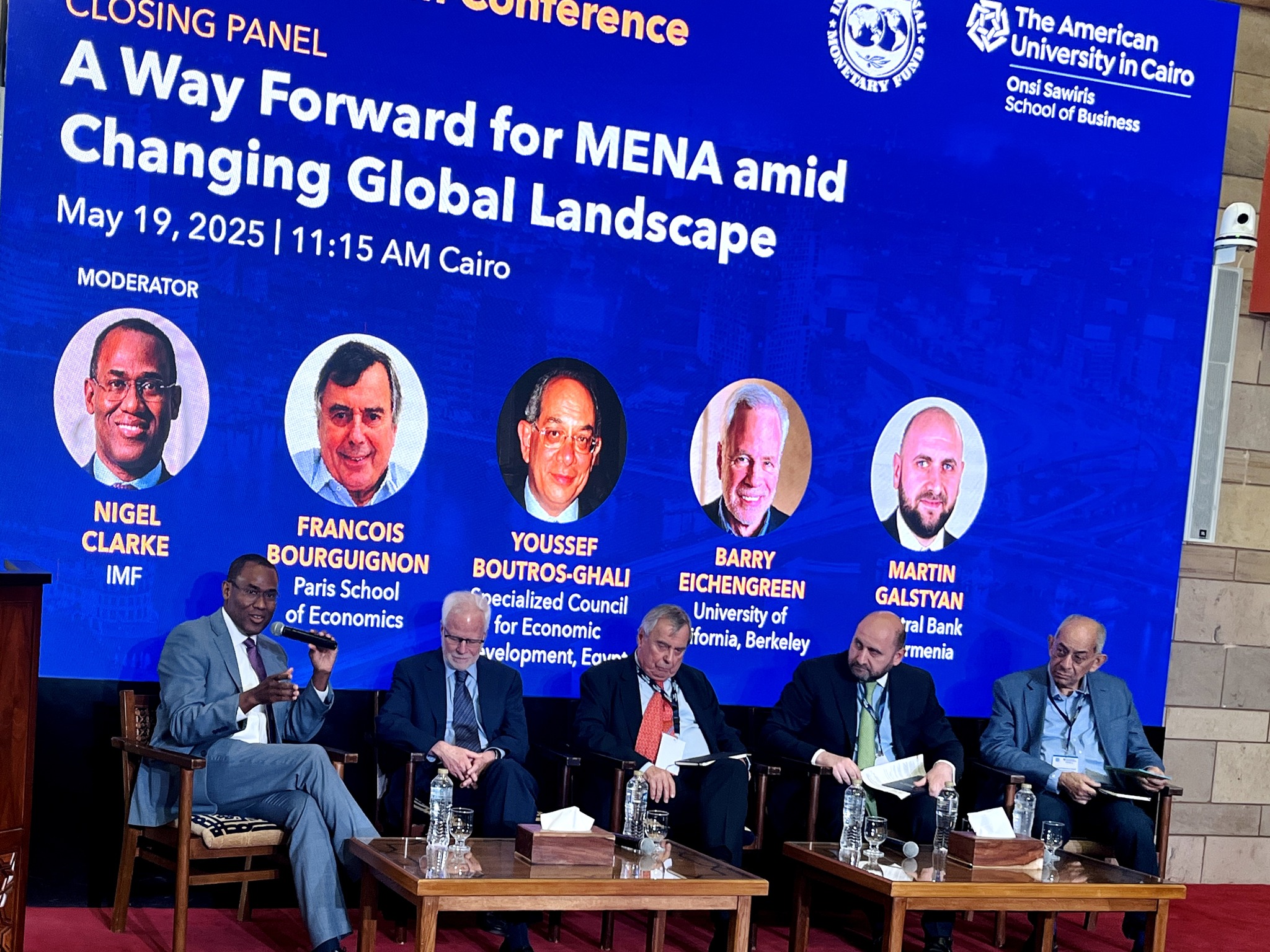
A panel of speakers sitting on stage at the IMF MENA inaugural research conference


Under the theme “Steering Macroeconomic and Structural Policies in a Shifting Global Economic Landscape,” discussions centered on four pivotal issues shaping the future of the MENA region and the global economy:

  • Fiscal Policy: With public debt at historic highs, experts stressed the importance of rebuilding fiscal buffers while tackling social inequalities, aging populations, and climate pressures. Proposals included reforms in fiscal frameworks and measures to mobilize revenues, including through multinational taxation and more progressive tax systems.  
  • Monetary Policy: Participants reflected on the lessons of recent inflationary shocks, emphasizing the need for more preemptive and well-communicated policy responses to global shocks and sector-specific disruptions, particularly for emerging markets.
  • Industrial Policy: Speakers examined the renewed interest in industrial policy as a tool to drive inclusive growth, innovation, and climate resilience. The discussion highlighted the need to balance vertical strategies with horizontal reforms that promote private investment, trade integration, and productivity.
  • Green Transition and AI: The intersection of climate action and digital transformation sparked debate about their potential to reshape labor markets. Recommendations included investing in human capital, developing targeted safety nets, and aligning policy tools to support job creation in low-emission sectors.

Throughout the sessions, there was a clear consensus that the MENA region’s economic resilience depends on institutional reforms, cross-border cooperation, and investment in skills and innovation. Participants also underscored the importance of embedding policy in local realities — an approach that both the IMF and AUC pledged to champion moving forward.

In addition to prominent global and regional academics, as well as economists and government officials from across the region, and representatives of international and regional organizations, the conference brought together policymakers, including Egypt's Minister of Planning, Economic Development and International Cooperation Rania Al-Mashat '95; Youssef Boutros-Ghali, member of the Specialized Council for Economic Development; Mahmoud Mohieldin, United Nations special envoy on financing the 2030 Sustainable Development Agenda; and Martin Galstyan, governor of the Central Bank of Armenia.

As Nigel Clarke, IMF deputy managing director concluded, "This conference is a milestone demonstrating the IMF's commitment to deepening engagement with the research and academic community, as we strive to ensure that the IMF support is not only responsive to the needs of member countries, but also built on rigorous tested analytics and importantly, it's aligned with local realities. Through this kind of multi-stakeholder dialogue, we aim to better understand how all our expertise and resources can be directed towards the most pressing challenges of the region.”

Visit the conference website for more details and to watch Day 1 and Day 2 of the discussions. 

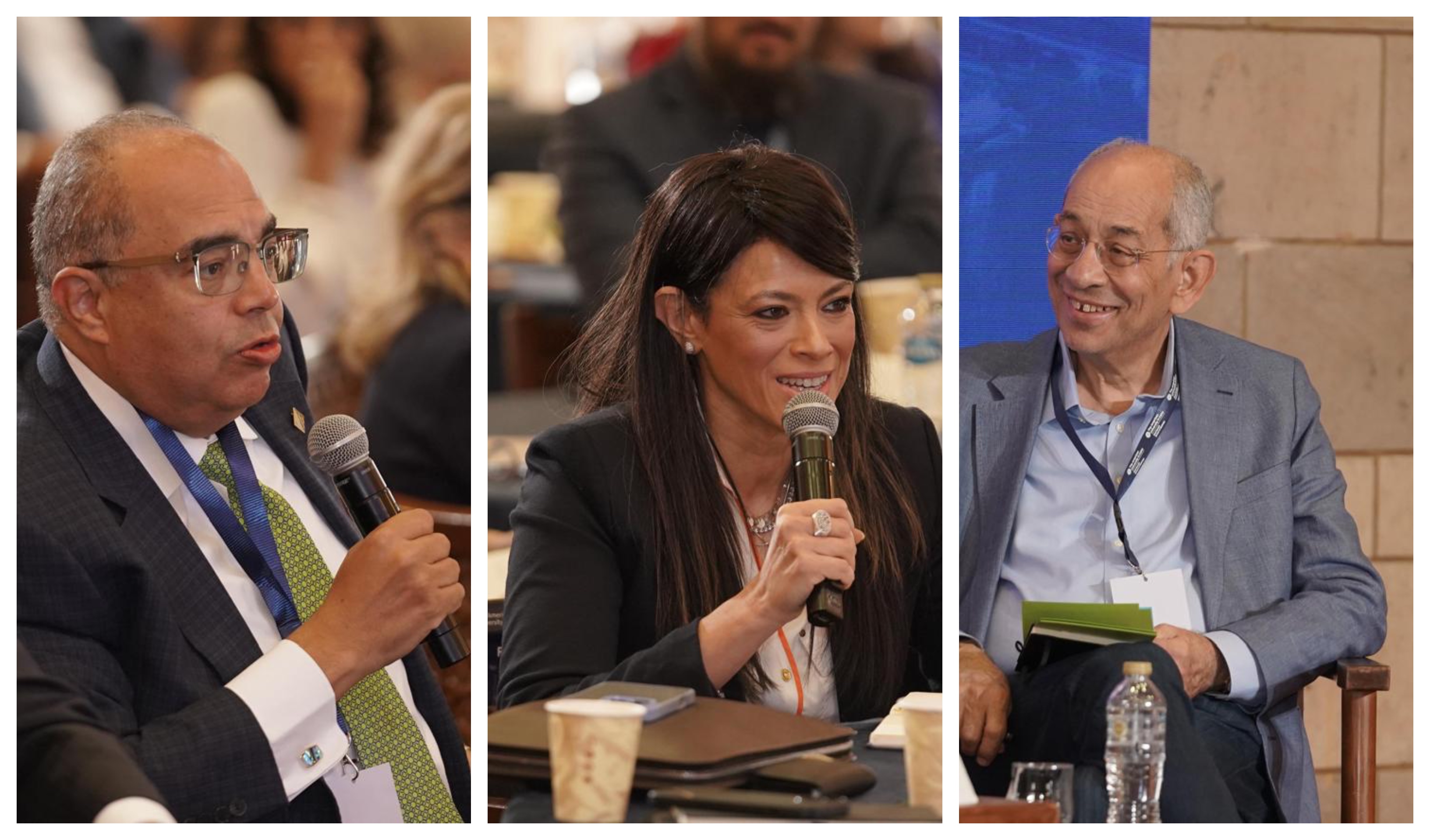
A collage of three speakers at the inaugural IMF MENA Research Conference

Mahmoud Mohieldin, United Nations special envoy on financing the 2030 Sustainable Development Agenda; Egypt's Minister of Planning, Economic Development and International Cooperation Rania Al-Mashat '95; and Youssef Boutros-Ghali, member of the Specialized Council for Economic Development

Share

Brandeis Student Comes to AUC

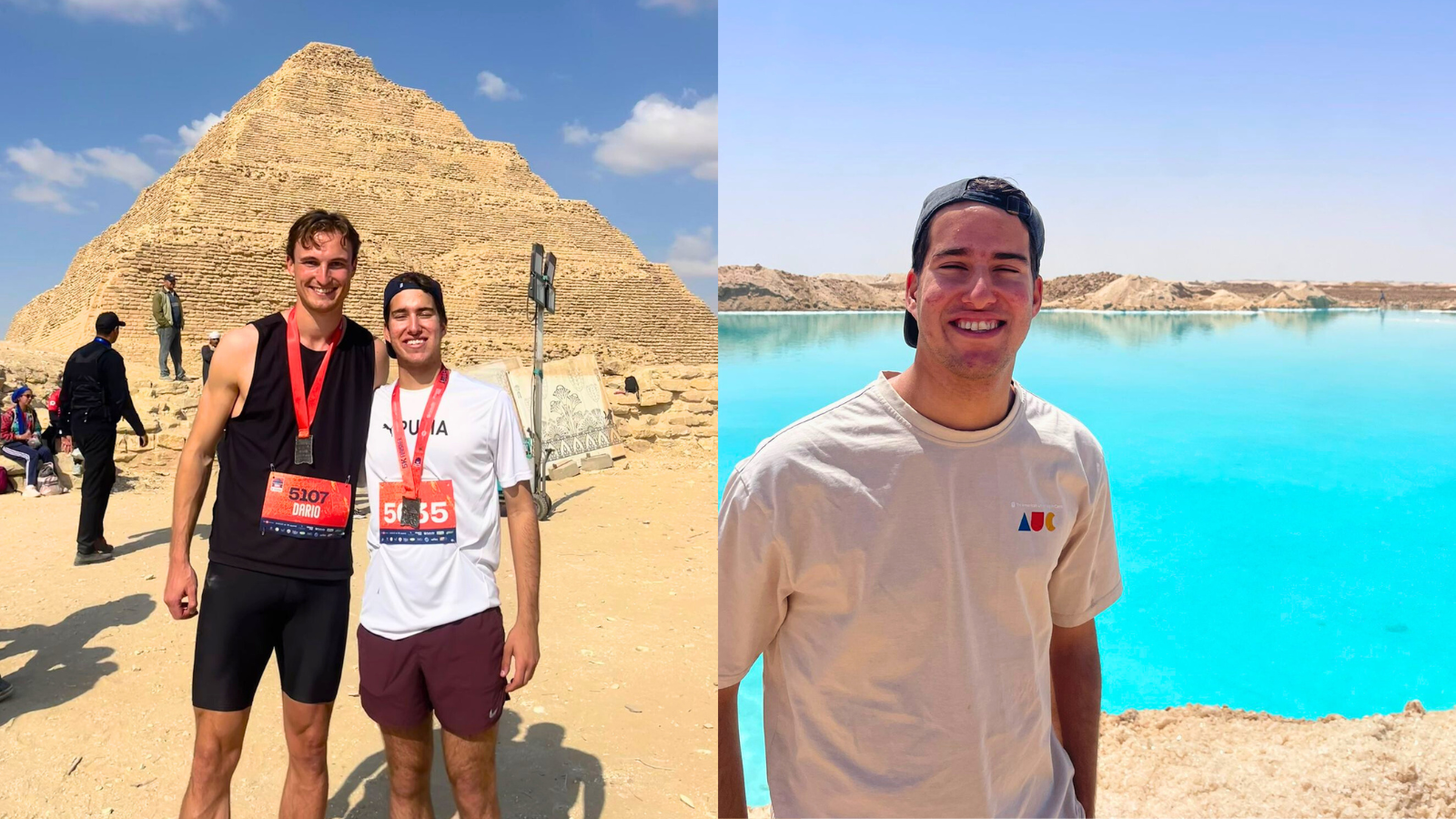
Two images in a collage: First, Allan Feldman stands alongside another student wearing numbers around their neck at a race or marathon (running event) with a Saqqara pyramid in the background; Allan Feldman smiles in an AUC-branded t-shirt in the sun, in front of a turquoise blue salt lake
Celeste Abourjeili
July 9, 2025

“My interests in this region have been instilled in me since my childhood through conversations with friends, peers and family, and hearing about it on the news,” said Allan Feldman, an economics and Middle East studies junior on an exchange semester from Brandeis University.

Feldman’s interest in the Arab world took on an academic fervor when he began studying the region at his home institution. “I decided to take Arabic classes at Brandeis and enjoyed the challenge of the language, which naturally grew into my being more interested in the local Arab culture and people,” he said.


Living Egypt


When he decided he wanted to move to the Middle East to immerse himself in the Arabic language for a semester, he knew he wanted to be at a high-quality institution where he could continue taking diverse courses in his fields of study; this helped him choose AUC. Now, Feldman is not only a student but also a research assistant for Professor Mona Said in the Mohamed Shafik Gabr Department of Economics. 

“The faculty at AUC and the economics department are great. If you look at the research these faculty members have produced, they’ve done really reputable work for organizations like the Economic Research Foundation and other international research institutions. They’re very experienced,” said Feldman. “In my interactions with Dr. Mona Said and Dr. Abeer Elshennawy, my Economic Development course professor, both were super welcoming,” he added.

“You can make a lot of connections here if you put yourself out there. I found that all the professors were very willing and happy to help me out.”

The Brandeis student was also impressed by the networking opportunities on offer at AUC — even the implicit ones. “You can make a lot of connections here if you put yourself out there. I found that all the professors were very willing and happy to help me out,” he said. As a matter of fact, Feldman first connected with Said for his assistantship through the faculty network. 

In his free time, Feldman volunteers with the student group Help Club, packing food boxes for those in need during Ramadan and working with underprivileged children.

Feldman was also a member of AUC’s track and field team last semester, which trained four days a week. In an impressive feat, Feldman placed third in the 3000-m track event at Cairo Governorate regionals and fifth at nationals in the 5000-m event. He also ran a spontaneous 10,000-m event around the Saqqara pyramids with another AUC track and field member.


A Cairene Summer


Since finding his footing at AUC, Feldman has gone on to secure opportunities in Cairo that will extend his stay into the summer. He also wants to continue studying Arabic and move downtown for greater immersion. “I want to meet more locals,” Feldman said.

For this summer, Feldman won a $10,000 grant from Middlebury College’s Davis Projects for Peace program to work with an Egyptian transportation startup. The company, Tink, graduated from the AUC Venture Lab and will create a program this summer addressing female sexual harassment through automobile and mobility workshops located in Cairo, the North Coast and potentially one more governorate for now. 

 “Since coming to AUC, my interest in Arab culture has only grown.”

“Through this program, I hope to gain experience doing community programming in Egypt, working with a startup and meeting as many people as I can,” said Feldman. He also shared his hopes to reach Egyptians across different socioeconomic backgrounds.

Another summer goal for Feldman is to immerse himself in the local cycling community. He recently invested in a bike and began riding with Egyptian teenagers and adults in the Cairo Crit Club, a local club that meets every Friday morning at 5 am. He has also ridden with an expat-based club, the Cairo Cycling Club.


Cairo and Beyond


Alongside his studies, Feldman has gotten to explore Cairo and learn from the locals, feeling welcomed by Egyptian people’s deep family values, relaxed attitude and collaborative ambiance. 

“One thing that shocked me was the pure chaos of the city juxtaposed with people’s extreme kindness. People are not afraid to just interact with you on the block, spontaneously, and I think they do that out of love,” said Feldman, who felt a personal need to talk to as many locals as possible coming into his exchange semester — a goal he feels he has accomplished. 

“I had a few experiences during Ramadan where I was invited to iftar with some Egyptian friends and their families, and that was both enriching and fascinating because I could see really how important this family gathering was. To be part of that has been very special,” he said.

After graduating from Brandeis next year, Feldman envisions himself focusing on the region in his career, be it through economic research or public and private sector work. In the long term, Feldman aspires to familiarize himself with Arabic’s various dialects while continuing to learn Modern Standard Arabic. “Since coming to AUC, my interest in Arab culture has only grown,” he said.
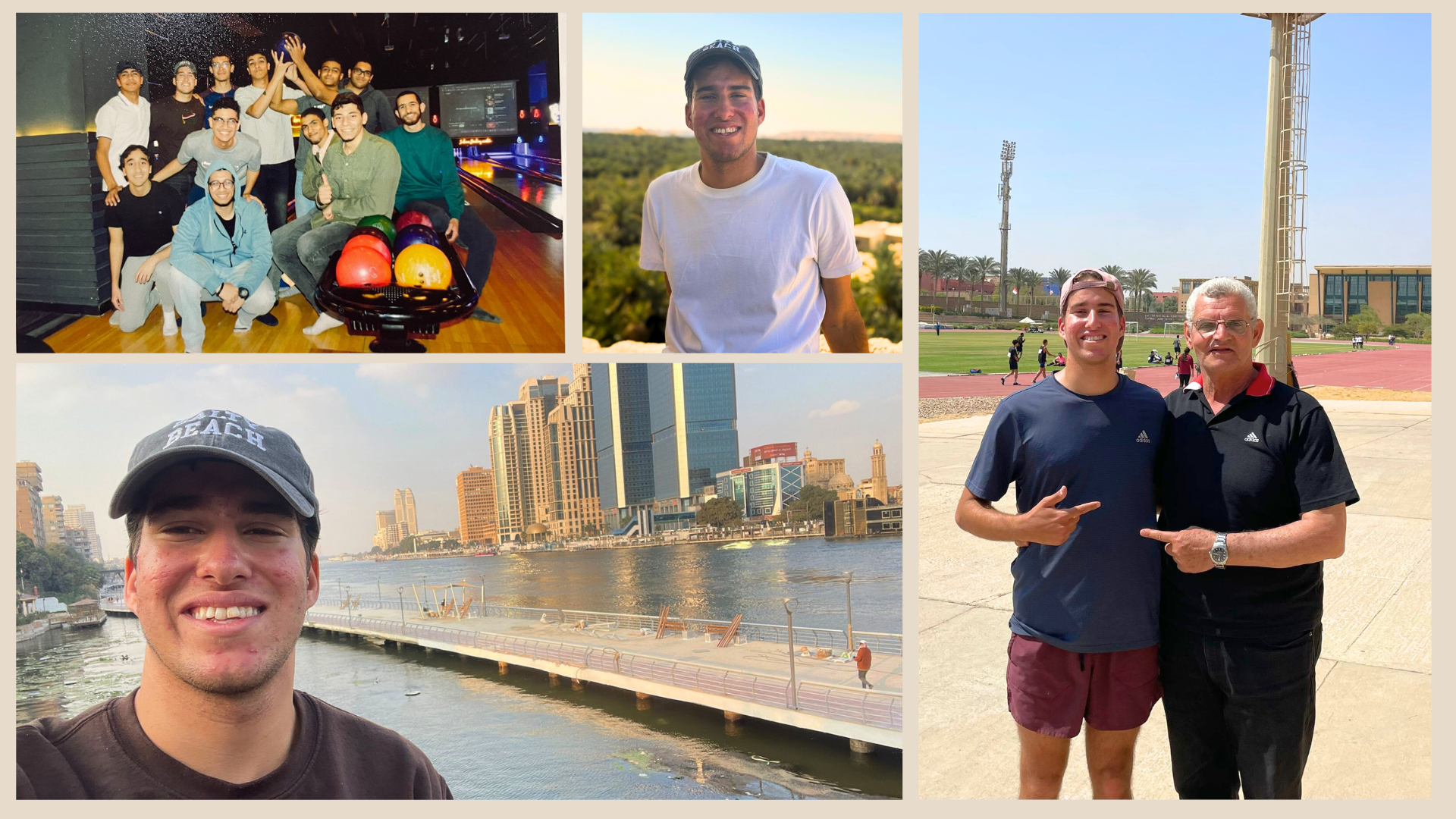
 

Collage of four images of Feldman: Feldman takes a selfie in front of the Zamalek promenade; Feldman in a group picture of Egyptian men at a bowling alley; Feldman in an outdoor heashot; Feldman at the AUC track, posing with an AUC coach. Note that Feldman wears a baseball cap in each of these images.
Share

Trendsetters

Trendsetters
Ioanna Moriatis, photos by Ahmad El-Nemr
<?xml encoding="UTF-8">

By Ioanna Moriatis, photos by Ahmad El-Nemr | This story appeared in the Spring 2018 edition of AUCToday.

As Mahatma Gandhi once said, "We but mirror the world. ... If we could change ourselves, the tendencies in the world would also change. ...We need not wait to see what others do."

AUCians definitely don't wait. They initiate and take the lead. You find them everywhere -- from business and education to technology and policymaking -- making a difference and leaving an impact, particularly when it comes to community building.

Education for the New Generation
 

A man poses with his arms crossed, smilingSeif Abou Zaid '08, '17, CEO of Mavericks school. Photo by Ahmad El-Nemr.

"I was always interested in education as a vehicle for liberation and empowerment," said Seif Abou Zaid '08, '17, CEO of Mavericks school. It's this understanding of education that led him to seek a new approach to schooling in Egypt.

Mavericks, Egypt's first blended learning school, was founded with an approach to education that focuses on personalized learning that fits the individual needs of students; an emphasis on hands-on activities that make the learning experience fun and engaging; character building; and open-house education, where students are not confined to the traditional classroom and all parts of the school are learning spaces. Students are empowered to make decisions starting in Pre-K and KG1, choosing where to learn and which activities to do during the day.

"We're not interested in comparing students to each other," Abou Zaid highlighted. "We want kids who accept themselves, have self-awareness, and challenge themselves and each other."

Though many praise the school for its blended learning techniques, this is just a tool, as Abou Zaid pointed out. "Actually, for us, blended learning is not the end game," he explained. "What's beyond blended learning is this idea of being child-centered, of following the child's interest and challenging students to be the best versions of themselves. If technology is a tool that can empower this, then so be it."

Having majored in political science, minored in history and earned a master's in public policy from AUC, Abou Zaid always focused on how he could make an impact on the community. "I was interested in the sweet spot or common ground between education as an empowering tool and public space," he said. "This is where I saw myself, hopefully, doing meaningful things."

Abou Zaid started out working on two startups before founding Mavericks, both targeting middle and high school students as well as middle managers. He quickly found that the impact at this stage wasn't what he wanted. "We wanted to build a different generation, empowering people to be mavericks -- or think outside the box -- and influencing the present and the future. This is what a student-centered learning experience is all about."

Hoping to expand the Mavericks model across Egypt's governorates, Abou Zaid established two campuses in Cairo and one in Damietta. The aim is to spread this new learning philosophy to the many students who still don't have access to quality education inside and outside of Cairo. "The impact we can have now is to set an example," he affirmed. "Later on, we're really interested in scale. We want to provide high-quality education, but at a scale that actually has the right impact for the millions or billions out there who deserve access."

Job Matching

20180424-_DSC1027Omar Khalifa '08 in front of the office for his online recruitment platform Shaghalni. Photo by Ahmad El-Nemr.

Education is one space in which impact can be made. But what happens after schooling ends? A major challenge in the Egyptian economy now is the large population of unemployed youth.

Omar Khalifa '08, CEO and founder of Shaghalni.com, saw a chance to expand opportunities for Egyptians by making the recruitment process and job market more transparent.

Through Shaghalni online platform, blue and grey-collar job seekers share their skills and experiences by posting their profiles and promoting their skills -- giving the chance for employers to hire them directly.

Khalifa's idea for the platform was sparked after observing AUC's successful employment fairs each year. "We have the best companies coming to campus," he said. "I never had a real issue finding a job. However, I always wondered, 'That's great, but the majority of working-class Egyptians don't all enjoy the same employment opportunities.'"

Shaghalni started out as a printed journal promoting middle-skilled jobs. Then, Khalifa switched things around, publishing individual profiles of job seekers for employers to browse. To have a real impact, though, Khalifa decided he was going to have to go online.
Although he faced difficulties raising funds at first, he eventually put his own money into creating a beta version to test out. Today, two years later, there are 90,000 users and 8,000 companies posting on Shaghalni's website, and a mobile app is in the making. "It proves that if you believe in something and you're passionate about it, things will actually work," Khalifa commented on his investment in the project. "If you don't put your money into it, no one will."

20180424-_DSC1075Khalifa's website now has more than 90,000 users and 8,000 companies -- connecting people with jobs across the country. Photo by Ahmad El-Nemr.

Now, Khalifa's passion is drawing him outside of Egypt, pushing him to continue growing and making changes in the job market.

"My passion is helping people," Khalifa asserted. "When you receive feedback and see people getting jobs -- these people have families; they aren't just individuals -- it's worth so much more than money. Shaghalni is successful in Egypt, but we want something that can go regional. We're nowhere near where we want to be, but I think we're making a difference. That's my passion."

 
Share