Home page
ع

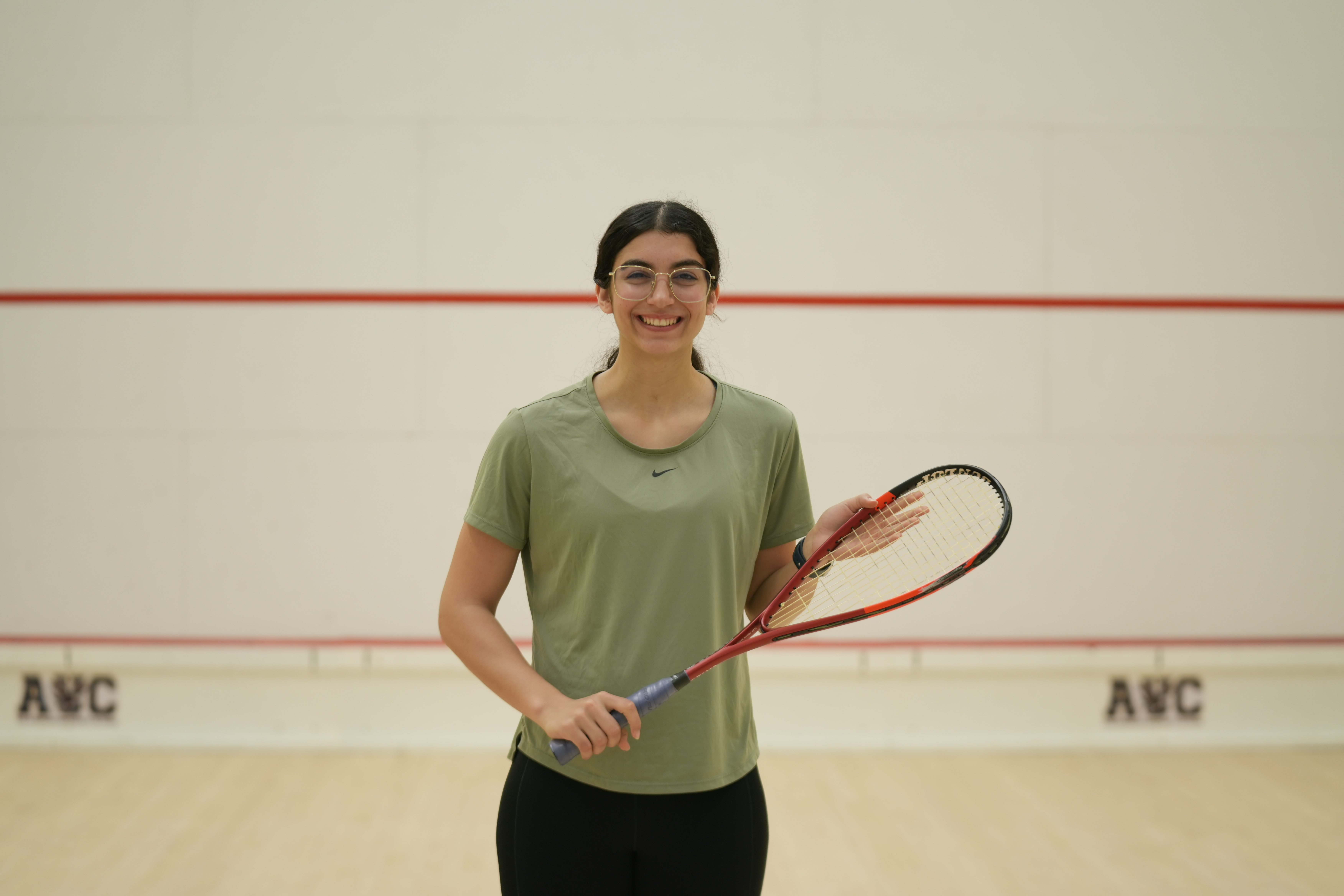
Meet Freshman Amina Orfi: World No.3 Squash Star

Amina Orfi attacks a squash ball with her racket
Olatunji Osho-Williams
March 5, 2026

Freshman Amina Orfi loves a tight shot, when the squash racket whips the ball straight along the wall, making it difficult to receive and react to. 

It’s a shot she’s practiced many times — and one of many that have brought her to be ranked third in the world in squash. 

Amina Orfi plays squash

“I love the process itself, training and getting better, fixing my mistakes and obviously the thrill of winning. That match point when you win a tough match — it's really what makes me happy."

In July 2025, Orfi became the first athlete to win the World Squash Junior Championships four times and in October 2025 became the youngest ever to reach world number 3. 

At 18 years old, she’s preparing for the 2028 Olympics in Los Angeles, where squash will make its debut as an Olympic sport, while balancing her first-year studies in economics as a recipient of AUC’s Excellence Scholarship. 

Keeping her vision aligned with her goals is the backbone a discipline Orfi applies to her academics and athletic goals. Managing a class-load, plus tournaments and training was a new challenge, but Orfi says communication with her professors has allowed her to hit her stride during her second semester at AUC.

Orfi chose to study economics to open new doors in the far future when she retires from squash. “I find it to be a bit interesting, and it's something I think I can balance well with squash,” Orfi said, “It's a very practical major.”

But for right now, she’s just getting started. 

Born to Play

Egypt is the home of international squash. International squash legends and the highest ranked players in the world hail from the courts of Om el Donia: current world No. 1 Hania El Hammamy ’23 and Asal Mostafa, No. 2 Nour El Sherbini, No. 5 Nouran Gohar ’21 and more call Egypt home. 

Orfi first picked up a racket at 5 years old and stuck with it. Youth squash in Cairo is a pressure-cooker, and Orfi began playing competitively at 8 years old in weeklong tournaments of 200 athletes playing to take the top rank. She says it's what created her competitive spirit.

Amina Orfi stands in a squash court

Squash is a sport where you and your opponent are trapped in a box, and only one person walks out the winner. It’s a mental game and the desire to win, cultivated in the courts of Cairo, has helped Orfi climb through international competitions in the United Kingdom, United States and Singapore.

She has won and lost matches against legends she grew up watching, winning against Nour El Sherbini in the semi-finals of the 2025 U.S Open Squash. Better known as ‘the Warrior Princess,’ El Sherbini is the current number 2 in the world and is currently tied for the world record of most women’s squash World Open titles.

“Seeing someone that you've been watching ever since you were growing up and finding them all over the news and social media, and then to compete and beat them, it meant a lot. It gave me a lot of motivation.”

Amina Orfi celebrates on a squash court.

“I really want to get to world number one and make the Olympics. Having these goals helps direct my mind in a positive way instead of thinking about the pressure.”

Orfi has spent over a decade of her life playing squash competitively, and her family has supported her all the way. “I know the amount of effort they put into this for me to achieve my dream. It means a lot to me, and I really enjoy when I win and see them proud,” Orfi said.

Orfi joined the professional circuit at 15, traveling more often and playing in professional environments with mature and experienced players five to ten years her senior. The switch was initially intimidating, but Orfi says what helped her adjust was knowing that as the young underdog, she had nothing to lose.

“I just wanted to play my best squash and show what I'm capable of,” she said. 

Amina Orfi reaches to stop a ball from hitting the ground on the squash court

Now that she’s aged out of being the underdog, Orfi faces a new pressure to keep her space in the top three and climb toward the first position. She practices six times a week to stay sharp, in two sessions a day alternating between drills, fitness and match play.

“I think it's more pressure, but having goals and things you want to achieve lifts that pressure because you don't think about it as much. You just think about what you want to do and what you want to achieve,” she said.

The next goal? Playing in the 2028 Olympics in Los Angeles, California.

“I really want to get to world number one and make the Olympics. Having these goals helps direct my mind in a positive way instead of thinking about the pressure.”

 AUC Excellence Scholar Amina Orfi is the third-highest ranked squash player in the world and an Olympic hopeful.

Share

Returning to Ramallah

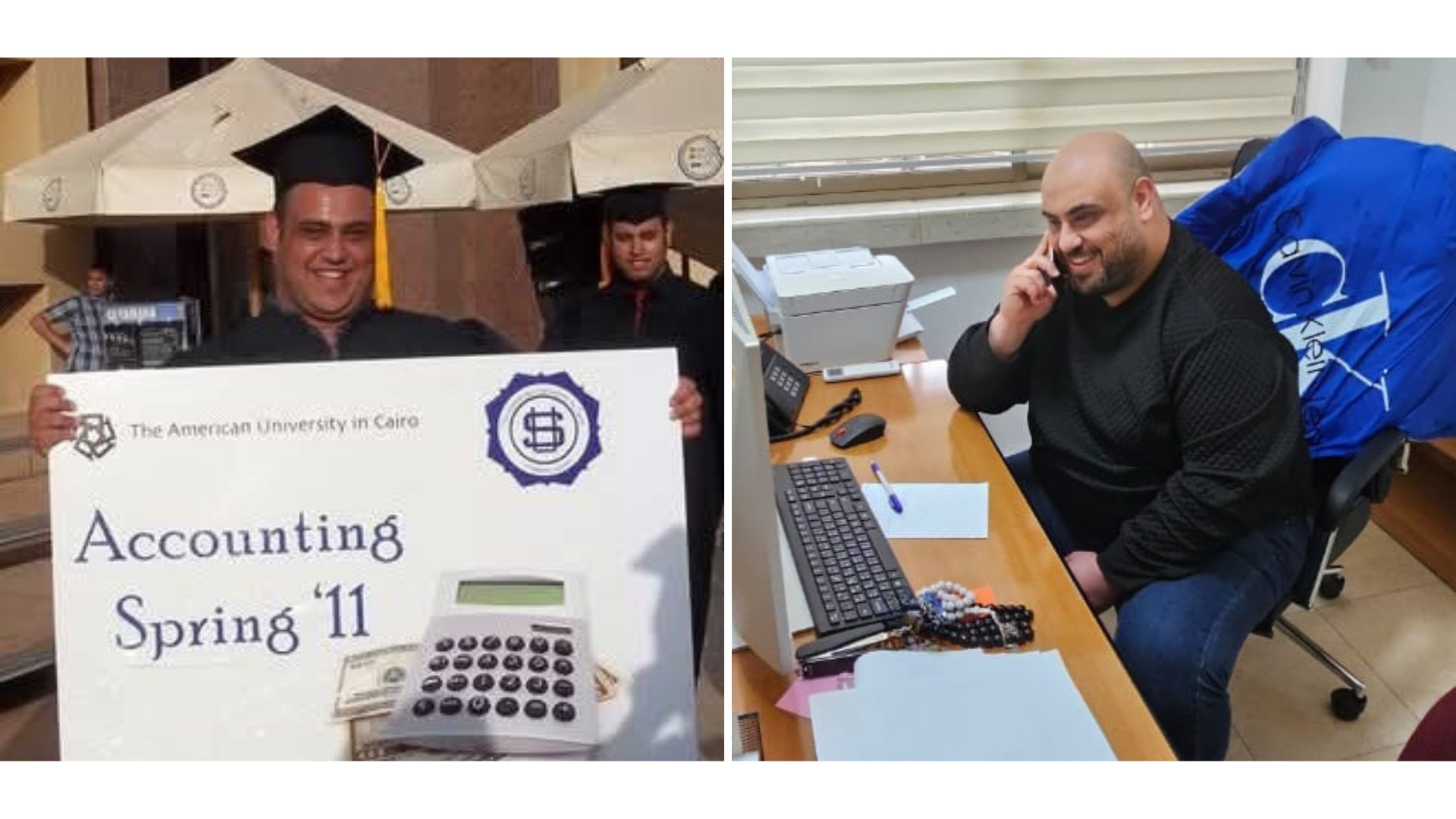
Mohammed Abuzaid at AUC graduation holding a large placard which reads "Accounting Spring '11"; another image of Mohammed Abuzaid at his desk
Olatunji Osho-Williams
March 11, 2026

Mohamed Abuzaid ’11 didn’t expect to attend AUC, but a fateful email from the registrar’s office changed his life.

“Living in Palestine, you don’t have that much luxury to put your kid in such a college,” Abuzaid said. Growing up in Ramallah, he heard good things about AUC from a friend who attended the University. Abuzaid emailed the registrar asking how to apply, but when he learned the tuition exceeded what he could afford, he let the registrar know it was out of budget. “They answered, ‘Why don't you apply for the Palestinian scholarship?’” he said.

Abuzaid was a recipient of the Taher Family Endowed Scholarship, established in 2005 by Abdulhadi Hassan Taher to support Palestinian students based on their financial need and academic merit. After learning about the scholarship, he and his friends in Ramallah applied together and were all admitted to the University. Two decades later, he says the decision changed his life. 

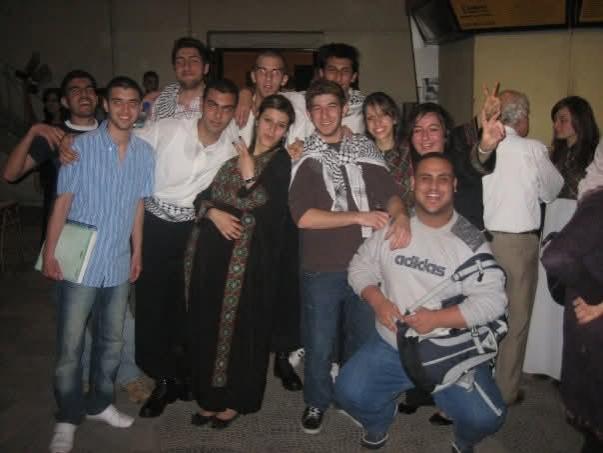
A group of students pose for a photo
Mohammed Abuzaid crouches and poses with other students at AUC.

""AUC got me to another level,” he says, “It made me a better critical thinker and gave me all the tools I need in work, life — everything.”

Today, he is the chief financial officer of Inash Al-Usra (Family Revitalization) Association in Ramallah, Palestine. The organization began in 1965 to support economically vulnerable Palestinian women and has since grown to one of the region’s oldest charities, offering funding initiatives, professional services and social welfare programs to Palestinians.

For Abuzaid, AUC’s education helped build the interpersonal and strategic reasoning skills he relies upon to do his work. “AUC got me to another level,” he says, “It made me a better critical thinker and gave me all the tools I need in work, life — everything.”

After graduating with a degree in accounting, Abuzaid weighed a postgrad job offer to work abroad, but his father’s wishes kept him in Ramallah. “My father told me ‘You need to pay back for your home country. After that, you can travel,’” Abuzaid reflected. 

Inash Al-Usra was the place where Abuzaid could combine his skill in corporate finance with his desire to do good. “I can see the financial health of the charity organization and distribute it to the people who really need it, ” he said.

"It’s more rewarding than any money in the world."

The work is challenging — over 100,000 people receive benefits from Inash Al-Usra’s expansive programs. The nonprofit sells traditional handicrafts produced by Palestinian women, does charity, operates restaurants and orphanages, provides scholarships and serves community members across Palestine. 

Since the war in Gaza began, the organization has faced even more challenges. Abuzaid and his colleagues maintain a list of co-workers killed during the conflict. They work to feed people in refugee camps, take in orphans and support community members.

“The economic situation here is a struggle, so you have to believe it when someone enters your office and tells you ‘I haven’t eaten in a week; I need anything.’” Abuzaid said.

With its challenges, the fulfillment he gets from supporting his city and country is more than anything he could ask for. 

“It’s more rewarding than any money in the world,” Abuzaid affirmed. 

Mohammed Abuzaid holds a Palestinian flag in front of a crowd.
Mohammed Abuzaid holds the Palestinian flag in Bartlett Plaza.

The University continues to offer numerous donor-funded, named and endowed scholarships to support Palestinian students today. Most recently, the Richard Brow and Angela Seay Palestinian Scholarship and Wasef Jabsheh '67 Palestinian Endowed Scholarships were established in 2025 to support the tuition of Palestinian students from Gaza. Learn more about scholarships at AUC.


An AUC scholarship sent Mohamed Abuzaid ’11 on the path to supporting his community in Palestine.

Share

Hub of Hustle

students sitting on a couch in the innovation hub
Zoe Carver

Just past the New Cairo campus portal stands a sturdy brick building housing the University’s hub for academic-industry collaborations: the AUC Innovation Hub. Inside, startups, multinationals and corporates work alongside students on real-world professional projects, without ever having to leave campus.

Smart tables, reservable offices and a gaming station fill the hub, where students and industry leaders meet, prototype and work with emerging technologies. All nine companies currently partnering with the AUC Innovation Hub fall within three focus areas: digital transformation, artificial intelligence and sustainability. 

Dalia Abd-Allah, senior director of the AUC Innovation Hub, knows that providing students with experiential learning is essential to making them competitive young professionals. “Our aim is simple yet bold: to make AUC a place where innovation actually happens, where companies can work through real challenges and students gain practical experience along the way,” she said.

View of the innovation hub lobby from the second floor
Students at the Innovation Hub turn bold ideas into real-world solutions

AUC architecture senior Maya Saad described the opportunities she gained while working at LAYN, an Egyptian startup specializing in 3D concrete printing and one of the Innovation Hub’s industry partners. “I got to develop my programming skills by actually working on projects that used the design programs I’d been learning about in class,” Saad explained. “When you work for a startup, you get to see how modeling functions in reality.”

LAYN operates partially out of the Innovation Hub and offers internships and curricular and noncurricular programs that immerse students in real-time innovation problem solving. Sama Abdelsayed, an architectural engineering student, reflected on her participation in the micro-internship program. “I learned a lot from the experience at the Innovation Hub about how my career doesn’t have to be dull or traditional,” she stated. “It is living proof that there are new ways to use our creativity and create successful collaborations between different companies.”

BluEV office meeting in the innovation hub
Industry collaborators bring their knowledge and projects to AUC, connecting with students

Two of the Innovation Hub’s partners, LAYN and SODIC, have collaborated with courses at AUC, including the Digital Design Studio and Workshop in the architecture department. Fatma Farrag ’19, ’23, senior computational designer at LAYN, is also an instructor for the course. “Normally in the classroom, we’re very limited to small models because so much of our work is experimental,” she explained. “But by partnering with LAYN, students are able to build actual prototypes. They get to see the application of their theoretical knowledge in a way that is essential before entering the field.”

“I got to develop my programming skills by actually working on projects... When you work for a startup, you get to see how modeling functions in reality.”

The architecture students designed and prototyped a pavilion using LAYN’s 3D concrete printing technology. They completed site visits, worked with professional software and participated in a jury review with judges from both LAYN and SODIC.

With so many companies collaborating in the same space, new partnerships are forming and finding creative ways to engage with students. “We’re all able to grow together — us as startups and the students as future professionals,” Farrag added.

Another partner, Blu EV, works in electric mobility and operates a battery-swapping platform for electric light vehicles. Students collaborated with the company on battery management challenges.

“I feel astonished by the quality of the solutions that were introduced by the students,” said Rida Baalbaki, CEO of Blu EV. “For them, it was exciting to have that sort of hands-on experience, and for us, the students are exceptional. This partnership creates real value for both AUC and the tech sector.”

Share

Business Education 2.0

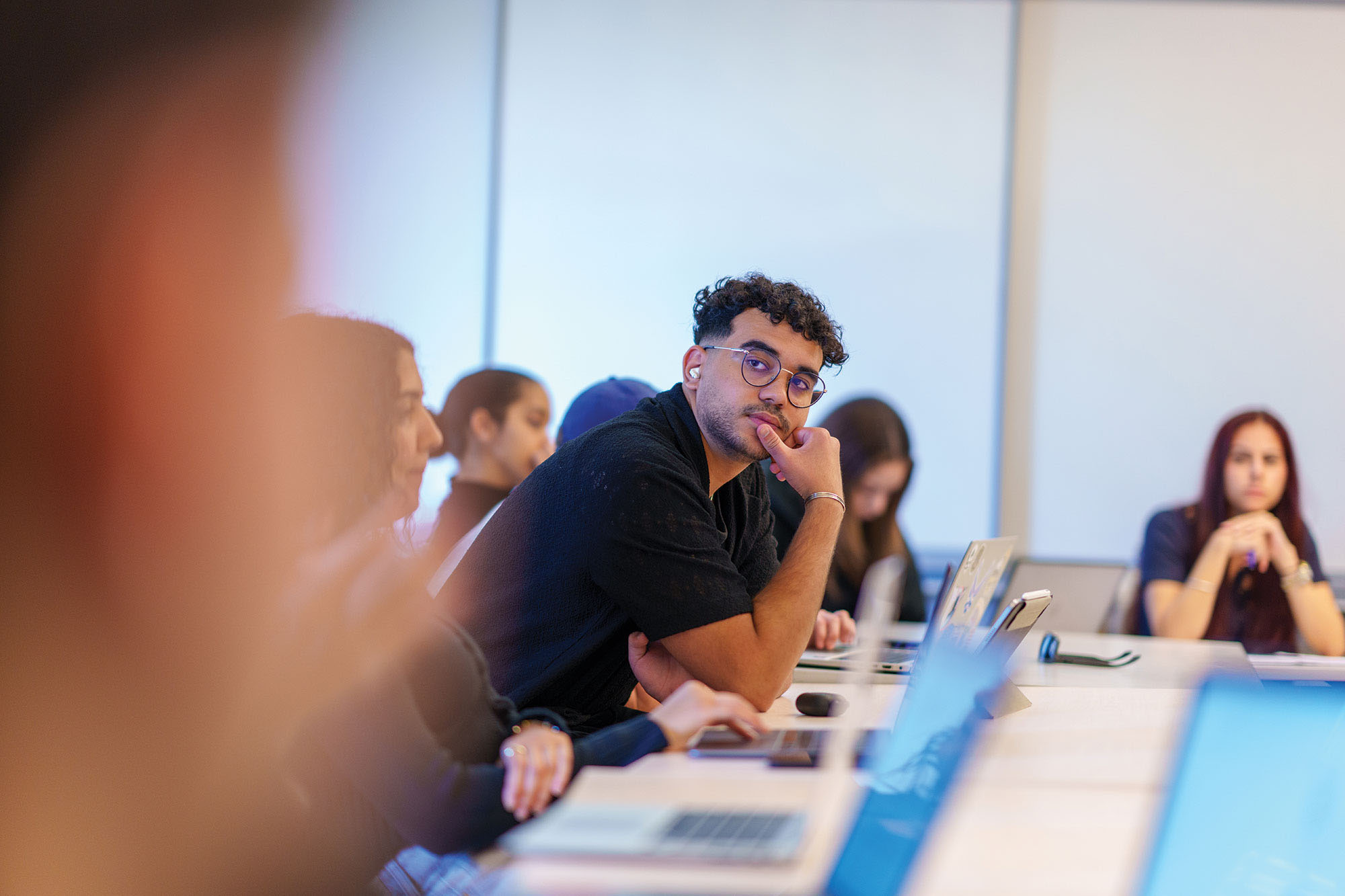
a boy in the classroom
Dalia Al Nimr

What are some of the biggest shifts in business school education?

The focus of business schools almost two decades ago was to produce leaders who transform corporations, boosting profit. Revenue was the prime goal. Now, business schools not only look at shareholder interest but also stakeholder interest — in other words, pressing societal concerns, such as sustainability, climate change, ethics, diversity, inclusion and governance. This represents a complete shift in business education around the world, and every school — from Africa to North America and around the world— is looking at how to consistently modify the curriculum to be timely and relevant. Shareholders are still key, but it’s all part of a bigger communal interest, now dubbed as social impact. This reflects the new role of business schools as a convener: a connector of stakeholders and an initiator of conversations around both global and local issues.

Now, business schools not only look at shareholder interest but also stakeholder interest — in other words, pressing societal concerns, such as sustainability, climate change, ethics, diversity, inclusion and governance. 

What challenges do business schools face in keeping their programs relevant?

The main challenge is working effectively within the market matrix. Some 40 years ago, business schools were looking at verticals, mainly disciplines that encompass marketing, finance, accounting, management, IT, strategy and HR. Twenty years later, they started examining horizontals, such as digital transformation, sustainability, data science, innovation, governance and others, and how they intersect with and complement the management verticals. But now, even this matrix, with the intersection between the verticals and horizontals, is not enough. We need to examine the implications on a variety of areas, including business, trade, services, industry, globalization and talent transfer. The difficulty lies in developing an adaptable curriculum that remains valid and relevant in this ever-changing landscape.

The difficulty lies in developing an adaptable curriculum that remains valid and relevant in this ever-changing landscape.

Do you see AI as a friend or foe?

AI has been around for much longer than many people realize, from Winston Churchill’s 1943 underground Cabinet War Rooms that housed the British government’s command center during World War II to human-computer interaction and expert systems in the 1980s to AI as we know it today. It has been gradually affecting our lives and is here to stay. In fact, we’re still scratching the surface. In education, AI affects not just what and how we study but also the facilities and resources available, enhancing productivity and efficiency — and it’s going to mature more and more. These are all positives, of course, but the downside is that AI raises concerns around issues such as ethics, bias, intellectual property rights, accuracy and trustworthiness. The key is learning to use it responsibly. In business education, AI is preparing students to lead in a fast-paced, tech-driven world. AI will not replace humans, but students who are better trained, educated, exposed and adapted will replace those who lack these fundamental skills. I like to think of it as augmented human intelligence backed by advanced technological innovations. It is not artificial.

Why would a business student choose to study business in Egypt instead of the United States or Europe?

Internationalization is not just confined to students traveling and studying abroad; it is an ecosystem. What we do here at AUC — similar to many business schools worldwide — is create cross-cultural exposure for students through international faculty, transnational case studies, incoming international students, global competitions and joint capstone projects in collaboration with other universities. For instance, our Doing Business in the Middle East program, now in its 16th year, gives AUC students the opportunity to interact firsthand with their peers  from prominent institutions around the world, including the University of Chicago, Harvard University, Princeton University, the University of Pennsylvania, Manchester Metropolitan University, China Europe International Business School and McMaster University. Students from both sides exchange perspectives on current business issues in the region through academic classes by our faculty experts, visits to industries and NGOs, as well as meetings with business executives, entrepreneurs, alumni and government officials. AUC students, in turn, also visit business schools in other countries and benefit from the same global experience.

What we do here at AUC — similar to many business schools worldwide — is create cross-cultural exposure for students through international faculty, transnational case studies, incoming international students, global competitions and joint capstone projects in collaboration with other universities.

How do you see business education evolving in the next decade?

The future of business education will highly depend on the intersection of people, technology and data. Just as open working spaces are becoming prevalent, there will be open learning spaces. Less time will be spent in the classroom, and more time will be spent off campus in companies, factories, as well as civil society and community development organizations. Business schools and higher education at large are going to be completely different. The knowledge is there online, so what can faculty uniquely offer that students don’t already have access to? It’s the critical thinking approach that they bring to the classroom. Faculty will not deliver content but will instigate conversations to come up with solutions, and this will be enhanced through hands-on programs such as Cooperative Education (Co-Op), internships and experiential learning opportunities. This approach — teaching students how to think, not what to think — develops leaders who are innovative, adaptable and creative problem solvers.

This approach — teaching students how to think, not what to think — develops leaders who are innovative, adaptable and creative problem solvers.
 

During Sherif Kamel’s tenure as dean, the Onsi Sawiris School of Business earned its triple crown accreditation, placing it among the top 1% of business schools worldwide; maintained its Financial Times global ranking in executive education; and expanded its international footprint through new partnerships and affiliations. Kamel has championed innovation in teaching and learning, launching the region’s first Co-Op Program as well as integrating sustainability and global challenges into the curriculum. He is the immediate past chair of the board of directors of the Association to Advance Collegiate Schools of Business and serves on the board of directors of the Central Bank of Egypt. A renowned scholar, Kamel published his debut book, Leading Change in Challenging Times: Lessons of Disruption and Innovation in Egypt, a collection of his reflections and observations on the school’s institutional history as well as business leadership advice.

Share