The Ethnographic Survey of Nubia
Documenting Nubian Culture and Traditions
The Social Research Center in Old and New Nubia, 1961-1975
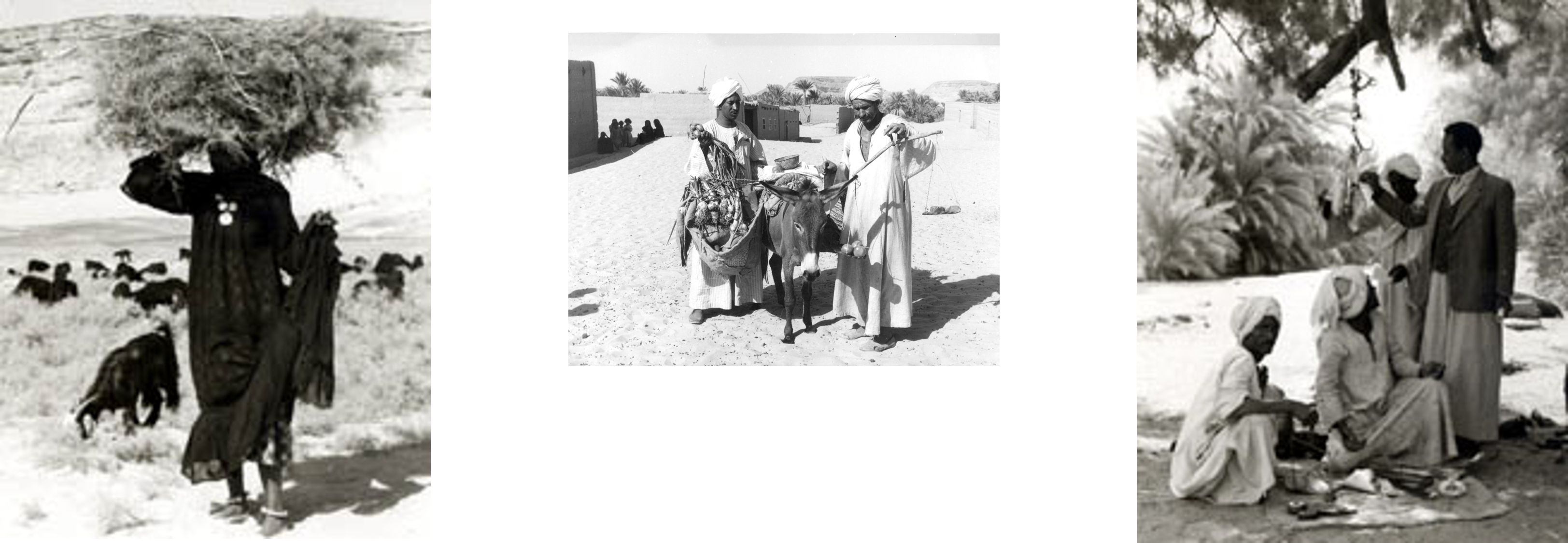
The Social Research Center was engaged in a pioneering ethnographic survey of Nubian villages, their livelihood, customs and architecture. It documented a unique moment prior to the Nubian move to a new location after the construction of the Aswan High Dam. The dam provided a more dependable supply of irrigation water to Egypt, and the government supported projects to extend cultivation and settlement beyond the densely settled Nile Valley and Delta. Social Research Center studies also explored the process of this settlement and how migrants adapted to their new surroundings.
The Ford Foundation financed the two Nubian projects, which were a major activity of the Social Research Center in the 1960s. The Ethnographic Survey of Egyptian Nubia (first phase: from 1961 to 1963) studied the livelihood, customs and other aspects of the distinctive and creative Nubian culture before the people moved to a new location. There are three distinct linguistic areas of Egyptian Nubia: the Kenuzi-speaking area in the north, the central Arabic-speaking area and the Mahasi area in the south. Researchers studied settlements in each of these areas. As over half of the people who called themselves Nubians worked outside Nubia, researchers also studied Nubian families who had migrated to work in Cairo and Alexandria. Some Nubians had moved voluntarily to the area around Kom Ombo, north of Aswan, after their lands in Nubia had been flooded in 1933. In one of these villages, known by the pseudonym Kenaba, researchers explored changes that had occurred in the community in the 30 years since the villagers had left Nubia.
The Ministry of Culture and Guidance seconded Abdul Fattah Eid, the Egyptian professional photographer, to the Ethnographic Survey. The well-known Egyptian architect Hasan Fathy also worked alongside the Social Research Center team.
Researchers also studied the two Nubian languages, Kenuzi and Mahasi. Organizers held a Symposium on Contemporary Egyptian Nubia in Aswan in January 1964 to present the major early findings of the Ethnographic Survey (see the bibliography).
This first phase of the project focused on the process of anthropological research: photographs of the research activities taken by researchers, the daily field notebooks and typed notes, as well as formal research reports and some of the many publications that resulted from the work. In the 1960s and 1970s, fieldwork was fairly low-tech; most photographs were black and white, and there was not a computer in sight. Participating researchers and Nubians living in Cairo have generously loaned Nubian artifacts that date from the time of the research. These are significant because the ways of making and decorating jewelry and household objects have changed in the last 40 years.
The second phase of the Nubian project, from 1963 to 1970, focused on the process of settlement and the adjustment of the Nubians after their resettlement in Kom Ombo, north of Aswan. Here, the Egyptian government provided houses, utilities and irrigated land for the cultivation of sugarcane, a cash crop useful for national development. Research in Kom Ombo continued until 1975 as part of the larger Social Research Center project, A Study of Newly Settled Communities: The Abis Area in the Northwestern Nile Delta and Kom Ombo, Upper Egypt, which looked at the process of settlement in other areas of Egypt. During 15 years of work, researchers were able to document the surviving Nubian culture and the social and cultural changes that occurred after people had moved to their new homes.
Reviving the Nubian Projects (most Recent Publications)
Nubian Encounters: The Study of the Nubian Ethnographic Survey 1961-1964
Edited by: Nicholas S. Hopkins and Soheir R. Mehanna
Project Title:
The Ethnographic Survey of Nubia
Project number: SRC # 1961-1
Type of project: Research
Date:
- Phase I: February 20, 1961 - February 19, 1963
- Phase II: September 11, 1963 – December 31, 1970
Donor:
- Project number: Amount
- Phase I: Ford Foundation; 06100115; $100,000
- Phase II: Ford Foundation; 06300518; $65,000
Researchers:
Name: Robert A. Fernea
Title for purpose of project: PI
Institutional affiliation(s): SRC
Academic discipline: Anthropology
Project Title:
A Study of Newly Settled Communities: The Abis Area in the Northwestern Nile Delta and Kom Ombo, Upper Egypt
Project number: SRC # 1971-2
Type of project: Research
Date: 1971-1975
Donor: Grant Number; Grant amount
Division of International Activities, Office of Research Demonstrations and Training, Social and Rehabilitation Service. Department of Health, Education and Welfare, Washington, D.C.
Grant number: 19-P-58018-F-01
Grant amount: $106,000
Researchers:
Name: Helmi Tadros
Title for purpose of project: Co-PI
Institutional affiliation(s): SRC
Academic discipline: Anthropology
Name: Hussein Fahim
Title for purpose of project: Co-PI
Institutional affiliation(s): SRC
Academic discipline: Anthropology