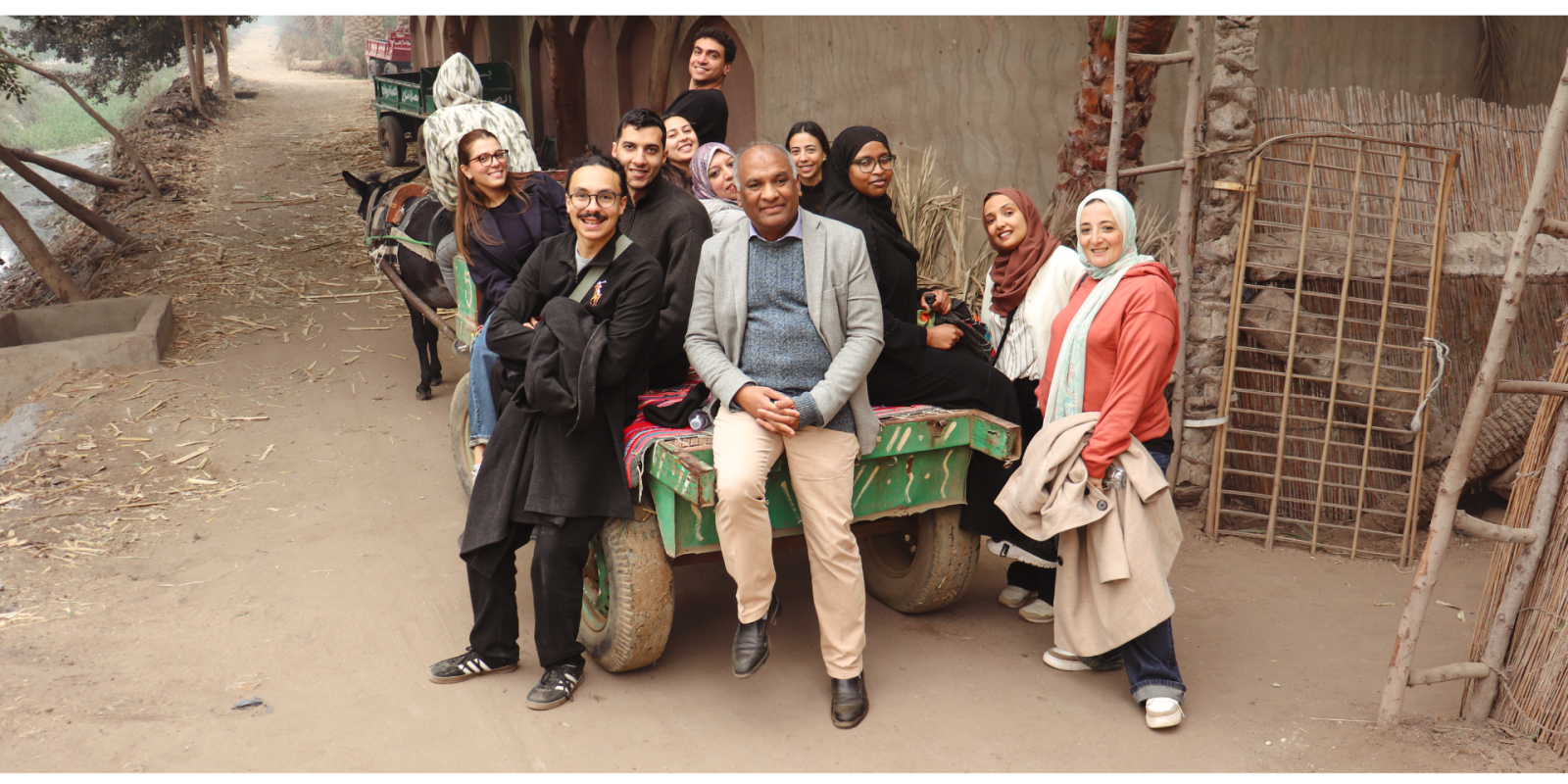
Practicing Public Policy in Dahshur
Master's students learn about local governance and development through a winter course lead by professor Shahjahan Bhuiyan.
Master’s students in the Governance and Development course immersed themselves in real-world governance during a field visit to the Badrashin district in the Giza countryside, witnessing firsthand how community-driven efforts advance sustainable agriculture and tourism.
“A field visit to a model farm in Badrashin helped me form a clear vision about the concept of governance and how to effectively apply it, which reinforced the principle that good governance is the way to sustainable development and building a better future,” said Noha Ragab, a public policy and administration student in the class.
Designed as an experiential learning course, students explored topics including good governance, public sector innovation in the age of AI, poverty alleviation, decentralization, climate change and barriers to achieving Sustainable Development Goals. They combined classroom learning with interactive, hands-on activities, such as analyzing a COVID-19 vaccine equity article, conducting a group case study on employment services, participating in guest lectures by international scholars, organizing a roundtable and visiting Dahshur, Badrashin to observe a co-governance initiative in sustainable agriculture and tourism implemented by the Dashur Tourism Development Association in support of the Greenish Foundation.
“The class was so engaging that all of us were motivated to join [this] completely optional field trip all the way out to Dahshur in the Giza countryside,” said Mohammad Badawi, another public policy and administration student in the course. “Stepping out of the classroom to interact with professionals applying these exact concepts in real life was incredible.”
Shahjahan Bhuiyan, professor in the Department of Public Policy and Administration and course instructor, explained the purpose of the visit. “It closely complemented the case study developed by students on co-production, allowing them to see theory translated into practice,” he said.
The course also featured several distinguished guest speakers. Faculty from Carleton University in Canada, New York University in the United States and the University of Cambridge in England delivered lectures on topics such as public sector innovation, urban governance, as well as decentralization and climate change. “Getting to interact with active professionals and world-recognized experts and hear such rich, on-the-ground information made the complex material really click,” said Badawi.
"This course was able to foster deep discussions about key issues and definitions in governance and development," shared Christiane Khouzam, who took the course as well. "It sparked conversations not only within the classroom but also with leaders and practitioners in the sector. Additionally, despite being a short semester, the course was able to hold a diverse pool of learning models. Dr. Shahjahan incorporated a roundtable discussion, site visit, research papers, and dynamic class debates. This diversity of formats kept the sessions engaging and allowed us to approach governance and development from multiple perspectives."
Students also organized a roundtable on the governance and development paradox, with faculty from the University of Dhaka in Bangladesh and professionals from the Sawiris Foundation for Social Development in Egypt providing practical insights and responding to student questions. Reflecting on both the conceptual frameworks and hands-on experiences, students learned that governance and development are mutually reinforcing forces and effective governance fosters sustainable development– contributing to the broader advancement of the human condition.
"Through a range of carefully designed exercises, this course equipped students with the knowledge and skills to concisely connect personal insights with academic concepts in analyzing real-life problems,” Bhuiyan noted. “Students engaged in practical case study analysis and, through a field visit, examined how theory and practice often diverge in everyday contexts. Altogether, these components enriched their practical understanding and strengthened competencies essential for both their personal development and professional careers."
