Home page
ع
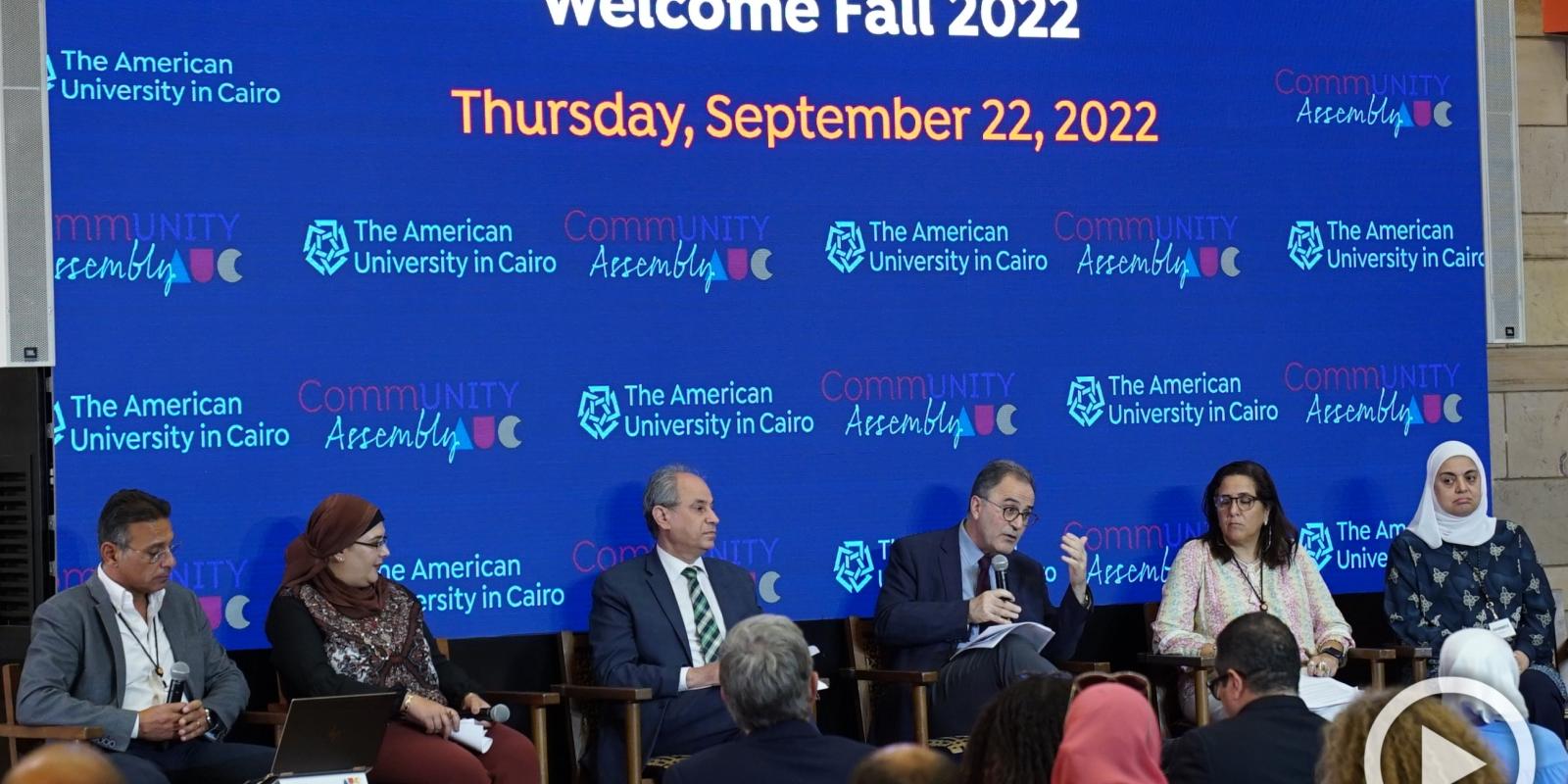
Panel at Campus Conversation

Campus Conversation: Welcome Fall 2022

September 25, 2022
University News

The first Campus Conversation of Fall 2022 took place last Thursday, September 22. Here are the main takeaways:

  • President Ahmad Dallal highlighted five main priority areas for AUC:
    • Launching a University-wide initiative, "Programs of the Future," to rethink academic programs, with the introduction of new interdisciplinary programs that address emerging trends
    • Enhancing the level of service for students not only on an academic level, but also in terms of student life 
    • Reintegrating AUC Tahrir Square into the campus culture of the University 
    • Building connections with Egypt through partnering with national institutions and spearheading academic programs that cater to community needs
    • Fine-tuning operations to model integrity and efficiency
  • As of Tuesday, September 27, the self-check tool will no longer be required to access campus. It will only be used to report symptoms. 
  • Masking is now optional on AUC campuses and buses. 
  • Visitors must still provide proof of vaccination, and athletic facilities will be open to all AUC community members. 
  • It has been officially confirmed that an AUC delegation will attend COP27 this November to showcase the University’s climate change research and initiatives. 
  • The Mental Health and Well-Being Initiative task force will be working this fall to collect community ideas, evaluate current support mechanisms and recommend measures.
  • The Office of Human Resources has introduced a new competency-based performance management system for staff members modeled on best practices at American universities. Training sessions for the new system will be held in English and Arabic this week.
  • In response to questions:
    • Visitors are now allowed in the dorms. 
    • AUC will not lose any student due to an inability to pay tuition.
    • Rewarding employee performance will be through a merit system, not promotions and restructuring, to avoid unnecessary expansion of the workforce. This is in line with best practices of academic institutions.
    • The University is undertaking an initiative to assess salary scales.

Related stories

IMF Director Jihad Azour speaking at an AUC podium
June 11, 2025

IMF, AUC Wrap Up First MENA Economic Research Conference

Following two days of high-level dialogue and expert analysis, the inaugural IMF MENA Economic Annual Research Conference co-organized by the International Monetary Fund and AUC, concluded with a strong call for coordinated, evidence-based policy responses to the region’s old and new pressing economic challenges. Held on May 18–19, 2025, the conference served as a critical platform for advancing rigorous research tailored to the realities of the Middle East and North Africa. It brought together global policymakers, academics, government officials and thought leaders to bridge the discussion on global economic issues with regional realities. The event marked a first-of-its-kind collaboration between the IMF and a leading University in the region, reflecting a shared commitment to deepening the link between academic research and policy development.  "This is about generating ideas that are globally informed but deeply rooted in the realities of our region."Jihad Azour, director of the IMF’s Middle East and Central Asia Department, noted that trade tensions and increasing uncertainty affecting the global economy, alongside ongoing regional conflicts and climate risks, are creating new layers of complexities for MENA policymakers. Azour called for building a regional platform for dialogue and exchange of ideas that connects MENA to world-class research centers to provide reliable analysis and develop workable and innovative policy responses to old and new economic issues facing the region. “We are deeply grateful to President Ahmad Dallal and AUC for their commitment to fostering dialogue, research and policy innovation in the region,” Azour said.AUC President Ahmad Dallal highlighted the event’s role as a vital platform in fostering collaboration between governments, academia and the private sector. "This is about generating ideas that are globally informed but deeply rooted in the realities of our region," Dallal noted.Dallal affirmed that this type of multi-stakeholder engagement is at the heart of AUC’s mission and reflects the University’s commitment to research, education and open dialogue as drivers of stability, resilience and inclusive growth.“We are deeply grateful to President Ahmad Dallal and AUC for their commitment to fostering dialogue, research and policy innovation in the region." Under the theme “Steering Macroeconomic and Structural Policies in a Shifting Global Economic Landscape,” discussions centered on four pivotal issues shaping the future of the MENA region and the global economy:Fiscal Policy: With public debt at historic highs, experts stressed the importance of rebuilding fiscal buffers while tackling social inequalities, aging populations, and climate pressures. Proposals included reforms in fiscal frameworks and measures to mobilize revenues, including through multinational taxation and more progressive tax systems.  Monetary Policy: Participants reflected on the lessons of recent inflationary shocks, emphasizing the need for more preemptive and well-communicated policy responses to global shocks and sector-specific disruptions, particularly for emerging markets.Industrial Policy: Speakers examined the renewed interest in industrial policy as a tool to drive inclusive growth, innovation, and climate resilience. The discussion highlighted the need to balance vertical strategies with horizontal reforms that promote private investment, trade integration, and productivity.Green Transition and AI: The intersection of climate action and digital transformation sparked debate about their potential to reshape labor markets. Recommendations included investing in human capital, developing targeted safety nets, and aligning policy tools to support job creation in low-emission sectors.Throughout the sessions, there was a clear consensus that the MENA region’s economic resilience depends on institutional reforms, cross-border cooperation, and investment in skills and innovation. Participants also underscored the importance of embedding policy in local realities — an approach that both the IMF and AUC pledged to champion moving forward.In addition to prominent global and regional academics, as well as economists and government officials from across the region, and representatives of international and regional organizations, the conference brought together policymakers, including Egypt's Minister of Planning, Economic Development and International Cooperation Rania Al-Mashat '95; Youssef Boutros-Ghali, member of the Specialized Council for Economic Development; Mahmoud Mohieldin, United Nations special envoy on financing the 2030 Sustainable Development Agenda; and Martin Galstyan, governor of the Central Bank of Armenia.As Nigel Clarke, IMF deputy managing director concluded, "This conference is a milestone demonstrating the IMF's commitment to deepening engagement with the research and academic community, as we strive to ensure that the IMF support is not only responsive to the needs of member countries, but also built on rigorous tested analytics and importantly, it's aligned with local realities. Through this kind of multi-stakeholder dialogue, we aim to better understand how all our expertise and resources can be directed towards the most pressing challenges of the region.”Visit the conference website for more details and to watch Day 1 and Day 2 of the discussions. Mahmoud Mohieldin, United Nations special envoy on financing the 2030 Sustainable Development Agenda; Egypt's Minister of Planning, Economic Development and International Cooperation Rania Al-Mashat '95; and Youssef Boutros-Ghali, member of the Specialized Council for Economic Development
Global connections
Senior officials from AUC, including the president and provost, sit and stand at a table to sign a memorandum of understanding.
May 12, 2025

AUC Launches Egypt's First Process Safety Management Diploma for Energy Sector

AUC, the Ministry of Petroleum and Mineral Resources, and Methanex Egypt are collaborating to launch Egypt’s first Process Safety Management (PSM) professional diploma for the oil, gas and petrochemical sectors. The diploma will be offered through AUC’s Engineering and Science Services (ESS) at the School of Sciences and Engineering. AUC’s Department of Petroleum and Energy Engineering, ESS and Methanex Egypt — the sole producer of methanol in the country — jointly developed the curriculum for this diploma, which aims to provide industry professionals with the knowledge and skills necessary to apply the 24 PSM standards and guidelines adopted by the sector.  “Together, this partnership offers a robust academic and training program that will prepare a new generation of specialists committed to operational excellence and the highest safety standards."“As Egypt develops its natural gas and petrochemicals sector to drive long-term growth, safety is a top priority,” said AUC President Ahmad Dallal. “It is part of our mission to foster knowledge translation through collaboration and support, building technical competence in Egypt and the region.” Egypt’s Minister of Petroleum and Mineral Resources Karim Badawi noted that this diploma is the result of a distinguished tripartite partnership between the ministry, with its highly qualified human resources; AUC, with its prestigious academic legacy; and Methanex Egypt, with its extensive international experience in process safety. “Together, this partnership offers a robust academic and training program that will prepare a new generation of specialists committed to operational excellence and the highest safety standards,” Badawi said. “By combining our academic strengths with industry expertise, we are helping to shape a safer and more sustainable future for Egypt’s energy sector.”The partnership enhances cooperation between the public, private and academic sectors to establish a strong culture of process safety management, develop individual capabilities, build technical competence in these sectors and boost institutional knowledge to support the local economy in line with Egypt Vision 2030.“We are honored to join forces with the Ministry of Petroleum and Mineral Resources and Methanex Egypt on this important initiative,” said Lotfi Gaafar, dean of AUC’s School of Sciences and Engineering. “By combining our academic strengths with industry expertise, we are helping to shape a safer and more sustainable future for Egypt’s energy sector.”Mohamed Shindy, managing director of Methanex Egypt, also highlighted the importance of this step. “We are not only strengthening our partnership but also investing in future generations for a safer, more resilient future for the entire sector.”
Civic Engagement
Members of the Sawiris family, senior AUC leadership, ministers, ambassadors and other notable figures standing in front of the Onsi Sawiris School of Business at AUC
January 6, 2025

Legacy of Excellence: AUC Celebrates Naming of Onsi Sawiris School of Business

Along with the Sawiris family, AUC celebrated the naming of the Onsi Sawiris School of Business in a special ceremony on the New Cairo campus on January 6. The school was named in honor of the late Onsi Sawiris, a titan of business in the Middle East, founder of the Orascom Group and patriarch of the family, in appreciation and recognition of a transformative gift from the Sawiris family. The single largest philanthropic gift in the institution’s history, it provides funding to support excellence in business education.“For the first time, a school at the University is to be named, and it is fitting that it honors Onsi Sawiris — a man who embodied a deep love for Egypt, visionary business acumen and an unwavering commitment to education,” said Mark Turnage (ALU ’82), chair of AUC’s Board of Trustees, at the ceremony. “On behalf of the Board of Trustees, I extend our deepest admiration and appreciation to the Sawiris family: We thank you for your extraordinary generosity, your trust and your partnership.”“For the first time, a school at the University is to be named, and it is fitting that it honors Onsi Sawiris — a man who embodied a deep love for Egypt, visionary business acumen and an unwavering commitment to education."AUC President Ahmad Dallal also paid tribute to the enduring Sawiris legacy. “We are here to honor the late Onsi Sawiris — a visionary leader of industry and business whose legacy is carried forward by his three sons, grandchildren and the thousands of people who have been touched by the Sawiris family. Onsi Sawiris was not merely a businessman; he was a pioneer who transformed the way we think about business, leadership and innovation. Despite the many obstacles that lay in his path, Onsi saw opportunities where others saw only barriers.”The funding will impact the school and its different stakeholders in several ways. It will provide scholarships for students, facilitate interdisciplinary research for faculty, establish a professorship in artificial intelligence and data science, and support visiting faculty and student exchange programs with several leading U.S. business schools and universities, including the University of Chicago –– one of the top worldwide. These collaborations will enable AUC and partner institutions to tackle pressing global issues, such as climate change and economic fluctuations, through multidisciplinary research and best practices, producing graduates who are globally informed, culturally sensitive and driven by innovation. “Our partnerships with leading American universities will create pathways for students of the Onsi Sawiris School of Business to develop a global mindset, a nuanced regional understanding and interdisciplinary skills essential to tackling the challenges of the future,” said Dallal."Bonds with AUC have also served to reinforce and extend the historic connection between Egypt and UChicago."Melina Hale, dean of the College at the University of Chicago, highlighted the transformative impact of the Sawiris Scholars Program at UChicago and other U.S. universities: "The University of Chicago has been fortunate to witness while we are celebrating here today the extraordinary and long-standing commitment of the Sawiris family to the cause of education," she said. Hale also commeded the University of Chicago's well-established ties with AUC: "The American University in Cairo has played an important part in the Sawiris Scholars program from the start. With two successful students from AUC in its first year., the program was soon opened to other universities and increased numbers of students. Bonds with AUC have also served to reinforce and extend the historic connection between Egypt and UChicago. With your prestigious institution, we look forward to supporting The American University in Cairo and the Onsi Sawiris School of Business in its bright and impactful future."“Our partnerships with leading American universities will create pathways for students of the Onsi Sawiris School of Business to develop a global mindset, a nuanced regional understanding and interdisciplinary skills essential to tackling the challenges of the future.”This gift is made possible through the generosity of the NNS Foundation, the Naguib Sawiris Charitable Fund, Naguib Samih Sawiris, the Sawiris Foundation for Social Development and Orascom Construction. Nassef Sawiris, executive chair of OCI Global, reflected on his father’s belief in the importance of education for future generations. “Not only did my father believe in the value of education for his children, but he also recognized the benefits of providing similar opportunities to talented and deserving students across Egypt and the capacity for bolstering Egypt's economic competitors in so doing,” he said. “As a result, 25 years ago, my father established the Onsi Sawiris Scholarship Program, which was unprecedented at the time, to promote academic excellence and achievement.” “Seeing the potential within the AUC community –– the tenacity, curiosity, creativity and drive to succeed within the student body. Our family looks forward to continuing the support to AUC and its mission to be a global leader in education and excellence.”The program has thus far provided full-tuition scholarships to 99 Egyptian students to pursue bachelor's or master's degree at prestigious U.S. universities, including the University of Chicago, University of Pennsylvania, Harvard, Stanford and MIT. “The only stipulation my father made in return was that recipients returned to Egypt upon graduation to immediately begin reinvesting their talent and entrepreneurial skills to advance Egypt's economic standards for future generations,” said Nassef Sawiris.So why is the Sawiris family creating new educational opportunities through the Onsi Sawiris School of Business at AUC? “Seeing the potential within the AUC community –– the tenacity, curiosity, creativity and drive to succeed within the student body,” said Nassef Sawiris. “Our family looks forward to continuing the support to AUC and its mission to be a global leader in education and excellence.”“Today’s school naming honors the past and inspires the future."Through scholarships, research, professorships and exchange programs, the Onsi Sawiris School of Business will continue on its path to driving educational excellence in Egypt, the region and worldwide. “Today’s school naming honors the past and inspires the future. It celebrates our shared vision to create a learning environment that fosters creativity, critical thinking and ethical leadership,” said Sherif Kamel ’88, ’90, ’13, dean of the Onsi Sawiris School of Business. “Here’s to the future, the endless possibilities that lie ahead and the enduring spirit of our beloved school of business.”Photo caption: The Sawiris family, including Engineer Naguib Sawiris, Engineer Samih Sawiris and Mr. Nassef Sawiris; AUC President Ahmad Dallal; Board of Trustees Chair Mark Turnage; Dean Sherif Kamel; Dean of the College Melina Hale at the University of Chicago; Provost Ehab Abdel-Rahmen as well as senior AUC leadership, ministers, ambassadors and other notable figures at the Onsi Sawiris School of Business celebration
Business
Group photo with the Naguib Mahfouz Medal winner holoding a trophy and standing with AUC President Ahmad Dalal, AUC Press Executive Director Thomas Willshire and Jury Chair Sarah Enany
December 17, 2024

Mohammed Tarazi Wins 2024 Naguib Mahfouz Medal for Literature

AUC awarded Lebanese novelist Mohammed Tarazi the 2024 Naguib Mahfouz Medal for Literature for his novel Mīkrūfūn kātim Ṣawt (Muted Microphone). The award ceremony, which was held at the historic Ewart Memorial Hall on AUC’s Tahrir Square Campus, celebrated Tarazi’s literary achievement alongside prominent writers and cultural figures from across Egypt.The winning novel was chosen by the members of the judging panel and selected from six shortlisted novels. “The jury selected Mīkrūfūn kātim Ṣawt (Muted Microphone) for the 2024 Naguib Mahfouz Award for its deep metaphor and imagery and powerful characters as well as its smooth narrative style," said Sarah Enany, chair of the judging panel, professor at Cairo University's English Department and winner of the Banipal Prize for Literary Translation. "Although it discusses Lebanon today, it emerges from the limits of its own setting in space and time to unveil a general human reality for those of us in contemporary society who live in cities that stifle souls and kill dreams.”At the ceremony, Mohammed Tarazi expressed his appreciation for this recognition: "Perhaps it was this silence that struck a chord with the distinguished members of the committee, who chose to grant me the highest honor a writer can aspire to — a voice. This voice came in the form of a medal bearing the name of the great writer, Naguib Mahfouz, placing me among the remarkable creators recognized for their literary excellence and unwavering stand against hatred and tyranny.”“The jury selected Mīkrūfūn kātim Ṣawt (Muted Microphone) for the 2024 Naguib Mahfouz Award for its deep metaphor and imagery and powerful characters as well as its smooth narrative style."The judging panel was comprised of Kay Heikkinen, formerly at the University of Chicago, and winner of the Banipal Prize for Arabic Literary Translation; Ahmed Taibaoui, winner of the Best Arabic Novel Prize at the Sharjah International Book Fair in 2023 and the Naguib Mahfouz Medal for Literature in 2021; Youssef Rakha, novelist, poet and essayist; and Maysa Zaki, literary and theatre critic with over 30 years of experience in the field.Thomas Willshire, executive director of AUC Press, acknowledged the incredible efforts of the judging panel saying: “I must thank our panel of five judges of the Mahfouz Award Committee, that despite full calendars of their own they have spent the last year reading and reviewing the 181 submissions for the prize. These came from 18 countries across the Arab world. An embarrassment of riches that makes the selection of the six titles shortlisted for the prize, let alone the determination of a single winner, an achievement worthy of this celebration.”Perhaps it was this silence that struck a chord with the distinguished members of the committee, who chose to grant me the highest honor a writer can aspire to — a voice. This voice came in the form of a medal bearing the name of the great writer, Naguib Mahfouz, placing me among the remarkable creators recognized for their literary excellence and unwavering stand against hatred and tyranny.”Willshire added that the award ceremony also commemorates the 113th anniversary of the birth of Naguib Mahfouz Long before winning the Nobel Prize in 1988, he was already recognized as the towering figure of Arabic literature, the author of 34 novels, more than 350 short stories, dozens of screenplays and five plays over an extensive career that paralleled Egypt's history during the 20th century. In 1985, AUC Press began translating the works of Naguib Mahfouz into English. AUC Press has been the originating publisher of Naguib Mahfouz’s English-language editions for more than 30 years and has also been responsible for the licensing of some 600 foreign-language editions of the Nobel laureate’s works in more than 40 languages around the world since the author won the Nobel Prize for Literature in 1988. With up to 60 new publications annually and more than 800 titles in print,  AUC Press is recognized as the region’s leading English-language publisher.The Naguib Mahfouz Medal for Literature, established in 1996, recognizes the best contemporary novel published in Arabic in the past two years. In addition to a $5,000 cash prize, the winner receives a trophy and an English translation of their work, published under the renowned AUC Press fiction imprint, Hoopoe.The winners of the Naguib Mahfouz Medal for Literature have included 11 women and 15 men; of these, there are 13 Egyptians, three Palestinians, two Algerians, two Lebanese, two Syrians, one Moroccan, one Iraqi, one Sudanese and one Saudi Arabian. 
Global connections
Share