AUC has established the Amelia Peabody Endowed Professorship and Research Fund in Egyptology — the first such professorship in the Middle East and Africa and one of few in the world.
Thanks to the generosity of a donor who wishes to remain anonymous and with the support of the Fourmi Legacy Foundation, the professorship and research fund will provide expanded opportunities for teaching, research, fieldwork and excavations. “The purpose of this endowment is to advance fieldwork, research and teaching that deepen our understanding of Egypt’s past and strengthen the foundation for future scholarship,” said AUC President Ahmad Dallal.
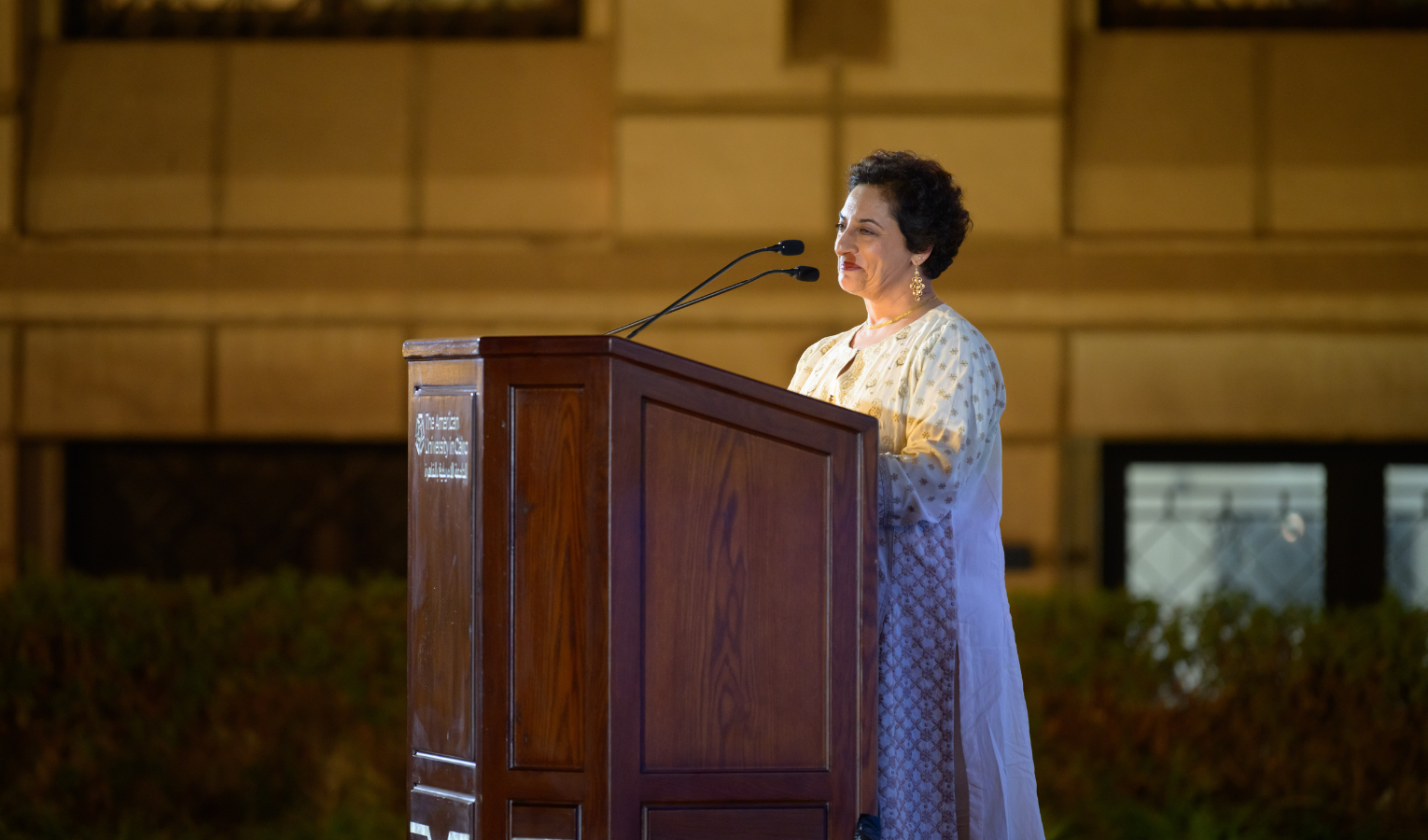
The inaugural professorship has been awarded to Distinguished University Professor of Egyptology Salima Ikram (YAB ’86), a world-renowned Egyptologist and field archaeologist.
“I am honored and delighted to be the first incumbent of the Amelia Peabody chair in Egyptology,” said Ikram. “The generosity of the donor ensures that Egyptology will have a secure place at AUC. The professorship has been instituted in order to sustain and develop Egyptology at AUC, and I very much hope to continue fostering Egyptology at the University as well as exposing AUCians to the richness of ancient Egyptian culture and emphasizing its links to the present.”
Ikram first came to AUC as a year-abroad student in 1985, when she “fell in love with Egypt,” and returned as a faculty member in 1995. She has helped shape AUC’s Egyptology department through her field work, partnerships with international stakeholders and commitment to public engagement. Ikram has published numerous articles and books on Egyptology and led field initiatives such as the North Kharga Darb Ain Amur Survey, the Amenmesses Project, the Animal Mummy Project and currently administers the Theban Mapping Project. Her research interests include animal mummification, funeral archeology rock art, the environment, diet and disease, with studies that have led to groundbreaking discoveries that changed scholastic understandings of daily life in ancient Egypt.
Affirming the importance of Ikram’s work to the AUC community and the Egyptology field at large, Dallal said, “Dr. Ikram’s work exemplifies the purpose of this new endowment: rigorous scholarship that serves knowledge and society.”
Through this professorship, Ikram will be endowed with the financial backing to continue her groundbreaking work and follow the footsteps of its fictional namesake: Amelia Peabody.
Peabody is the star of a series of historical mystery novels set in the late 19th century that feature an unconventional and daring Egyptologist, fascinated by Egypt and eager to uncover ancient mysteries. Written by the New York Times best-selling novelist and Egyptologist Barbara Mertz (under the pen name Elizabeth Peters) and published between 1975-2010, the series inspired an entire generation to engage with the wonders of Egyptology. Curious and determined, the name of Amelia Peabody is meant to invoke this same passion for Egyptian history and culture in its awardees.
“It is a matter of joy that the chair is named after a fictional optometrist, Amelia Peabody,” said Ikram. “The creator of the Amelia Peabody character was a very dear friend of mine, Barbara Mertz, one of the first women to earn a PhD in Egyptology from the University of Chicago. She popularized Egyptology, and we found that Amelia and I had many things in common, from our love of ancient Egypt to mysteries, and the handy belt meant for archaeology.”
As a field, Egyptology is a cornerstone of the AUC community. Books on the subject remain among AUC Press’s all-time best sellers, including several by Ikram, such as Ancient Egypt: An Introduction, Death and Burial in Ancient Egypt, and Divine Creatures: Animal Mummies (as editor). Other Egyptology best sellers include Ancient Nubia: African Kingdoms on the Nile, Gods and Myths of Ancient Egypt, Nefertiti, Queen and Pharaoh of Egypt, and Ancient Egyptian Jewelry.
Emphasizing the importance of Egyptology as a field, Ikram noted, “Teaching Egyptology at AUC is not only to create new Egyptologists, but also to expose Egyptian students to different aspects of their culture and history, to instill a sense of pride in their heritage and to make them more conscious of its value — not only to them and Egypt, but to the world.”