Home page
ع Search AUC

Adam Talib's Poetry Discovery
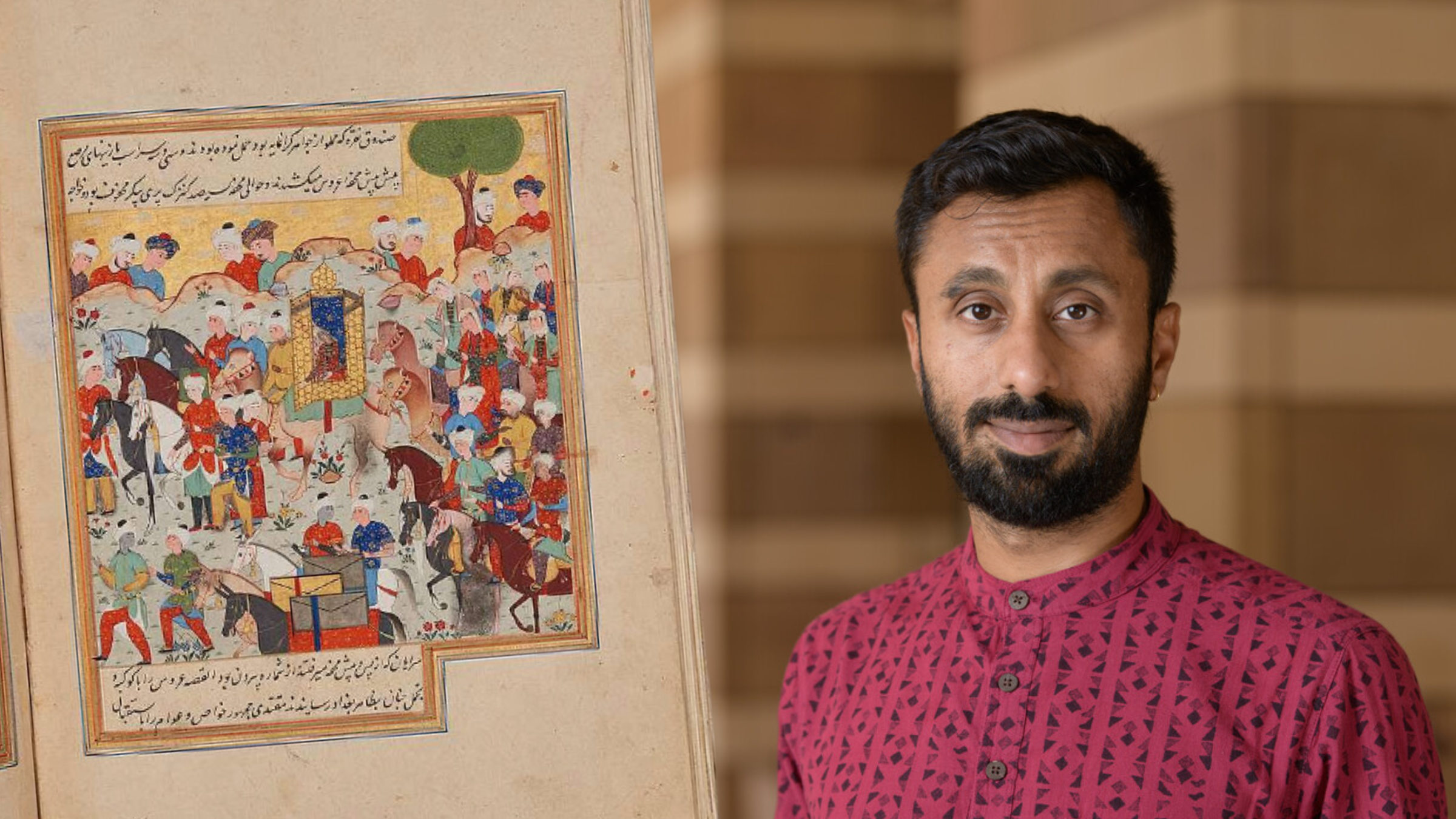
Man in red shirt stands next to a brightly colored illustration on a time-worn page

New historical sources on the medieval era are few and far between. However, an AUC faculty member has uncovered a “never-before-studied” source on the courtly life of Abbasid Baghdad, told through the eyes of a vizier from Mosul in northern Iraq.

Ian Greer
April 17, 2024

Adam Talib (MA ’08), associate professor in AUC’s Department of Arab and Islamic Civilizations and a specialist in Arabic poetry, discovered an entire diwan (collection) of poetry by Ibn al-Musalaya, who was famous for his poetry as well as eloquent letters written on behalf of three Abbasid caliphs (Muslim rulers). 

“This collection has never been researched or analyzed before,” said Talib. “I found the manuscript while looking through archives for another project altogether. The discovery of his diwan promises new perspectives on the history of the Abbasid dynasty, the life of a medieval man of letters and the nature of Arabic poetry itself.”

Ibn al-Musalaya’s diwan is a collection of praise poetry, a genre in which poets typically applaud — and legitimate — powerful patrons or rulers, following the rules and conventions of an elite poetic culture. Ibn al-Musalaya praised the most powerful statesmen of his age, the Caliphs he served; their rivals for symbolic power, the Seljuk Sultans; and the great Sunni revivalist Nizam al-Mulk (1018–1092). 

“The relationship between the Seljuk Sultan and the Abbasid Caliph has long been a subject of historical interest,” Talib says. “The Seljuks foreshadowed the future of the Muslim world, and Nizam al-Mulk is the source of dozens of influential ideas and institutions in Islamic civilization.”

Ibn al-Musalaya’s poetry describes celebrations, events and meetings between these historical characters, their comings and goings in Baghdad, as well as their negotiations and plans –– adding color and texture to otherwise dry history. “The value of Ibn al-Musalaya’s poetry is not purely artistic but also historical, providing some of the only sources available on the relationship between the most powerful men of the Abbasid era,” explains Talib.

Talib wants to link his work as a poetry specialist with that of historians during that period, bringing the details of Ibn al-Musalaya’s diwan to a wider readership. He hopes to publish a translation and an Arabic critical edition. In his view, poetry remains a critically underestimated historical source.

“My work is arguing for the primacy of poetry,” he states. “ In an elite culture like that of the Abbasids, poetry is a key, if not the key, idiom. Poetry of this kind was not primarily the expression of individual emotions. It was how elites negotiated symbolic power.”

Share

Building Community Resilience to Mitigate Floods

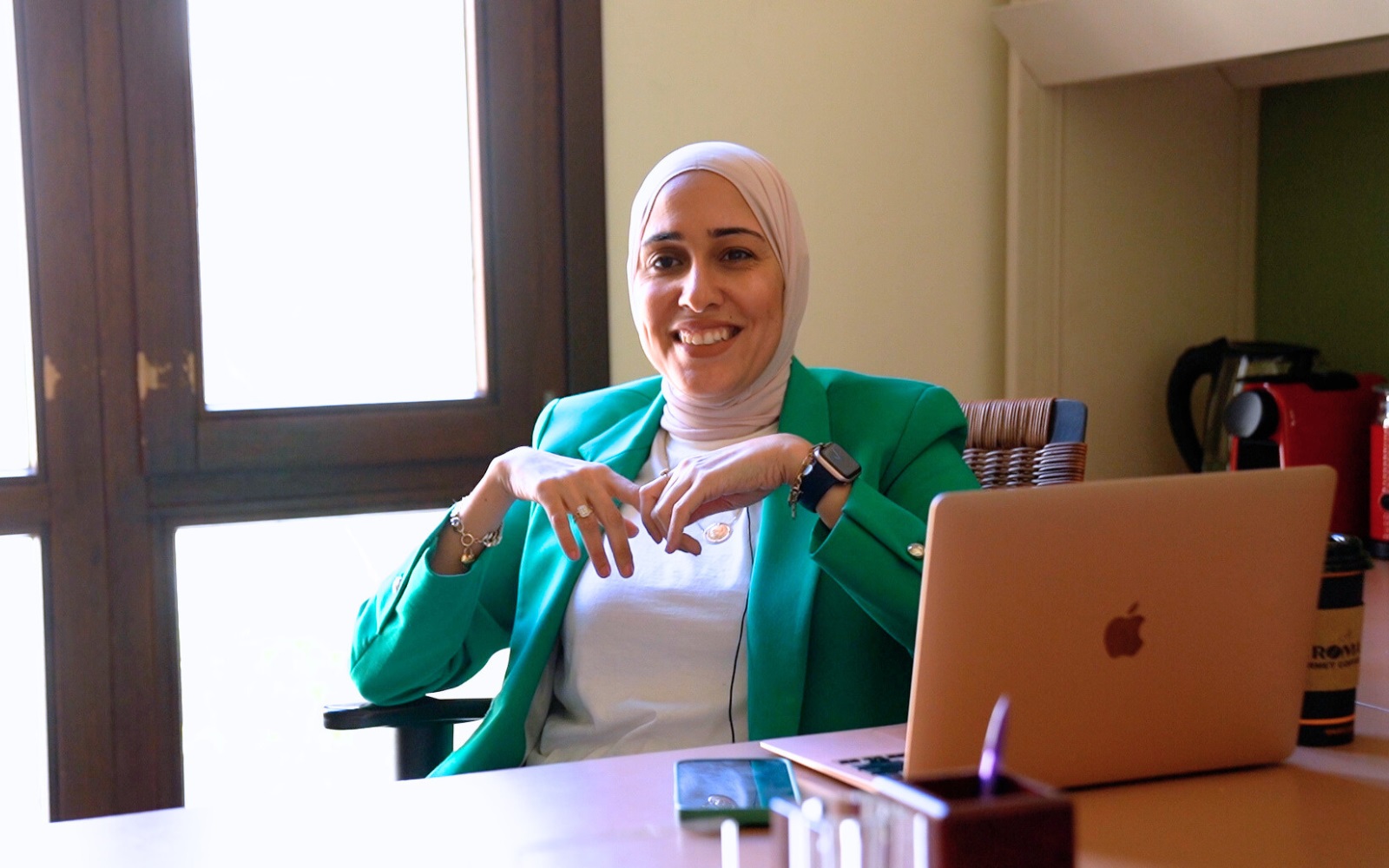
Woman in green jacket and white hijab sits at a desk smiling

The only AUC faculty member specialized in community resilience, May Haggag ’11, ’16, assistant professor in AUC’s Department of Construction Engineering, uses data science and machine learning to develop effective flood risk-management strategies specific to Egypt's unique climate and geography.  

Rawan Ezzat
April 2, 2024

“I want to reshape Egypt's approach to mitigating natural hazards to ensure the safety and resilience of our communities, particularly with climate change taking its toll and Upper Egypt’s susceptibility to floods,” said Haggag. "People have to be ready; Mother Nature is in charge. Shifting weather patterns can trigger natural disasters, and we have to be able to adapt.”

Natural hazards and natural disasters are actually different, explained Haggag: “A natural hazard is something that can cause risk for people or communities. For instance, if you have a thunderstorm happening in the middle of nowhere, it will not affect people. It's just a hazard. But when the same thunderstorm happens in a city, it can affect people, buildings and infrastructure. This is when it becomes a natural disaster,” said Haggag. 

The number of climate-induced disasters has tripled in the past four decades and is expected to double in the next 13 years, according to the Centre for Research on the Epidemiology of Disasters. The impacts are also severe, with approximately 1 million deaths attributed to climate-induced disasters and around 250,000 deaths expected to occur in the next 10 years, as per the Consumer News and Business Channel. Furthermore, the intensity of these disasters, along with life and property losses, is rapidly increasing. In the last two decades alone, climate-induced disasters have resulted in global damages of approximately $1.7 trillion, as reported by the Asian Development Bank. 

“This highlights the critical need for proactive measures in disaster risk reduction and climate resilience,” Haggag states. 

"People have to be ready; Mother Nature is in charge. Shifting weather patterns can trigger natural disasters, and we have to be able to adapt.”

Resilience, according to Haggag, refers to the ability of a system to bounce back to its original operations after a disaster hits. “This is evident in any power system, for instance, where redundancy is created by having backup transmission lines to transfer the load if one line fails –– preventing the collapse of the entire system.”

Community resilience is similar but focuses on people. “It’s about a community’s capacity to rebound from a disaster and recover in a sustainable and effective way in the presence of any challenges,” said Haggag, adding, “I am a construction engineer, but my work is all about communities, not just buildings. While pursuing my PhD at McMaster University, I decided to start developing models that could predict what would happen to our communities if a disaster hits.” 

So how can we make our community resilient? How can we enable it to absorb shocks and quickly get back to its normal operations? 

“The answer lies in maximizing the robustness, resilience and agility of our community by effectively managing the redundancy and resourcefulness of our people alongside our critical infrastructure systems,” said Haggag. “This was the base of my work. I was concentrating on climate-induced disasters because this is what we cannot foresee. Communities need to be prepared, and it’s important to raise awareness of proactive measures to mitigate and respond to disasters among policymakers, industry professionals, the general public and, of course, our students.” 

Share