Humans and Things Recent Literary and Cultural Theory
A lecture by Timothy Brennan Cultural Theorist, Professor of Literature, and Activist
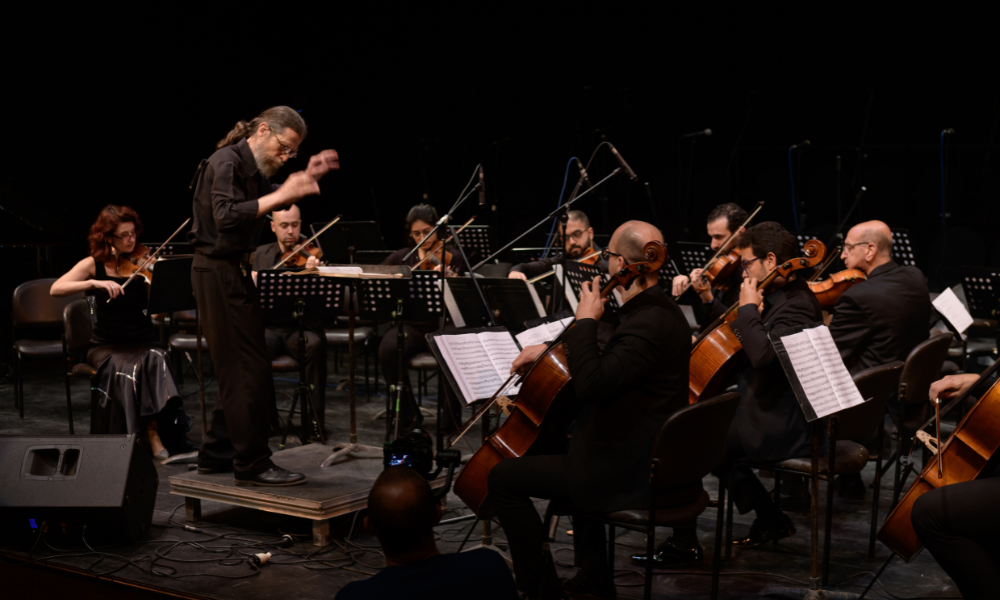
As finals week comes to an end, AUC’s Department of the Arts, in collaboration with the Embassy of the Kingdom of Morocco in Cairo, is hosting a lecture-concert by Moroccan artist Nouamane Lahlou as well as a Moroccan-themed reception at AUC New Cairo’s Malak Gabr Arts Theater this Thursday from 1 to 3 pm.
Lahlou is a singer, composer, author, music researcher and lecturer who is considered one of the most important Moroccan and Arab musicians of his generation. He has received multiple awards, including the Moroccan National Medal and Morocco’s Person of the Year Award.
Born in 1965 in Fez, Morocco, Lahlou entered the world of music and art at the age of 5 after being gifted a guitar. At 10 years old, he joined the Conservatory of Fez. Following years of playing with the group and studying, he left Morocco for the United States, where he further developed his musical talent while pursuing his studies.
Lahlou finally settled in Egypt, where his artistic career took off. In Cairo, he appeared as a singer and composer on radio and television and participated in the second conference of Arab music at the Egyptian Opera House. After gaining considerable acclaim, he returned to his home country to become a professional composer and researcher in Moroccan music.
Throughout his career, Lahlou has participated in festivals and has given lectures and workshops in major universities in Morocco, the Middle East, Europe and the United States.
The lecture-concert will be attended by Ambassador of the Kingdom of Morocco to Egypt Ahmed Tazi. Lahlou will be accompanied by his band.
As an interdisciplinary program co-administered by AUC’s Department of Psychology and Department of Biology, the new behavioral neuroscience minor will allow students to study the relationship between the structure and function of the nervous system with an emphasis on the biological and psychological elements that affect emotions, behavior, learning and memory.
“There has been increasing interest and requests from AUC students for a Neuroscience program,” explains Patricia Correia, assistant professor of behavioral neuroscience in the Department of Psychology. “Internationally, behavioral neuroscience is a growing field, widely represented in top universities and research centers across the world. We believe this minor is an excellent first step towards opening a new, exciting field in Egypt at AUC.”
For students, this minor will provide a new perspective on biology and psychology and create a foundation for admission to graduate or professional programs, primarily for careers involving research, teaching, medicine, consulting and the pharmaceutical industry.
“Through this minor, I am hoping to broaden my knowledge and understanding of how the nervous system functions, and how the brain is involved in everything we think or do,” says Mariam Elnahhas, a biology major. “Hopefully, completing this minor will be a great first step for me to continue to study neuroscience after graduation and possibly make a career out of it someday.”
In terms of research, Jacquelyn Berry, visiting assistant professor in the Department of Psychology, uses behavioral neuroscience to study learning and expertise in humans. “I am super excited about the new minor. It works well with my research and teaching about how people learn and I can focus more on how different brain areas are involved,” Berry states.
More than 87 art projects from AUC’s Visual Arts Program are on display now at the archival exhibition Mapping Time, held at Tahrir Cultural Center. The exhibition showcases drawings, digital prints, videos and installation art produced over the last ten years under the program.

Designed and supervised by Shady Elnoshokaty, associate professor of practice and director of AUC’s Visual Arts Program, the project explores how individuals understand time by examining three layers: present/reality, past/memory and future/fantasy. While varying greatly in appearance, each piece translates a well-researched idea into the visual structure of a map.

“The project was designed to create an educational experience that establishes a direct connection between experimental research and art education,” Elnoshokaty wrote. “This individual and collective undertaking results in an experience that is both profound and extensive for the group at large.”

The U.S. Agency for International Development (USAID) has awarded The American University in Cairo (AUC) $86 million for USAID Egyptian Pioneers, a new program that provides scholarships and training to Egyptian students with emphasis on sectors that can advance Egypt’s climate goals. Through a nine-year cooperative agreement, AUC will administer the program in coordination with the Ministry of Higher Education and Scientific Research, the Ministry of International Cooperation, and private and public sector institutions. Prioritizing women’s empowerment, diversity, inclusion and climate resilience, the USAID Egyptian Pioneers will build and develop the capacity of a cross-disciplinary network of public, private and academic entities. The program includes:
Accordingly, more than 500 Egyptian women will engage in leadership and professional training, undergraduate and postgraduate scholarships, and study-abroad programs in the United States.
AUC President Ahmad Dallal said, “Leading the USAID Egyptian Pioneers program is a great honor for AUC. We commit to extending our longstanding leadership and excellence in education, capacity development and training to ensure the sustainable integration of the public, private and academic sectors. Egyptian Pioneers will surely leave an enduring impact on Egyptian society, advancing Egypt’s economic development and progress toward its Vision 2030. We thank the U.S. government and the Ministry of Higher Education and Scientific Research as we endeavor together on this partnership journey,”
USAID Deputy Mission Director Margaret Sancho stated, “Climate change is an enormous challenge for all people, all over the world. But we also know that women and girls bear a disproportionate burden of its impact. Despite this, women and girls are leading climate change solutions in their communities. That is why USAID’s Egyptian Pioneers program will include leadership and professional training, undergraduate and postgraduate scholarships, and study-abroad programs in the United States for more than 500 Egyptian women."