Home page
ع
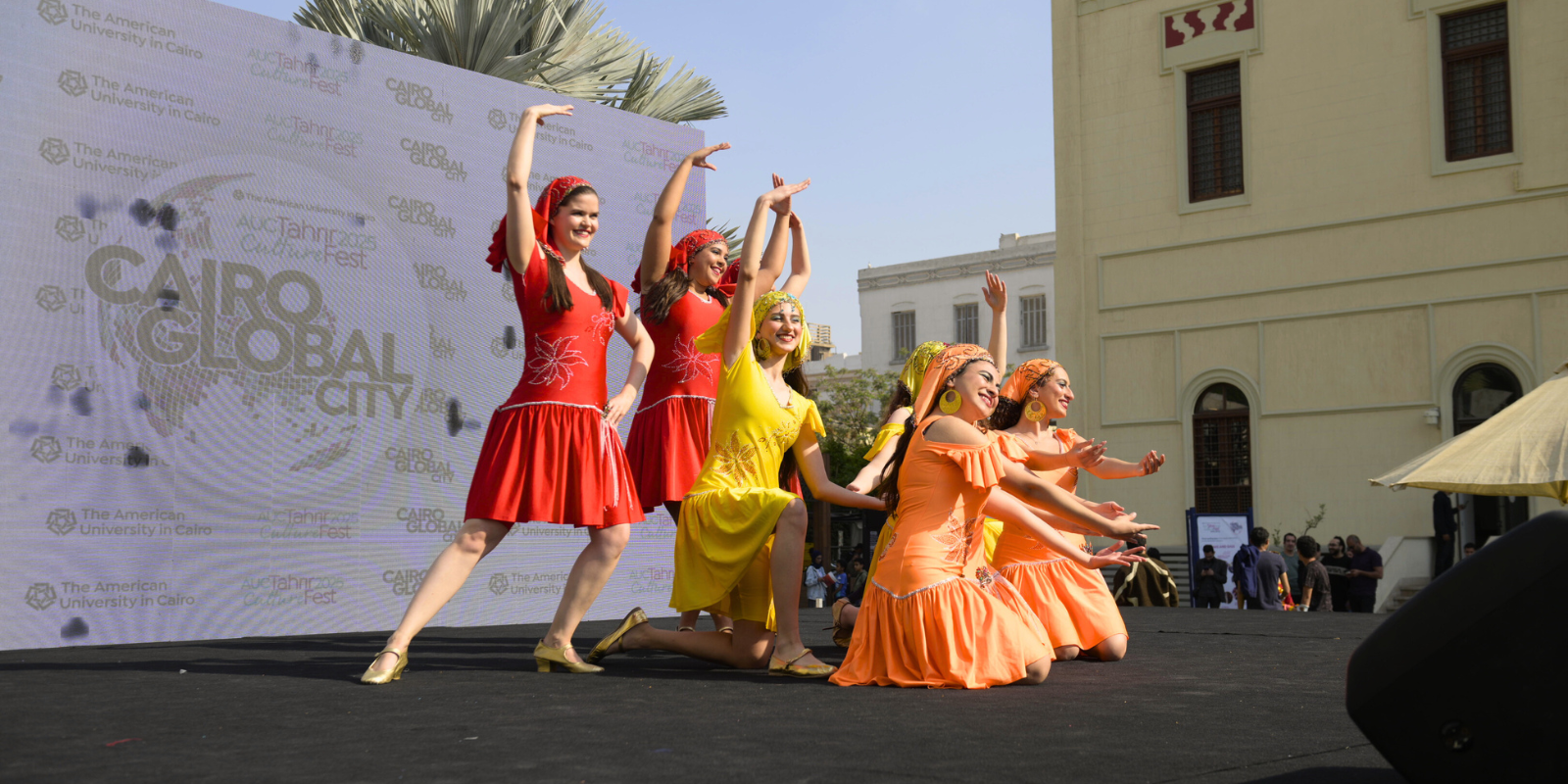
Female dancers from AUC Folklore smile mid-dance on stage with dresses in red, yellow, and orange.

Tahrir CultureFest: Day in the Life of Student Performers

Celeste Abourjeili April 16, 2025
Arts and Culture

“Port Said, Siwa, Upper Egypt — we learn about the cultures and dance traditions from Egypt’s different regions,” said Amira ElKouny ’18. “This event in Tahrir also has diversity in all the activities and even the audience.”

ElKouny trains and performs with the student group AUC Folklore, a dance troupe that performed on campus on Saturday, April 12, at the Tahrir CultureFest.

“We’ve been training very hard for this event every single day, usually from 10 am to 4 pm, to correct any mistakes and perform perfectly,” said electronics freshman Omar Mohsen, who performed in three out of four male dances at the fest.

AUC Folklore: ‘Like a Family’

Film senior Mohamed El Khatib participated in the majority of dances in addition to his tanoura routine, a traditional Sufi dance style that consists of rotating around oneself while wearing a colorful weighted skirt. “I love tanoura because it’s related to Turkish and Sufi culture, which I wanted to learn more about,” he said. 

El Khatib officially rehearses tanoura twice a week, revolving around himself for anywhere from one to eight minutes at a time. At home, he continues practicing spinning without the costumes to perfect his technique. “Outdoor tanoura is more difficult than indoor because of the sun,” he said. 

“We’ve been training very hard for this event, every single day, usually from 10 am to 4 pm, to correct any mistakes and perform perfectly.”

The troupe practices 2-3 times per week, depending on whether they have a performance coming up. “It’s more than just an undergrad activity; it’s a safe and comfort zone away from stress at work,” Nadine Ezzeldine ’21, who occasionally practices and performs with the troupe. Ezzeldine fondly remembers staying past the end of rehearsal with her troupemates to improvise and have fun: “It’s like a family.”

Like many members, Ezzeldine had no previous dance experience when she first joined the troupe. El Khatib, who first began dancing tanoura four years ago when he became a member of the troupe, said, “I had never practiced any dances before joining AUC.” 
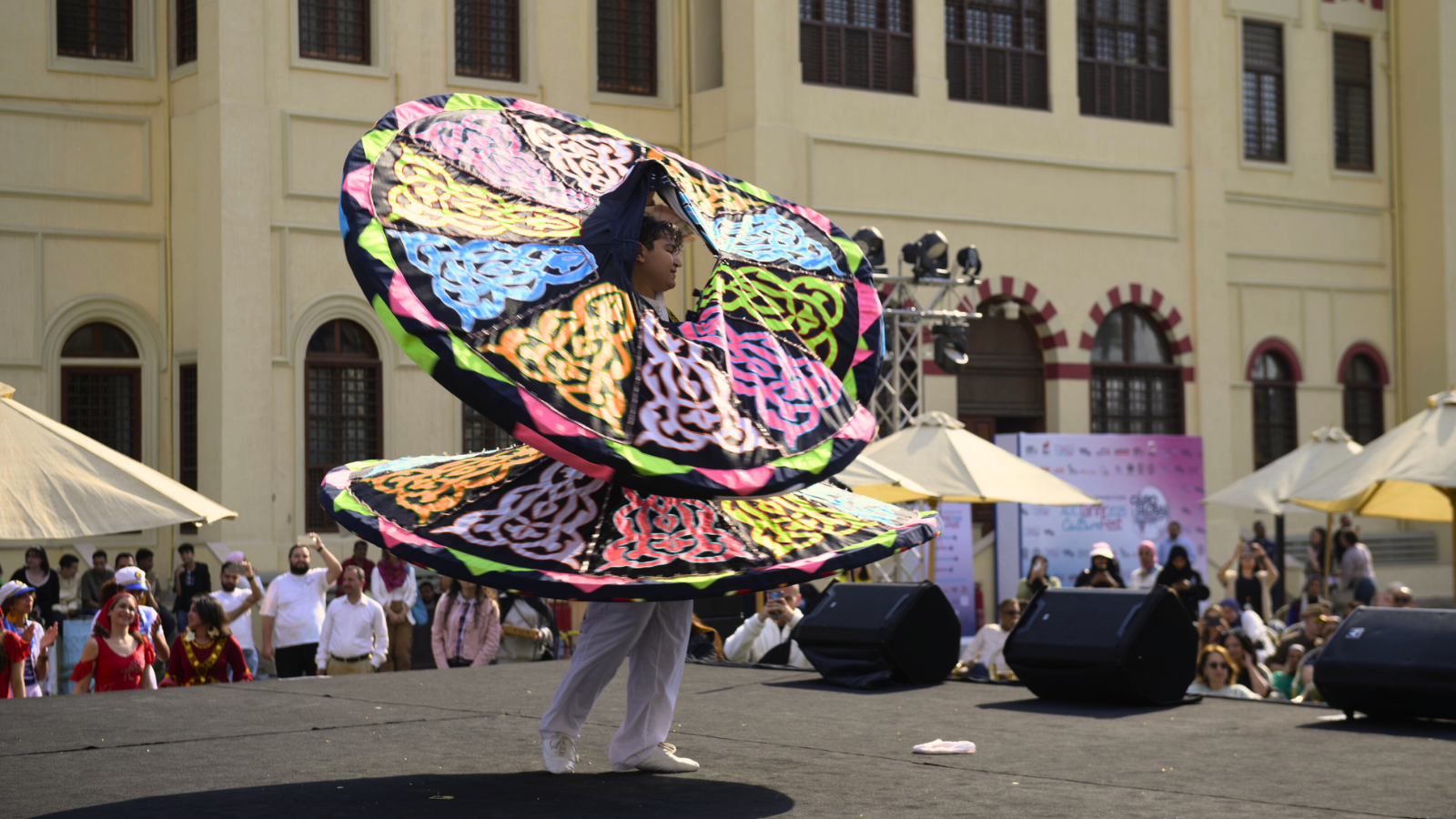
 

AUC student dances tanoura


Dancing for Egypt

The troupe spent two weeks at a festival in France last summer, performing nearly daily during the trip. This summer, the troupe will spend 10 days in Greece. “We have two or three new dances we’re preparing for Greece,” said Hana Abdelsalam, biology and theater sophomore. 

Abroad, the troupe represents Egypt in all its diversity of culture, including the Eskandaroni dance, performed in blue-and-white sailor costumes, a nod to the country’s coastal cities. “Luxor’s style is diverse, unique and uplifting as well,” said Ezzeldine.

Abdelsalam was first inspired to join the team because she was interested in folklore’s unique songs, costumes and dance styles. The fully funded trips attracted her too. 

“The audience here definitely had more people and they were super engaged and fun to perform for.”

At Tahrir, the troupe got to show off Egypt’s rich culture right at home. “It’s my first time performing in Tahrir, and this event was so well organized,” said El Khatib, who was excited to perform an exclusive, new version of his tanoura routine at the CultureFest.

The venue presented new challenges that the team had to work around: “The costume changes were super fast, and that was difficult,” Abdelsalam shared. The outdoor stage was a lot smaller than what the troupe is used to and featured a makeshift tent as backstage. “We had to adapt for this performance. We had to squeeze in on the stage and be careful not to fall.”

Despite the challenges, the team found a supportive and enthusiastic audience in the heart of Cairo. “The audience here definitely had more people. They were super engaged and fun to perform for,” Abdelsalam said. 

With big smiles on their faces, the student performers just seemed happy to dance for their country that they love.
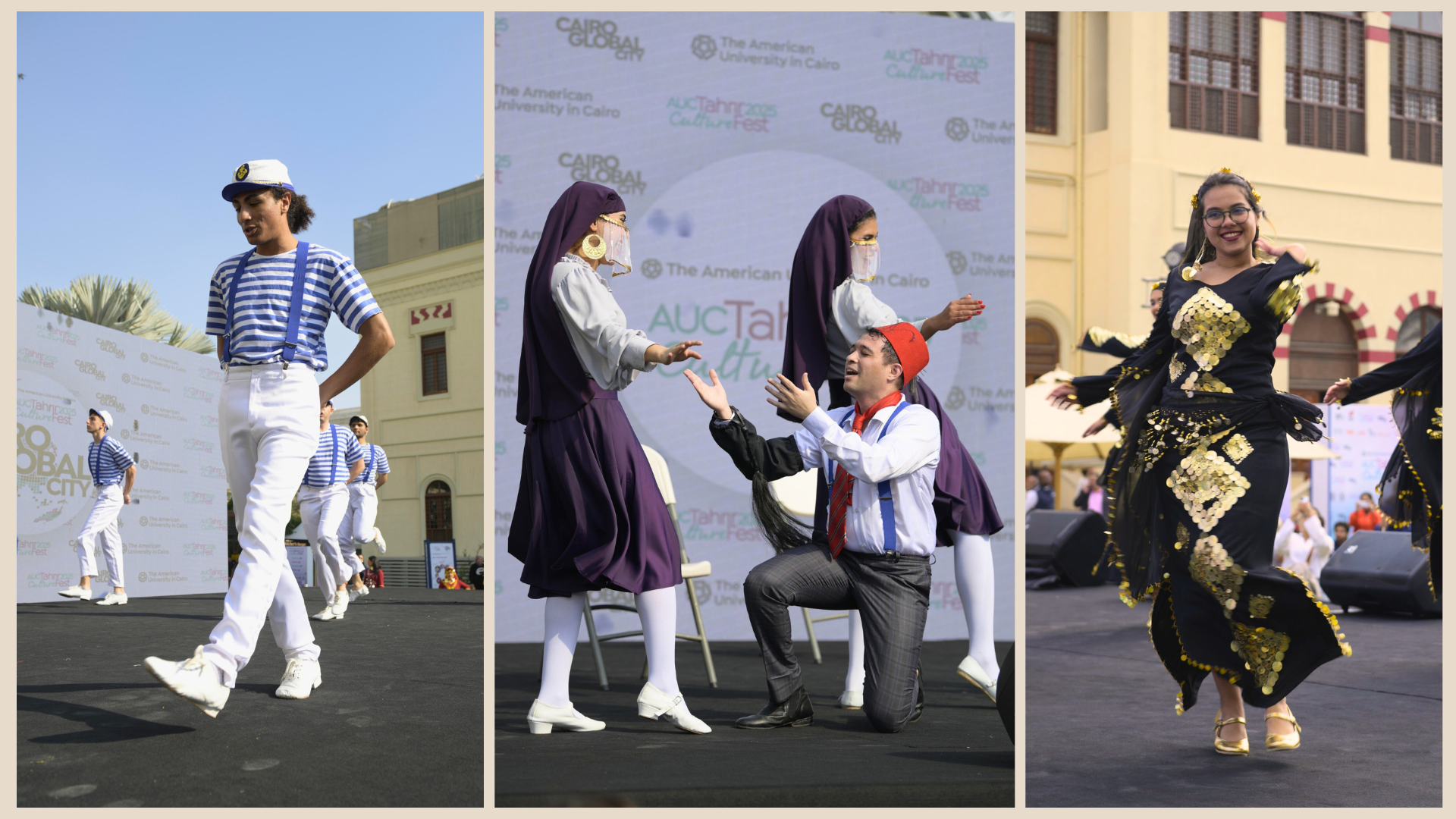
 

Collage of dancer in a sailor costume doing a funny walk across the stage; couples dance of a man in a tarbouche on his nears before a woman shimmying in traditional costume; a dancer smiles mid spin

Related stories

Dr. Rabab helping students at APS
December 16, 2025

Students Gain Hands-on Experience in Policy Solutions

Alternative Policy Solutions (APS) sits under the high ceilings of an unassuming office in the historic palace on AUC’s Tahrir Square campus. The think tank is home to policy researchers looking to influence the world of development through in-depth research, consultations and evidence-based policy solutions to some of the most difficult challenges facing Egypt. Rabab El Mahdi ’96, founding director of APS and associate professor of political science, heads the team of researchers and employs some unlikely policy practitioners: undergraduate students in her Introduction to Development class.“We’re challenging students in ways they haven’t experienced before,” El Mahdi stated, “There are so many benefits to having students at work at APS. They learn from the team, but also bring  fresh insights.” Class StructureThe Introduction to Development course is broken up into three parts: an introduction to development theory, a five-week practicum at AUC Tahrir Square and a final project to reflect on the experience. The students spend their Tuesdays in APS’s office, discussing policy with research professionals and learning firsthand the pace of working in a real policy office. They aid in the office’s operations, provide preliminary research for policy analysts and do background research for APS’s publications. Sitting in the APS office on the third floor of the palace, the student researchers brought a palpable energy to the airy office space. They were busy researching the development impacts of the Grand Egyptian Museum opening, Egypt’s involvement in debt swaps and possible programs to use for the APS podcast initiative. The hands-on experience of working on policy solutions in real time is unique to the program and a process that turns policy students into policy practitioners.“The excitement of being in an actual workplace gives them a different drive during their time in the office” said El Mahdi. Students around her buzzed, hard at work. “Hands-on learning has so many benefits in terms of furthering their theoretical understanding of the subject-matter, they apply concepts they learned to current developmental challenges. Plus, there's a different energy at the office than in a classroom.”Sitting in a cubicle in the corner of the office, junior Laila Mamdouh vigorously typed away at her assignment. “It’s making me learn so much so quickly, without it being stressful or overwhelming,” said Mamdouh. “It's not just a typical format where you go to class, take notes and then have an exam. We actually get to apply what we learn, which gives me so much more incentive.”The excitement for their work was notable across students. “We were surprised to see just how big of a project this is,” stated junior political science major Omar Fahim. His chair faced the window that revealed the vibrant gardens of the Tahrir Square campus. “APS talks directly to ministers and the government, so it makes me think that our work could be presented to officials. It motivates me to put my all into it.”More than just encouraging students to critically think about development concepts, the program offers real support to the small but mighty APS office. Mohamed Badereldin, a junior policy researcher at APS, complimented the students helping him on his policy papers. “It’s incredibly useful to have them here in the office,” he said. “Instead of going back and forth on email, I can tell them what I need instantly, and we can have a real conversation about the project. I also think it’s helpful for them to learn how to apply the theories they’ve been taught to real-world situations, which is exactly what we do every day at APS.”Development concepts might seem abstract in the classroom setting, but these students are learning firsthand how to extract their real-world applications. More than just learning the impact of their field, students felt the responsibility to use their education to help policy practitioners and rise to meet that challenge. Having the APS in-office experience was critical for students to understand what being a professional in an office environment is like. For many students, this was their first time personally experiencing office dynamics and expectations. “Dr. El Mahdi’s our professor, but she’s also our boss,” stated student Ginevra Hanna. “She’s treating us just like she treats her employees. It makes me feel grown up, like I can actually do the work.”Learning how to work in an office is just as important as learning to apply policy concepts to real-world scenarios. As an experience, it is something students will take into all future jobs, even if they end up working in different fields. “They get daily feedback from me and my colleagues, which helps them develop their research in real time. I’ve seen them grow tremendously,” added El Mahdi. “It’s important to encourage strong work ethic in AUC students. By putting them in this environment, we’re testing their limits and showing them what they’re capable of.”Tahrir as a Classroom The opportunity to work in Tahrir was a draw in itself for students, bringing them into the busy hustle of the city. “Tahrir is 45 minutes away from my house, so I don’t get to come out here very often,” Mamdouh stated. “It’s really nice to have something to bring me to this campus. The aesthetic of the office is just incredible with Tahrir Square as a phenomenal view; it really pushes me in the mindset of doing quality work. And since it’s part of class, it’s a win-win.”Other students echoed how much they enjoyed coming to the Tahrir Square campus and how a new environment encouraged them to give the class their focus and attention. “You know that if you’re coming all the way out here, you have to actually work hard,” shared Hanna. “If you don’t, then it feels like a waste.”The Introduction to Development’s practicum is part of AUC’s Tuesdays at Tahrir initiative, aiming to bridge the gap between the two University campuses. By providing transportation from New Cairo to Tahrir and vice versa, and encouraging students and faculty to use the Tahrir Square campus as a fixture of their academics, the University is displaying the unity of One University, Two Campuses. It’s also an opportunity to allow students to take advantage of the historic Tahrir Square campus, a landmark and cultural oasis in the heart of Cairo.“I love the Tahrir Square campus, but unfortunately, I don't come here enough. Sitting here doing work makes me feel like it’s my campus, my second home,” Mamdouh continued. “I’m thankful that AUC provides transportation because it motivates me not only to come to campus, but also to explore the Tahrir area, which is so interesting and historic.” The Tahrir Square campus, which has been AUC’s home since its establishment in 1919, hosts a number of AUC programs along with conferences, festivals and symposiums. Its grounds cover a decadent city block that sits parallel to Egypt’s central Tahrir Square. Inside the grounds is a lush lawn, the shade of many palm trees and the historic palace that hosts classrooms, theaters, a cafeteria and, of course, APS. The history of the building is evident in everything from the intricate wood-working detail to neo-Mamluk architecture and designs over the arched windows. The Tahrir Square campus wears its historical and political significance on its sleeve, something felt strongly by the class of politics students. “Bringing students downtown is not just a learning experience; it’s a life experience,” El Mahdi confirmed. “It has to do with working on their essential skills, how to navigate the space and deal with colleagues. Coming to Tahrir gets students familiar with the campus, which is important considering all the cultural events that are organized here. Having a course where the Tahrir Square campus is integral is an incredible opportunity because so many things, like consulting sessions with stakeholders, can only happen in Tahrir. This is the center of the city, and it’s a privilege to show that to students.”
Student Experience
Two students sit and write at the top of a staircase
November 11, 2025

Writing in the Palace on the Square

The sound of pens scribbling on paper fills the wood-latticed windows of AUC Tahrir Square. Nina Ellis, assistant professor of English and comparative literature, gestures to the ceiling: a gold-trimmed mosaic of red, green and blue. “Notice the light in the room,” she tells her class. “What colors do you see? What textures do you feel? If it's gold, does it shine? Does it reflect the light?”  Students from the Creative Writing class observe and draw inspiration from Oriental Hall in AUC's historic palace.AUC Tahrir Square was once a palace overlooking Cairo’s downtown area for almost 150 years. Now it is a historical hub for the arts in Cairo, where a Creative Writing class taught by Ellis conducts a field study on characters and setting. The field trip is structured for students to explore the University’s oldest building through the perspectives of characters developed over the course of the semester."What colors do you see? What textures do you feel? If it's gold, does it shine? Does it reflect the light?” Students explored the history-laden rooms of Oriental Hall and Ewart Memorial Hall and drew inspiration from the campus. AUC psychology sophomore Mazen Massen watched microbuses and motorcycles zip around downtown Cairo through the eyes of his character, a spirit of stasis who believes things change in patterns. “I felt my character would gravitate to that, looking at the big picture of all the people,” Massen says.AUC integrated marketing communications senior Layla Khaleb wrote in Oriental Hall, where her character focused on the room’s smallest details, “like the smell of the wooden chairs, the mosaics and the glass all over the walls,” Khaleb says. The Khairy Pasha Palace was constructed in the 1870s by Khedive Ismail to house his confidant and Minister of Education Ahmed Khiary Pasha.Ellis was inspired and struck by the beauty of the Tahrir Square campus during the new faculty orientation. “Dazzled is the word, which I think must be the intention,” Ellis says. “I thought, ‘I'm teaching creative writing, and I want to sit down and write, and usually I find that to be a good indication of something students will enjoy.”“Dazzled is the word, which I think must be the intention."AUC Tahrir Square was first erected in the 1870s by Khedive Ismail, then sold to Greek businessman Naestor Gianaclis in 1899 and used as a cigarette factory, then bought in 1919 to serve as the University’s first campus. Students and dignitaries alike have graced its halls— 800 people crowded Oriental Hall to hear Helen Keller speak in 1952. Martin Luther King Jr. visited the Tahrir Campus in 1959 to reconvene with his former college friend AUC professor of psychology, Jimmy Beshai.  Edward Said delivered a commencement address in Ewart Memorial Hall in 1999.The American University in Cairo bought the palace in 1919 to house the University's first campus.After the University moved to the New Cairo campus in 2008, the Tahrir campus transformed into the center of the University’s public engagement, hosting community events, performances and guest lectures.“It continues to serve Cairo and to serve the community,” Ellis says of AUC Tahrir Square. “And I think it’s really important that these students return to this campus. I say return because it is part of the history of their identity as AUC students.”While integrated marketing communication senior Marian Elammawy has visited the Tahrir campus many times during her four years at AUC, she looks forward to these field trips as a shake-up from her normal AUC routine. “I was really happy when I was standing with my friends during assembly hour. I was excited and told them, ‘I have to go to Tahrir today!’”The Creative Writing class walks outside of AUC's historic palace.
Civic Engagement
Dancers from Indian Embassy perform in colorful orange and pink saris on stage, arms spread
April 16, 2025

Tahrir CultureFest 2025: Voices of Cairo

Performances, panels, bazaars and more: This year’s AUC Tahrir CultureFest, which took place from April 10 to 12 at the Tahrir Square campus, had offerings for everyone. But beyond fun programming, the CultureFest, now in its second year, was a chance to build meaningful human connections and community for residents and visitors of Cairo, right in the heart of the city.“I love the work that AUC does; it’s really great,” said Jude, an expat from New Zealand who now lives in Cairo and attended with her visiting friend Ros.The Gaza Salute Choir was one event that seemed to deeply move the audience and particularly touch Palestinian residents in Cairo. Ghada Ziada, a 45-year-old woman from Gaza who came to Cairo two months after October 7, 2023, has found a sense of belonging and resilience through the Tahrir CultureFest. “Coming from Gaza, we missed these cultural events,” she said. “So we enjoyed this performance, and we feel resilient.”“My mother, who is 75 years old and can barely move, insisted on coming today.”This is Ziada’s second year at the nascent CultureFest, and she now takes it upon herself to share the link with her family members through Facebook: “We came together both this year and last year for this event,” she said. Ziada first learned about AUC through last year’s CultureFest and got the idea for her daughter Jana to apply. Now, she told us Jana is an architecture student at AUC.The choir performance had a powerful meaning for Palestinian-Egyptians as well. “My mother, who is 75 years old and can barely move, insisted on coming today,” said Mahmoud Sameh, a 37-year-old Egyptian with Palestinian and Sudanese ancestry. “Since I’m half Palestinian, this event means a lot to me. It’s so nostalgic to see the choir with little kids from Gaza since I had my own experience singing in a Palestinian choir as a child.”Sameh was able to enjoy the diverse offerings at AUC with many family members, including his sister, an architect who attended the panel on Cairo’s Architecture: A Cosmopolitan Canvas. “Everyone in the family is running all over here to attend different parts of the fest,” he said.Ahmed Omar, also an architect who attended the architecture panel and Gaza Salute Choir performance, really appreciated the offerings at the festival. “The events were affirmative and entertaining, and I collected some gifts for my wife and mother from the bazaar,” he said. “I also just reserved the Cairo Steps concert for later tonight.” This was Omar’s second year attending the CultureFest, and he said he had previously enrolled in a project management program at AUC several years ago.“Everyone in the family is running all over here to attend different parts of the fest.”Though some talks and panels were academic and professional, the festival was also family-friendly. “My kid Farida did all the activities like coloring, painting, face painting and T-shirt printing,” said Ahmed Youssef, a 39-year-old from Sheikh Zayed who attended with his wife and child all three days after coming to last year’s CultureFest. “The event is good for the kids, and I love the live music,” he said. Youssef is hoping to complete a business course at AUC next month.The events attracted Cairo locals from all age groups and fields, including the city’s youth. Habiba Younes, 19, and her group of friends are studying Japanese at Cairo University, and they attended the CultureFest for the Japanese calligraphy event. “The vibes are really good,” the girls said.For people who live near AUC Tahrir Square and want to integrate in Cairo’s community, the CultureFest — and other University events — always leave a positive mark. Outside of the festival, Jude from New Zealand is a regular at AUC. “There are lots of interesting book events from the bookstore and cultural events on campus. They’re very easy to access,” she said.
Arts and Culture
Yasmine (author) pours date molasses into a bowl of Freekeh with the photographer and moderator standing by in front of the stage at AUC Tahrir outdoors.
April 16, 2025

Tahrir CultureFest: Book Talk with Author and Photographer of ‘Bilhana’ Cookbook

Freekeh eggplant salad topped with pickled onions and fresh seasonal raisins, all coated with date molasses: This tasty snack awaited attendees of the Tahrir CultureFest on Saturday at the Bilhana book talk by AUC Press. The dish was served after author Yasmine Elgharably and food photographer Yehia El-Alaily shared tips on sustainable cooking and behind-the-scenes details on publishing the book.“From ideation to completion, it took around five years [to produce],” Elgharably said. Assembling the book — which Elgharably calls her passion project — was no simple task, from waiting for ingredients to come into season to conducting lengthy photoshoots to revising recipes with the board.“Someone from New Zealand recently sent me a picture of something they cooked from the book — just wow, wow, wow.”“[We] wanted the book to be global so it would apply to anyone, anywhere in the world,” said Elgharably. At the same time, the pair wanted the book to be rooted in Egyptian culture. “We made sure our spices are there, our herbs are there.”Much consideration was given not just to the ingredients, but to the content that made the final page — including the page itself. “One thing is the printing paper, and I’ve seen several… this one lasts in the kitchen,” El-Alaily said. As the book’s photographer, he pushed hard to allow a photograph alongside each recipe, a move that ultimately set the colorful book apart. The pair also discussed the zero-waste production of the book. “When you attend commercial shoots, you see the massive waste happening on set,” El-Alaily said. Instead, “we just properly made one [of each plate] and took our time.” The book’s first two pages, which feature a picture of an empty plate, acknowledge this. “Every shot here was [of food] that was ultimately eaten; somebody enjoyed this in reality,” said moderator and chef Wesam Masoud.Backdrop items were also given serious consideration, with a battle brewing between Elgharably’s maximalist idea and El-Alaily’s minimalist vision. “I need only the plate,” said El-Alaily, while Elgharably joked that “an Egyptian dining table is not empty.” For the materials that did make the cut, such as plates and cutlery, the pair stayed true to their zero-waste mission, keeping the shoots plastic-free and sourcing the pottery locally, from Fayoum.“[We] wanted the book to be global so it would apply to anyone, anywhere in the world." In an exclusive interview with News@AUC, Elgharably said, “Having the AUC Press editorial team structure the production for us made a huge difference. They provided a full editor from the west, so we got the perspective of target markets outside the region.” This helped with writing recipes and choosing ingredients, she said.Elgharably also praised AUC Press’s distribution after the book came to life. “We got to be in the international press and podcasts. This would not have been possible if AUC’s distribution was not that strong, especially in the U.S.”AUC Press Director Tom Willshire said, “Establishing a line of cookbooks about Egypt really fits into our mission because it’s fun but also very cultural.”Now, Elgharably regularly receives messages from the United States and Australia. “Someone from New Zealand recently sent me a picture of something they cooked from the book,” she shared. “Just wow, wow, wow.” 
Arts and Culture
Share