Home page
ع
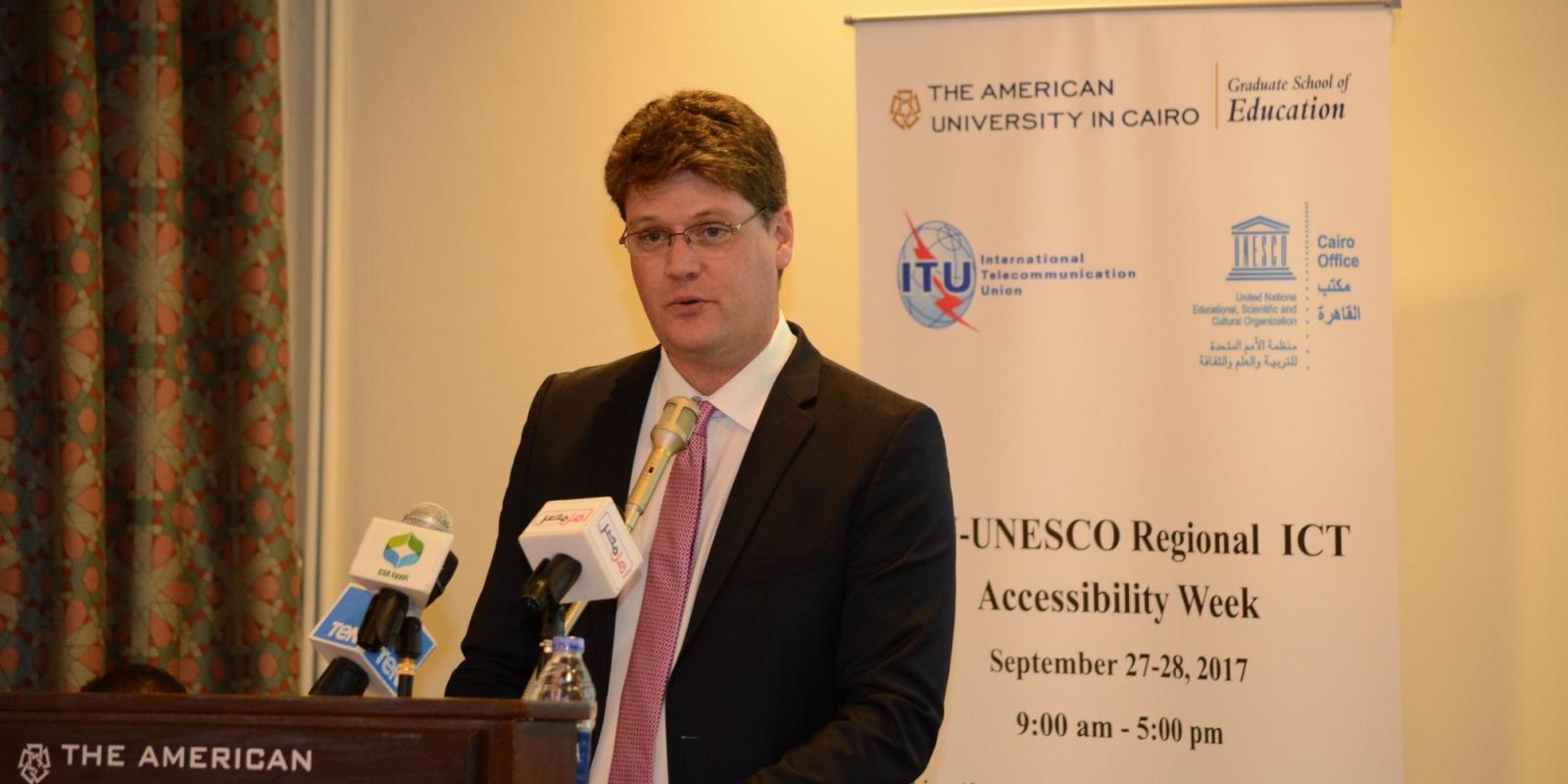
Ted Purinton, dean of AUC's Graduate School of Education, calls for recognition of the “massive hidden potential” of people with disabilities

AUC, UNESCO Partner to Make Education, Technology Accessible for People with Disabilities

Elizabeth Lepro October 01, 2017

Dressed in smart casual attire and settled in their seats in Prince Alwaleed Bin Talal Bin Abdulaziz Alsaud Hall, people began to adjust the volume on their translation headsets, flip through programs written in Braille and turn their heads toward a sign language interpreter at the front of the room.

If this didn’t make the message of the UNESCO and International Telecommunication Union’s (ITU) Regional ICT Accessibility Symposium clear enough, President Francis Ricciardone laid it out in his opening keynote, “Information must be accessible to all. It simply must be.”

“We take pride in being pioneers, with Egypt, in Egypt, for Egypt,” Ricciardone went on to say. “We recognize that we must devote special attention to making sure that [accessibility] is possible. We must think purposively and deliberately in our architectural arrangements for places of learning. We must think purposively and creatively in exploiting the telecommunications and electronic resources of our time. So this one area of massive change -- AUC is proud to be in it.”

About 35 educators; disability advocates; members of various governmental, nonprofit and international organizations; ministry representatives; technology specialists; and members of the AUC community gathered recently at the University for the symposium, which marked the end of a week of accessibility awareness and two days of workshops focused on making technology and education more accessible to people with disabilities.

Ted Purinton, dean of the Graduate School of Education (GSE), which hosted the event, called for recognition of the “massive hidden potential” of people with disabilities, who make up about 15 percent of the world’s population and about 12 percent of Egypt’s, according to the World Health Organization and United Nations estimates.

Despite these statistics, accommodations as simple as accessible sidewalks and ramps often remain missing from Egypt’s cityscape and public universities. This is a problem that alumna Amena El-Saie ’11, president and CEO of Helm foundation, and her colleagues are dedicated to solving. Presenting at the event, El-Saie described Entaleq app, which she and her team developed to make it easier to find out which businesses have accommodations before visiting. They also created accessible walkways and campaigns at Cairo University.

“We ask, ‘Why do people with disabilities not get a chance?’” El-Saie pondered. “The reason is because we have a role as a society to make every shop and every service [accessible] and to raise awareness about the private sector’s role.”

Speaking of her organization’s initiatives to work with local businesses directly, she noted the importance of including people with disabilities in Helm and creating opportunities for mentorship. “We tried to [just] employ people with disabilities in companies and we realized that’s not enough,” she said. “We realized that maybe our role is to try to show people what they are capable of doing -- and we want to ensure sustainability. This became the biggest tool that they have: self-confidence.”

The Ministry of Education has also made the inclusion of people with disabilities a more fundamental part of its mission throughout the last five years. According to a representative at the symposium, the ministry has made 500 schools more accessible, provided technology to 23 public universities, trained more than 1,200 persons with disabilities for employment and connected 300 with job opportunities at companies throughout Egypt.

Gihan Osman, assistant professor in the Center for Learning and Teaching and the Graduate School of Education, where she specializes in technology, has also been working on a variety of projects to enhance access to education to all Egyptians. “As we work for sustainable development, as we think of the importance of education for the development of Egypt, we need to put into consideration that we would be doing ourselves an incredible disfavor in ignoring such a huge, proportional population by depriving them of access to education -- and even more: of access to quality education,” Osman said.

As she spoke, AUC was coordinating with the Massachusetts Institute of Technology to host a panel session on blended and online learning -- a topic those in attendance knew was connected to the day’s discussion. “Here at AUC and in the rest of the world, there are increasing conversations about using technology and online learning to enhance access to quality education,” Osman continued. “But now, as we move in that direction, it’s very important that we put into consideration web accessibility and make sure that people with disabilities [not only] have access to quality information, but also have access to quality resources online.”

Alumna Heba Hagras ’82, ’98, a member of the Egyptian Parliament and a lifelong advocate for disability rights, relayed the importance of including the needs of people with disabilities among the priorities laid out in the Egyptian government’s sustainable development goals. “The key objective of the SDGs is for no one to be left behind, and so these objectives lead us to start with marginalized groups,” Hagras said.

Highlighting the potential -- and limits -- of technology for marginalized groups, Hagras added, “Of course, we all know that technology, once it emerged, was valuable to people with disabilities. It was like the Great Wall of China to them. Until people with disabilities started to attack technology, saying ‘you are building high walls that we cannot climb’.”

Hagras acknowledged that technology is one of the most valuable tools for people with disabilities, but still criticized a lack of coordination between governmental ministries in facilitating its use and creating policy focused on accessibility.

All panelists agreed that, despite bureaucracy and misconceptions, it is possible to create a more accessible Egypt. “A lot of people said it’s not doable,” El Saie said. “It is doable. We’ve done it.”
 

Related stories

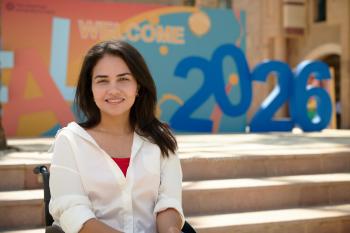
A girl posing to the camera right next to a massive Fall 2026 decoration
September 23, 2026

The Story Behind the Design

Hayam Sayed, graphic design staff intern at the Office of Marketing Communication and Public Affairs who joined AUC as part of the People with Disabilities (PwD) Employee Mentorship and Development program, had previously contributed to the campus decoration campaign through her work. This time, she was given full ownership of the creative design, which was then applied to flags, danglers, mockups, tripods and instant photo frames across campus."It’s very rewarding to see my designs all around campus.”“It was like a gift for me,” she says. “I was entrusted with a big project, so I took it seriously and felt responsible for it. It’s very rewarding to see my designs all around campus.”After extensive research, Sayed spent nearly two months developing ideas and exploring different directions. She refined concepts and explored multiple options to develop the final visual direction. She also incorporated additional visual elements to give the design more depth, while keeping it catchy and relatable for students.“I wanted to create something colorful and simple, but also flexible enough to work across different applications throughout the year,” she said. “I wanted the campus decorations to stand out.”Sayed’s path to design was far from conventional. She holds both a bachelor’s and master’s degree in electrical engineering and spent five years as a teaching and research assistant in Kuwait — an experience she describes as highly academic. When she moved to Egypt several years ago, she started freelancing as a graphic designer during COVID."Engineering taught me to think analytically and systematically, whereas design taught me to think creatively."What began as remote work in digital marketing gradually opened the door to Sayed’s career in graphic design. As a PwD intern at AUC, she found the environment to turn that interest into a profession. “I learned so much from everyone I work with at AUC, and I’m so grateful for that,” she said. “I love math, but as a career, I love graphic design. Engineering taught me to think analytically and systematically, whereas design taught me to think creatively. Art is multifaceted; there are different ways of communicating a single message. Design can invite people in, communicate information, tell a story, or make someone stop and look. That’s what I enjoy the most about it.”
University News
Students participating in the simulation with "stepping into the shoes of others" on the board
December 3, 2025

Stepping Into Others’ Shoes: AUC Students Run Accessibility Simulation

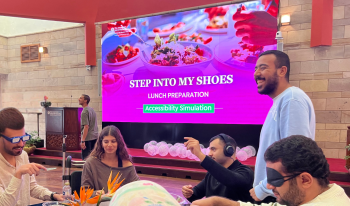
To honor the International Day of People with Disabilities, the Psychology of Inclusion and Exclusion in Egypt undergraduate class set up an accessibility simulation, bringing together students and faculty from across the AUC community to gain a new perspective on what life is like with a disability — stepping into the shoes of others. The event, hosted by the Center for Student Wellbeing and Student Accessibility Services, started with each attendee being assigned a disability. Some were assigned visual impairments and given eye masks. Some participants were designated audio impairments and wore noise cancelling headphones. Others were given various mobility restrictions, such as being paralyzed from the waist down or having limited mobility in their hands. Together, the participants had to work together to make a salad, a task that might seem simple but had many added challenges. Participants worked together to navigate cutting vegetables, reaching across a wide table and communicating through the challenges that come with audio and visual impairments.The simulation showed participants the ways people with disabilities have to go about their daily lives as well as how they can support each other. Participants had to rethink their typical teamwork processes to play to their strengths and accommodate gaps. Those with mobility impairments could help coordinate visually with those with audio impairments and auditorily to those with visual impairments. The experience showed how important accommodation, support, grace and understanding are to people with disabilities.“The event was a focused, high-impact simulation designed to foster empathy and build awareness among participants regarding the challenges faced by individuals living with various disabilities,” explained Alexandra Gazis, associate director of Student Accessibility Services at AUC and course instructor. “The primary goal is to provide attendees who do not have a disability with a short, experiential understanding of how simple, everyday tasks can become exclusionary, especially when various barriers are present.”The purpose of this simulation was to help raise awareness of the ways that disabilities impact daily life and the ways that the AUC community can think through necessary accommodations by being conscious of what it's like to live with disabilities.“The simulation was a great way to raise awareness of the realities of living day to day as a student with a disability,” shared Grainne Condron, one of the students in the class. “I see this collaboration between staff and students as making strides toward real change.”Additionally, AUC will be lighting the plaza and Bassily Auditorium in purple on December 3 to celebrate the International Day of People with Disabilities. AUC will be the first institution to light its buildings purple for this occasion in Egypt, marking once again its commitment to accessibility and visibility. 
Student Experience
Heba Kotb doing field research
December 3, 2025

AUC Psychology Professor Aids WHO Funded Study on Autism Care Training in Egypt

As researchers and psychologists work to improve the lives of those with autism around the world, the need for country-specific support networks and training has become clear. Heba Kotb ‘84, associate professor of practice in psychology, helped to develop an Egypt-specific autism training program in partnership with the World Health Organization and international universities. “It’s critical that we tailor autism care to specific cultural environments, which is exactly what this research developed," Kotb explained. “The importance of this program comes not only from the context-specific research, but also the ability to share it with families who need the support.”Autism care in Egypt has been heavily concentrated in major urban areas, with limited access to support for those outside of Cairo. This study — which was in partnership with AUC, the University of Maryland, McGill University’s Montreal Neurological Institute-Hospital, Egypt’s Ministry of Health and Population, Autism Speaks and WHO — sought to train families to care for the needs of youth with autism. The study sent out 16 Master Trainers to conduct five-day intensives in rural areas, with the intention of providing caregivers — mainly mothers — with the knowledge to support their children. Kotb worked with the international partners to design the training for the Egypt-specific program. “Egypt has a very different societal context around caregiving than, say, the United Kingdom,” Kotb affirmed. “It was essential that we consulted on this context so that Egyptian families could best access the support they needed.” Kotb also helped to assess the effectiveness of the program after it was concluded, interviewing eight mothers in Upper Egypt and 10 in Alexandria. She then provided thematic analysis on the data, which was published into a paper last August, concluding that programs like the country-specific master training do have a strong impact.“The interviews were really eye opening; I couldn't believe the impact of the program. Families don't get many services, especially for children with disabilities. In many cases, they are neglected,” Kotb said. Reflecting  on her experience within the study, Kotb said that parents shared with interviewers that their children couldn’t speak and would spend all day at home doing nothing until this program began training them how to better interact with their kids.. “The parents described it as a miracle,” Kotb said. “The children were suddenly speaking and playing, and became toilet-trained. They started to learn that they can actually do anything.”    Kotb has been specializing in researching children with disabilities for over 30 years. After getting her bachelor’s in psychology from AUC, she worked as an educator in a school for students with disabilities before eventually pursuing her PhD in education from Leeds University in the United Kingdom. Since then, she has been researching how to make schools accessible for all students. “I found working with children with disabilities to be incredibly rewarding. All my research has been in the area of disability studies, and it’s such satisfying work.”Ultimately, Kotb hopes that this study will serve as a pilot program that will lead to many other training programs like it. Now that the study is concluded, WHO and Egypt’s Ministry of Health will potentially work together to expand the training. Kotb is eager to continue helping. “I think the training program should be spread to all cities. Children with autism are everywhere. Many people don't realize that children with autism can be educated and trained, and can become productive members of society. We need to continue working to provide support.”
Civic Engagement
visual impaired person guided by someone
October 20, 2025

Tips on Navigating Inclusivity

Debunking myths, Farid shared firsthand tips on the do’s and don’ts of engaging with people with visual impairments:Face to FaceDon’t assume we need help. Ask first.If we do need help, it will only relate to visual impairment. We don’t need help with everything.Communicate with us on how we would like to be assisted so there is mutual respect for each other’s space. Don’t ask someone to lead us out of a place. Speak to us directly on how we would like to be guided.Offering help is thoughtful and appreciated, but don’t go out of your way to accompany us wherever we go. Sometimes giving directions is all we need.Don’t treat us differently than people around us. If we’re standing with a group, there is no need to grab a chair for us or get us coffee. Don’t give us front-row seating. These are nice gestures from well-intentioned people, but they make us feel uncomfortable.You don’t need to raise your voice to speak with us. We only lost our eyesight; our other senses are not affected.If two people, including a person with a visual impairment, are talking to you or asking a question, address them both. Don’t just speak to the sighted person. We can sense it.The tools we use are not toys for others to fool around with. My cane is indispensable for my safety and existence.Avoid grabbing or pulling someone’s cane, even if you’re trying to help that person move around. It’s dangerous and invasive. You can ask to hold one end of the cane while we hold the other.Don’t scream “Be careful” or honk at us when crossing the street. It distracts rather than alerts us.
Student Experience
Share