Home page
ع
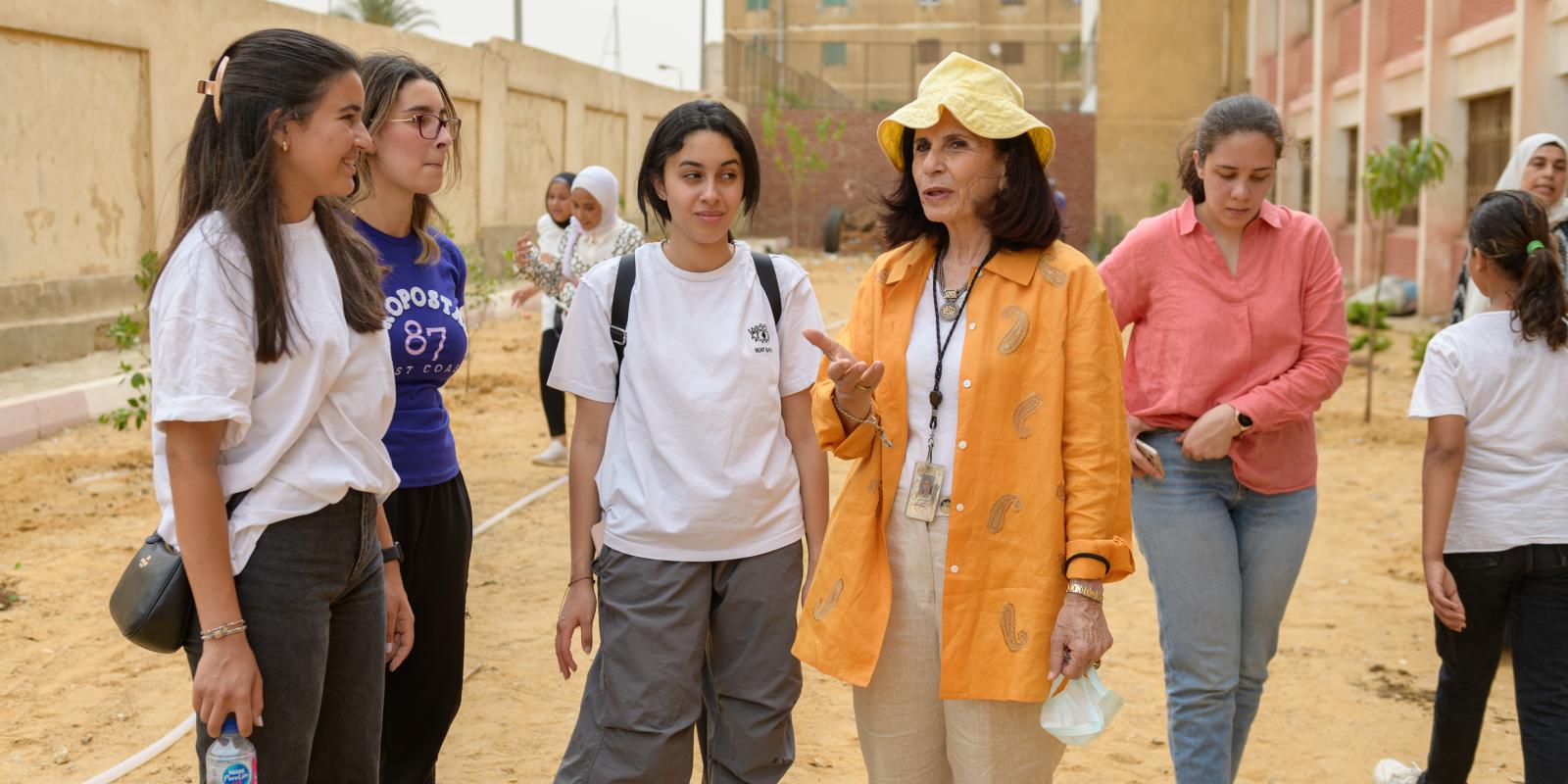
a woman in an orange shirt speaks with students in the yard of a school

Public School Initiative Honored by Ministry of Education

January 16, 2024
Civic Engagement


On December 31st, 2023, the Ministry of Education celebrated the success of the School University Partnership (SUP) at the Abou El Enein school in New Cairo. The Minister of Education expressed gratitude to AUC for their pivotal role in the initiative's success, and announced plans to integrate SUP into the national strategic plan, extending its reach across all Egyptian educational directorates.

Initiated by the Middle East Institute for Higher Education, the SUP project involved the collaboration of undergraduate and graduate students, AUC faculty from various disciplines, and government school teachers and pupils in order to leave a lasting impact on nine neighboring government schools. Throughout the Spring, Summer, and Fall of 2023, the team dedicated their efforts to developing student citizenship, leadership and participation, supporting sustainable development in schools, and opening doors for digital literacy.

The event, attended by the entire community-based learning team, featured Malak Zaalouk, who provided a historical background of the initiative. School pupils presented their accounts of the transformative impact SUP had on their schools. As a result of this successful collaboration, the Minister of Education recognized the program's potential to shape the future of education in Egypt.

Read more about the SUP initiative in AUCToday

Header photo (taken by Ahmad El Nemr): A new outreach initiative from AUC’s Middle East Institute of Higher Education is creating school-university partnerships that promote community engagement, empower public school students and foster sustainable development.
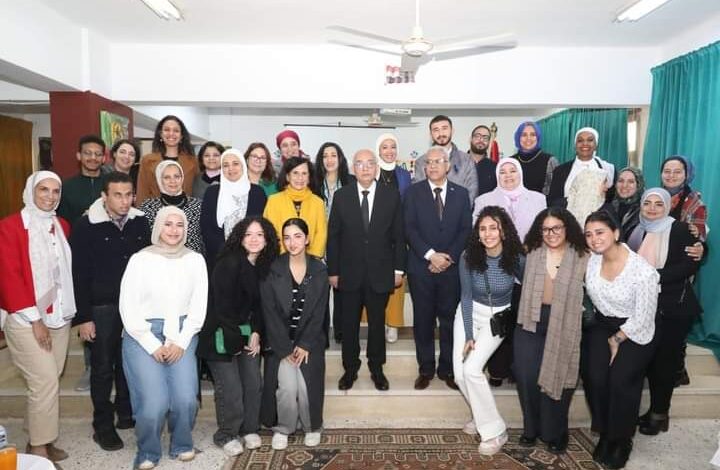
 

A group of participants at the SUP honoring event
SUP participants pose with Ministry officials at the event held at Abou El Enein school.


Related stories

A man is crouched in the water planting. A large shrub is behind him
September 29, 2026

AUC to Lead Climate Training Program for Africa

AUC is partnering with Egypt’s Ministry of Water Resources and Irrigation to implement a climate leadership program for Africa, training 100 African professionals from more than 22 countries across the continent in water management and climate-smart agriculture."AUC has the academic and research expertise, as well as capacity-building and program-management capabilities, to bring all the elements of the project together."The program, known as Building Climate Leadership Excellence for African Resilience (BCLEAR), is funded through an AUC grant from the William and Flora Hewlett Foundation. As the implementing partner, AUC is the entity responsible for overall management of the program in collaboration with the ministry's Nile Water Affairs Sector.The training will comprise three modules: Water-Energy-Food Nexus, Training of Trainers, and Crop Water Management—with sessions held in Egypt, Uganda and Rwanda. As part of the agreement, AUC will lead the content development and delivery of the Water-Energy-Food Nexus and Training of Trainers modules in each country, while the Crop Water Management module will be adapted and delivered by implementing partners to reflect the local climate and country context. In Cairo, the ministry’s Nile Water Affairs Sector, through the Regional Training Center for Water Resources and Irrigation, will serve as the local implementing partner. Hossam El Zayat, deputy director and senior manager of projects at AUC’s Center for Applied Research on the Environment and Sustainability, which manages the BCLEAR project, said the University’s role is to manage the implementation of the program and consolidate the program’s academic and research components.“AUC has the academic and research expertise, as well as capacity-building and program-management capabilities, to bring all the elements of the project together,” said El Zayat. “We are not just training professionals to work in the market. There is an educational element. We are training future trainers. We are preparing educators because AUC is by definition an educational institution.”Four cohorts are planned, with the first scheduled for October 2026 and the final one for April 2027. Under the program’s monitoring and evaluation plan, each of the 100 participants will commit to training at least 20 additional people after returning home, potentially extending the program’s reach to nearly 2,000 people."We are training future trainers."“In Egypt, we have a set of challenges different from what you find in other countries like Rwanda or Uganda,” said El Zayat. “Most of our agricultural challenges revolve around the optimization of water consumption and management.” Developing urban agriculture solutions in the face of water and food scarcity is the core of the expertise at CARES. AUC will contribute resources to the training from various disciplines, mainly the School of Sciences and Engineering.AUC’s partnership with the ministry gives the program access to its regional networks and training infrastructure, while allowing local partners in Uganda and Rwanda to tailor part of the curriculum to conditions in their respective countries.“Africa has not been receiving adequate support to tackle its climate challenges,” said El Zayat. “This program helps address this need by uplifting African professionals and bridging the gap between theoretical knowledge and practical skills to ultimately enhance livelihoods across the continent, including Egypt."
Science and Tech
a man wearing a suit and glasses, standing in the architecturally hollow space inside the HUSS building
September 14, 2026

New Dean, Familiar Ties

Maurice Pomerantz is the new dean of the School of Humanities and Social Sciences (HUSS). He is no stranger to the University, having studied at the Center for Arabic Study Abroad@AUC in 1996 — a unique experience that triggered his lifelong engagement with Arabic literature and Middle Eastern studies.“I loved learning languages,” Pomerantz said. “I had studied classics and religion as an undergraduate, and toward the end of my junior year, my professor said to me, ‘Someone like you should really learn Arabic and study the origins of Islam.’ I took a year of Arabic (which was a challenge) and then went off to Cairo to follow this advice. Being a student in Cairo and my year of study in CASA@AUC was transformational. I had studied the history of the region in the abstract, but coming to Cairo taught me about the importance of history and politics in people's lives, and it gave me a new perspective that I did not have before.""The trick is getting faculty and students to a place where they can forget about all that exists and have a powerful conversation. That’s the way I look at the job of the dean: making sure those kinds of important educational moments happen as they should."Pomerantz comes to AUC from New York University Abu Dhabi, where he most recently served as executive director of the NYU Abu Dhabi Institute and as a professor of literature and Arab crossroads studies. He joined NYU's Department of Middle Eastern and Islamic Studies in New York in 2008, then moved to NYU Abu Dhabi in 2013, where he took on a series of academic leadership roles over the following decade.As dean of HUSS, Pomerantz aims to create a healthy learning community, where AUC students can experiment with new ideas and challenge themselves. “Teaching of all kinds is a personal act, and it’s best understood on that level,” he said. “Institutional structures matter deeply, courses, requirements etc., but the trick is getting faculty and students to a place where they can forget about all that exists and have a powerful conversation. That’s the way I look at the job of the dean: making sure those kinds of important educational moments happen as they should.”"Being a student in Cairo and my year of study in CASA@AUC was transformational. I had studied the history of the region in the abstract, but coming to Cairo taught me about the importance of history and politics in people's lives, and it gave me a new perspective that I did not have before."Pomerantz received his BA in classics and religion and an MA and PhD in Near Eastern languages and civilizations all from the University of Chicago.He has also been a long-serving member of the editorial board of NYU Abu Dhabi’s Library of Arabic Literature, a landmark translation series for classical Arabic literature. His international recognitions include a Mellon Fellowship at the Institute for Advanced Study in Princeton and Fulbright faculty fellowships in Jordan and Lebanon.  What’s something people don’t know about you?I'm an avid musician and sang in musical ensembles throughout high school, college and graduate school. How did you get into Middle Eastern music?I always enjoyed the music of the region, but I didn't know a lot about it. Around six years ago, I took up the oud in an attempt to learn more, and now you'll find me practicing most evenings. What else do you do in your free time?I'm a lifelong reader of novels. We are only given one life. Through fiction, we can explore the lives and perspectives of others. What’s your favorite memory from when you were a student?  It was a moment when my adviser discovered something in me that I myself could not see at the time. When I returned to the University of Chicago after living in Egypt, I was determined to become a serious historian of the formative period of Islam. In one of my first graduate-level courses, we were exploring the early Islamic administration of Umayyad Egypt through bilingual Arabic and Greek papyri. It was very difficult, painstaking work, and all of the students struggled to make sense of these documents. Even the script was hard to read. In the midst of these long seminars, I asked a question about the nuance of an Arabic word, wondering if I missed something. My adviser’s eyes lit up, and she said somewhat severely, "Maurice, that’s a very literary question!” I remember thinking, “Oh no, I imagine she thinks I don’t have what it takes to be a good historian.”  Several weeks later, she invited me to work on a translation of a complex text written by the great 10th-century polymath, Abū Ḥayyān al-Tawḥīdī, that she was working on at the time.  She told me that this text was literary and she sensed I had a talent for words and imagery.  That invitation encouraged my talents and gave me the confidence to use them in research. And it was how I became a scholar of Arabic literature. Favorite movie genresMysteries. In another life, I would have been a detective chief inspector. Favorite book?Recently, Gravel Heart by Abdulrazak Gurnah. It's a classic postcolonial novel that becomes something else altogether. Favorite authorI’ll give you some things you might not guess at. George Eliot is my favorite classic English novelist. I love to read travel writing from the Middle East. If you've never read Evliya Celebi’s travels, you must. In Arabic, I’ve recently enjoyed reading more of Ibrahim al-Koni, and I will never think about desert landscapes in the same way again. Favorite foodIf we are talking about preferences here, kunāfa is better than qatā’if. By the way, this is a question to which the Mamluk-era polymath al-Suyūṭī devoted a monograph: "An Elegant Debate Between Kunāfa and Qaṭāif" (Luṭf al-laṭā’if bayn al-kunāfa wa-l-qaṭā’if). Your question makes me think I should write a similar monograph on the difference between bamiya (okra) and molokhiyya. Not to give anything away, but my preference is for bamiya. What accomplishment are you most proud of?I think the times I've served as a mentor to others have been the work that has really meant the most to me in my life. That is the most important thing we do. Advice to AUC students Find a way to connect your studies to the world around you. Academic work is a great opportunity to reflect on the changes you want to make in yourself and the world around you. 
University News
AUC students cheer from the stands holding an AUC banner.
September 14, 2026

AUC Students Shine at All-Africa University Games

AUC students brought home medals across swimming, badminton, taekwondo, fencing, squash and more at this week's All-Africa University Games. Here's the full medal count.SwimmingAli Tharwat🥇 Gold – 800m freestyle🥈 Silver – 1,500m freestyle🥉 Bronze – 200m freestyle🥉 Bronze – 400m freestyleMalak Abass🥇 Gold – 50m butterfly🥈 Silver – 50m freestyle🥈 Silver – 100m freestyleFarida🥉 Bronze – 100m butterflyYassin Nabil🥉 Bronze – 200m backstrokeIslam Nashaat🥉 Bronze – 50m backstrokeMaya Abdelaziz🥉 Bronze – 400m freestyle AUC Women's Relay Teams🥇 Gold – 4x200m freestyle relay🥈 Silver – 4x100m freestyle relay🥉 Bronze – 4x100m medley relay AUC Men's Relay Teams🥈 Silver – 4x200m freestyle relay🥈 Silver – 4x100m freestyle relay🥉 Bronze – 4x100m medley relay Para SwimmingAya Ayman🥇 Gold – 100m freestyle🥇 Gold – 100m breaststroke🥇 Gold – 50m freestyle Malak Abdelshafy🥇 Gold – 50m backstroke🥇 Gold – 50m breaststroke🥈 Silver – 100m breaststroke🥈 Silver – 50m dolphin🥈 Silver – 100m freestyle🥉 Bronze – 50m freestyle Mohamed Elsayed🥇 Gold – 50m backstroke🥇 Gold – 100m freestyle🥇 Gold – 50m breaststroke Badminton🥉 Bronze – Team Event🥉 Bronze – Women's doubles (Ganna Elwazery and Nour Refaat) Para Badminton🥉 Bronze – Abdelrahman Shebieb Taekwondo🥇 Gold – Adham El Sheikh (+80kg) JudoMen🥉 Bronze - Mostafa Hamada FencingMen🥇 Gold – Omar Dewedar🥈 Silver – Ali DewedarWomen🥉 Bronze - Yassmin El Gamal Squash🥇 Gold – Team EventMen🥇 Gold – Karem El Torky🥈 Silver – Hassan Al-Menshawy🥉 Bronze – Omar EhabWomen🥉 Bronze – Amina El Borolossy TennisMen Singles🥇 Gold – Gawad El Feky🥉 Bronze – Mostafa SallamWomen Singles🥇 Gold – Amina Osman🥈 Silver – Hana MokhlesMen Doubles🥇 Gold –Mahmoud Fathalla and Gawad El Feky🥈 Silver – Yassin Hefnawy and Mostafa SallamWomen Doubles🥇 Gold –Amina Osman and Hana Mokhles🥈 Silver – Mariam Tamer and Talia AmrMixed Doubles🥇 Gold –Amina Osman and Gawad El Feky🥈 Silver – Yassin Hefnawy and Hana Mokhles🥉 Bronze – Mahmoud Fathalla and Talia Amr Pentathalon🥇 Gold – Team Events Men🥇 Gold – Team Events Women🥇 Gold – Mixed Doubles (Dahab Sherif and Adam Mohamed)Women Singles🥈 Silver – Dahab Sherif Table TennisWomen Singles🥇 Gold – Roaa Amr Men Singles🥉 Bronze – Yassin WaelMixed Doubles🥉 Bronze – Roaa Amr and Yassin WaelMen Doubles🥇 Gold –Yassin Wael and Mohamed Elwakel PadelMen 🥇 Gold – Mohamed Ragab and Sherif SalahWomen 🥈 Silver – Talia Mebed and Malak Islam🥉 Bronze – Marla Fady and Hana IhabMixed Doubles🥈 Silver – Hana Shehab and Sherif Salah🥉 Bronze – Mohamed Ragab and Malak Islam FutsalWomen Team🥇 Gold – First Place BasketballWomen Team🥈 Silver – Second Place
University News
A person in front of a pyramid of cubes with text on their sides, points to a folder that says career accelerator
July 20, 2026

AUC’s School of Continuing Education Launches the Career Accelerator

The School of Continuing Education launched the Career Accelerator initiative, a professional learning model enabling professionals to earn credentials within weeks amid an evolving workforce.“The world of work is being reimagined. Careers are no longer linear paths; they are crafted piece by piece, shaped by each individual's ambition,” said Mahmoud Allam, dean of SCE.The initiative’s launch at AUC Tahrir Square featured a full day of 33 career-building workshops, including professional CV reviews, mock interviews, LinkedIn profile optimization and skills assessments led by the Advising Center.The Career Accelerator offers 17 career tracks and 200 stackable credentials accredited under the international ANSI/IACET standard. Instead of long-term fixed programs, the flexible model allows professionals to earn future-ready skills and credentials through real workplace-relevant tasks at their own pace.These credentials can be combined over time into larger qualifications, preparing learners to succeed in the Egyptian and regional labor market. After completion, learners receive a verified digital badge and certificates of competency to add to a CV or professional profile.The Career Accelerator represents a significant shift in how professional education is delivered in Egypt and the region. The initiative also offers the Career Clinic, a personalized career service advising professionals on skill gaps, strengths and what credentials they need to achieve their career goals.Allam added that educators have a responsibility to remain responsive to the evolving market needs and to empower learners to build their journeys on their own terms.“The Career Accelerator embodies that freedom. We are not only preparing learners for the future of work, but we are also equipping the very people who will define and create it,” Allam said.
University News
Share