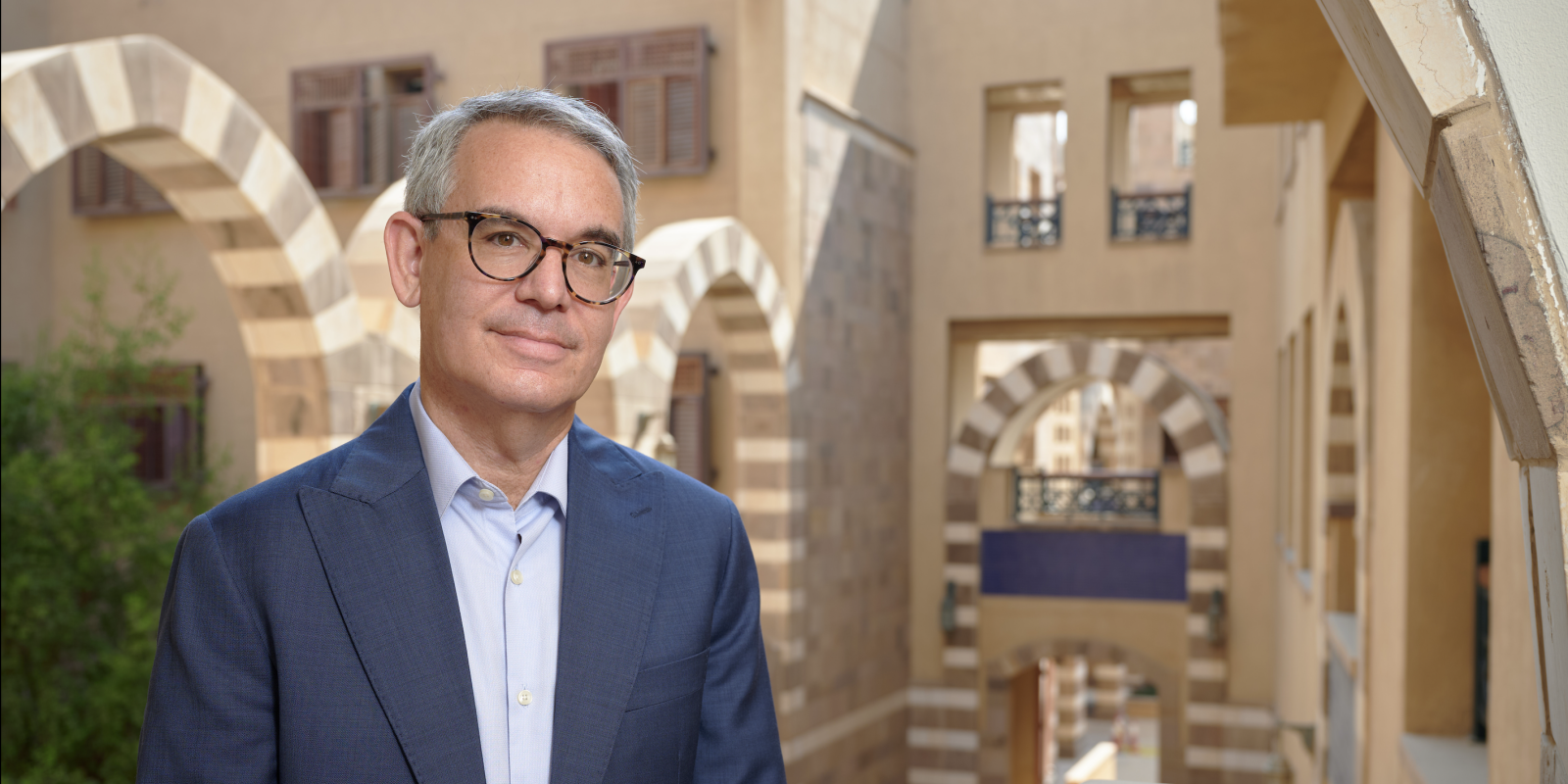
New Dean, Familiar Ties
Maurice Pomerantz is the new dean of the School of Humanities and Social Sciences (HUSS). He is no stranger to the University, having studied at the Center for Arabic Study Abroad@AUC in 1996 — a unique experience that triggered his lifelong engagement with Arabic literature and Middle Eastern studies.
“I loved learning languages,” Pomerantz said. “I had studied classics and religion as an undergraduate, and toward the end of my junior year, my professor said to me, ‘Someone like you should really learn Arabic and study the origins of Islam.’ I took a year of Arabic (which was a challenge) and then went off to Cairo to follow this advice. Being a student in Cairo and my year of study in CASA@AUC was transformational. I had studied the history of the region in the abstract, but coming to Cairo taught me about the importance of history and politics in people's lives, and it gave me a new perspective that I did not have before."
"The trick is getting faculty and students to a place where they can forget about all that exists and have a powerful conversation. That’s the way I look at the job of the dean: making sure those kinds of important educational moments happen as they should."
Pomerantz comes to AUC from New York University Abu Dhabi, where he most recently served as executive director of the NYU Abu Dhabi Institute and as a professor of literature and Arab crossroads studies. He joined NYU's Department of Middle Eastern and Islamic Studies in New York in 2008, then moved to NYU Abu Dhabi in 2013, where he took on a series of academic leadership roles over the following decade.
As dean of HUSS, Pomerantz aims to create a healthy learning community, where AUC students can experiment with new ideas and challenge themselves. “Teaching of all kinds is a personal act, and it’s best understood on that level,” he said. “Institutional structures matter deeply, courses, requirements etc., but the trick is getting faculty and students to a place where they can forget about all that exists and have a powerful conversation. That’s the way I look at the job of the dean: making sure those kinds of important educational moments happen as they should.”
"Being a student in Cairo and my year of study in CASA@AUC was transformational. I had studied the history of the region in the abstract, but coming to Cairo taught me about the importance of history and politics in people's lives, and it gave me a new perspective that I did not have before."
Pomerantz received his BA in classics and religion and an MA and PhD in Near Eastern languages and civilizations all from the University of Chicago.
He has also been a long-serving member of the editorial board of NYU Abu Dhabi’s Library of Arabic Literature, a landmark translation series for classical Arabic literature. His international recognitions include a Mellon Fellowship at the Institute for Advanced Study in Princeton and Fulbright faculty fellowships in Jordan and Lebanon.
What’s something people don’t know about you?
I'm an avid musician and sang in musical ensembles throughout high school, college and graduate school.
How did you get into Middle Eastern music?
I always enjoyed the music of the region, but I didn't know a lot about it. Around six years ago, I took up the oud in an attempt to learn more, and now you'll find me practicing most evenings.
What else do you do in your free time?
I'm a lifelong reader of novels. We are only given one life. Through fiction, we can explore the lives and perspectives of others.
What’s your favorite memory from when you were a student?
It was a moment when my adviser discovered something in me that I myself could not see at the time. When I returned to the University of Chicago after living in Egypt, I was determined to become a serious historian of the formative period of Islam. In one of my first graduate-level courses, we were exploring the early Islamic administration of Umayyad Egypt through bilingual Arabic and Greek papyri. It was very difficult, painstaking work, and all of the students struggled to make sense of these documents. Even the script was hard to read. In the midst of these long seminars, I asked a question about the nuance of an Arabic word, wondering if I missed something. My adviser’s eyes lit up, and she said somewhat severely, "Maurice, that’s a very literary question!” I remember thinking, “Oh no, I imagine she thinks I don’t have what it takes to be a good historian.”
Several weeks later, she invited me to work on a translation of a complex text written by the great 10th-century polymath, Abū Ḥayyān al-Tawḥīdī, that she was working on at the time. She told me that this text was literary and she sensed I had a talent for words and imagery. That invitation encouraged my talents and gave me the confidence to use them in research. And it was how I became a scholar of Arabic literature.
Favorite movie genres
Mysteries. In another life, I would have been a detective chief inspector.
Favorite book?
Recently, Gravel Heart by Abdulrazak Gurnah. It's a classic postcolonial novel that becomes something else altogether.
Favorite author
I’ll give you some things you might not guess at. George Eliot is my favorite classic English novelist. I love to read travel writing from the Middle East. If you've never read Evliya Celebi’s travels, you must. In Arabic, I’ve recently enjoyed reading more of Ibrahim al-Koni, and I will never think about desert landscapes in the same way again.
Favorite food
If we are talking about preferences here, kunāfa is better than qatā’if. By the way, this is a question to which the Mamluk-era polymath al-Suyūṭī devoted a monograph: "An Elegant Debate Between Kunāfa and Qaṭāif" (Luṭf al-laṭā’if bayn al-kunāfa wa-l-qaṭā’if). Your question makes me think I should write a similar monograph on the difference between bamiya (okra) and molokhiyya. Not to give anything away, but my preference is for bamiya.
What accomplishment are you most proud of?
I think the times I've served as a mentor to others have been the work that has really meant the most to me in my life. That is the most important thing we do.
Advice to AUC students
Find a way to connect your studies to the world around you. Academic work is a great opportunity to reflect on the changes you want to make in yourself and the world around you.
