Home page
ع
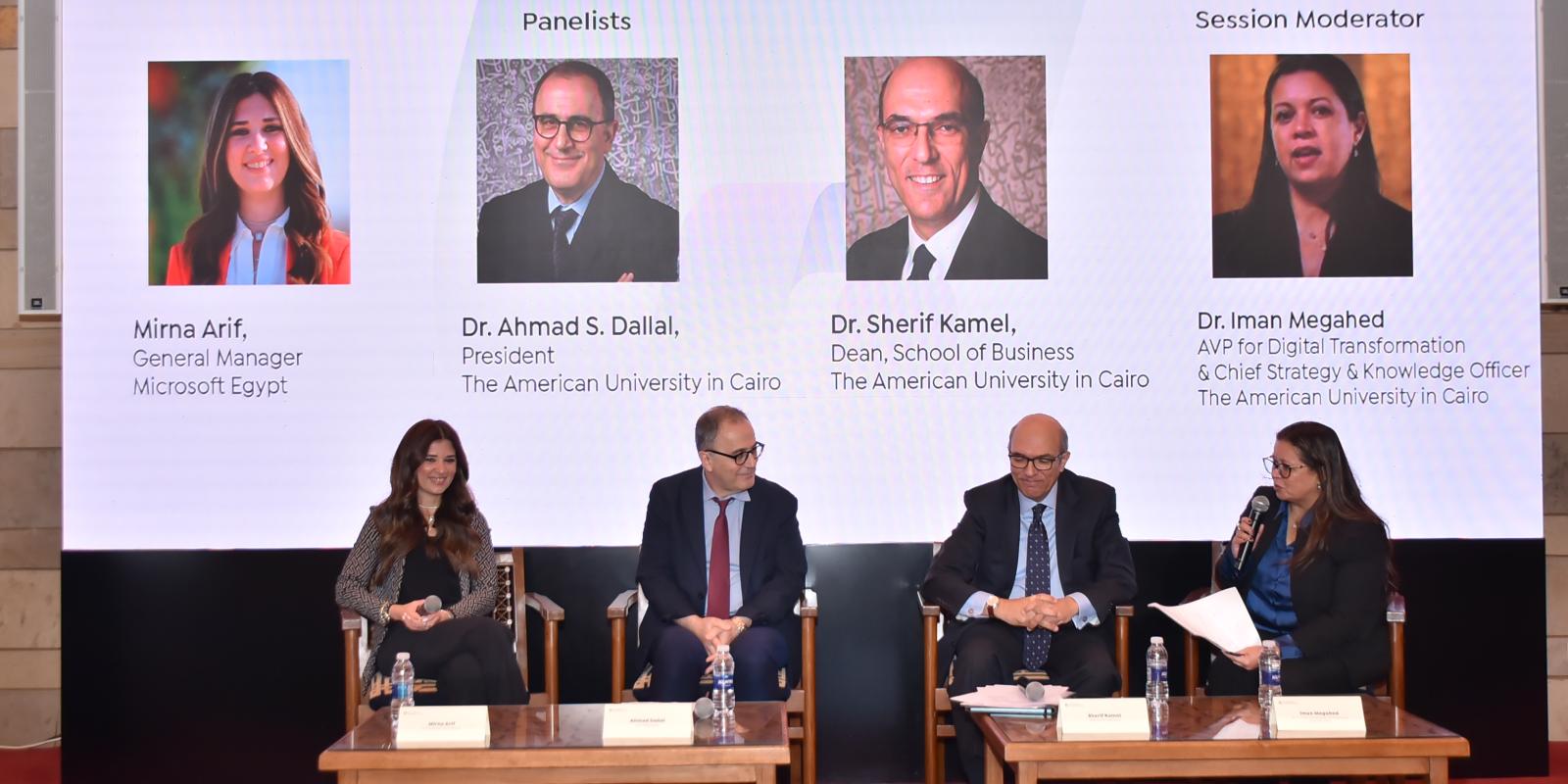
Microsoft panelists sit on a stage

Microsoft: “AI Democratization Will Continue to Expand” 

Dalia Al Nimr December 02, 2024
Science and Tech

At the forefront of the global conversation on the future of AI in higher ed, AUC engaged in discussions with a Microsoft leadership team on campus about “Shaping the Future with Responsibility.” News@AUC spoke with Amr ElMasry, education lead at Microsoft North Africa, to learn about advancing the future of higher ed with AI.

How can universities and students adopt AI responsibly?

  • Instilling a strong understanding of ethical AI principles in their curricula
  • Implementing guidelines that ensure fairness, privacy and accountability around AI usage
  • Providing access to the right tools, platforms and resources. 
  • Staying updated on the latest AI advancements and ethical implications

Universities can partner with technology leaders like Microsoft to help foster a responsible AI ecosystem that encourages innovation while also maintaining the highest standards of safety and security. 

What trends do you see shaping the future of AI in the next five years?

  • Generative AI will revolutionize industries by enabling personalized learning experiences, creative problem-solving tools and advanced content generation. 
  • AI-powered automation will streamline tasks, allowing educators and students to focus on higher-level thinking and creativity. 
  • The integration of AI with real-time data analytics will enhance decision making across sectors, supporting adaptive learning systems in education.
  • A growing emphasis on responsible AI practices, with regulatory frameworks and standards becoming more robust to ensure ethical and equitable AI adoption globally.
  • The rise of Edge AI, where AI systems operate directly on devices such as smartphones and IoT devices, enabling offline applications and reducing latency. 
  • AI democratization will continue to expand, as providers work with public and private institutions to lower barriers to entry, empowering students, startups and educators to create impactful AI solutions without needing extensive technical expertise.

How do you envision the role of AI evolving in the higher education sector?

  • It will enhance personalized learning by offering tools that adapt to individual students’ learning paces and styles, providing tailored resources and feedback. AI-driven platforms will foster collaborative learning and the sharing of knowledge  by connecting students and researchers worldwide, breaking down geographical barriers. 
  • AI will advance academic research by expediting data analysis, leading to breakthroughs in disciplines such as medicine, engineering, social sciences and more. 
  • As AI becomes more integrated into curricula, universities will play a pivotal role in upskilling students with the technical and ethical expertise required to thrive in AI-driven industries. 

We will see [personalized learning] in the form of AI tutors that will encourage learning both inside and outside the classroom. Administrative tasks, such as grading, course scheduling and other workflows, will become increasingly streamlined through automation, enabling educators to dedicate more time to teaching, guidance and mentorship. 

It will enhance personalized learning by offering tools that adapt to individual students’ learning paces and styles, providing tailored resources and feedback. What advice would you give to students interested in pursuing a career in AI?

  • Focus on building a strong foundation, staying curious and embracing practical experience.
  • Take the time to develop proficiency in both mathematics and computer science, and start familiarizing yourselves with programming languages like Python and Java. 
  • Staying informed about advancements in areas such as generative AI, ethical AI and emerging trends by engaging with research papers, conferences and online courses. 
  • Gaining hands-on experience through internships and traineeships.
  • Interdisciplinary learning, as combining AI knowledge with domains such as business, healthcare or environmental science can unlock innovative applications.
  • Cultivating skills in communication, teamwork and critical thinking to collaborate effectively with diverse teams. 

With the right skills, mindset and opportunities, students can play a pivotal role in shaping AI’s future responsibly. Platforms like Microsoft Learn offer resources to help students build essential AI and machine learning skills. Another great resource is the Microsoft AI Skills Navigator, a comprehensive platform designed to provide learners with personalized AI education, offering an AI-powered assistant to guide users to the most suitable learning paths based on their goals, roles and skill levels. 
Related stories

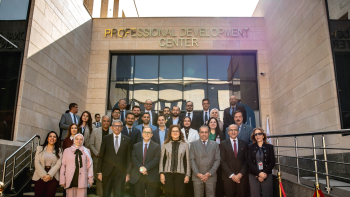
administrators standing in front of new professional development center
January 27, 2026

AUC Expands Professional Development Programs to Administrative Capital

AUC has signed an exciting new agreement with the Administrative Capital for Urban Development (ACUD) to bring academic and professional opportunities to the New Capital through AUC’s School of Continuing Education (SCE). Under this agreement, SCE’s Professional Development Center will now be located in the Administrative Capital, enabling professionals to continue developing their skill sets.“The opening of AUC’s School of Continuing Education Professional Development Center at the New Capital marks a significant milestone in SCE’s commitment to lifelong learning and extended education,” said Mahmoud Allam, dean of the School of Continuing Education. “Through this center, we aim to support the continuous professional development of government employees and professionals, while extending AUC’s impact beyond campus and closer to the institutions shaping Egypt’s future.”The School of Continuing Education has many partnerships with outside institutions, including the Ain Shams Medical School, Al-Azhar University and the U.S. Embassy’s Regional Language Office. The agreement with the Administrative Capital for Urban Development will be the latest in a growing cadre of institutional partnerships that connect Egypt’s diverse educational opportunities to AUC. As the Administrative Capital continues to develop and become the heart of Egyptian government, AUC hopes to continue strengthening institutional ties with ACUD. The Administrative Capital, which became the seat of the Egyptian government in 2024, currently hosts 14 ministries and can house up to seven million people. The development of the capital city is part of the wider development initiative Egypt 2030. “We are pleased to sign this agreement with the American University in Cairo, which not only aligns with our strategic mandate to position the New Capital as a regional beacon for knowledge but also presents a vital integration of urban development and academic excellence,” stated Khaled Abbas, chairman and managing director of ACUD. “ACUD is committed to delivering state-of-the-art infrastructure that meets international standards, providing the necessary foundation for the AUC to drive human capital development.”
University News
A group of people sitting around a table signing an agreement with the Egyptian flag in the background
December 30, 2025

AUC Leads National Initiative to Transform Egypt's Electronics Sector

AUC has been selected to lead the “Invest with Confidence-De-risking Tech Startups Alliance, part of the Ministry of Higher Education and Scientific Research’s Alliance and Development initiative. Spearheaded by AUC’s Center for Entrepreneurship and Innovation at the Onsi Sawiris School of Business and the Center for Nanoelectronics and Devices at the School of Sciences and Engineering, the initiative aims to accelerate innovation and enhance Egypt’s competitiveness in the electronic design and manufacturing sector.Over the past decade, Egypt’s startup ecosystem has experienced remarkable growth, fueled by national strategies like Egypt Vision 2030, a young and dynamic population, and increasing venture capital investments. Despite this progress, deep-tech startups face significant challenges, including high capital requirements, limited access to specialized equipment, and shortages of skilled talent and expert support. The DTS Alliance addresses these gaps by bringing together key stakeholders to create an integrated ecosystem, positioning Egypt as a regional leader in electronics innovation.Yehea Ismail, director of AUC’s Center for Nanoelectronics and Devices, noted that the project does not just focus on software development but addresses Egypt’s potential in designing and manufacturing hardware technology — filling a critical need in the local technology landscape. “We have been working with regional stakeholders on this scope, and now it is time to go full scale in our beloved country Egypt and support our private sector to compete globally and attract foreign direct investment,” Ismail said.“[This initiative] is the perfect opportunity to bring in different stakeholders from our network toward such a promising and strategic national objective."The DTS Alliance brings together nine local partners across academia, the private sector, public entities, investors and enabling organizations. These include AUC; Zagazig University; Elaraby Group; EMASS startup; Micro, Small and Medium Enterprises Development Agency (MSMEDA), Flat6Labs, Den Venture Capital, Startup Factory and Meska AI. Hala Barakat '98, director of AUC’s Center for Entrepreneurship and Innovation, highlighted the significance of this collaborative network. “[This initiative] is the perfect opportunity to bring in different stakeholders from our network toward such a promising and strategic national objective,” she said. “We formulated internal and external partnerships to ignite innovation in Egypt’s entrepreneurial ecosystem and untap academia’s potential in research commercialization.” “We have been working with regional stakeholders on this scope, and now it is time to go full scale in our beloved country Egypt and support our private sector to compete globally and attract foreign direct investment."The alliance focuses on strengthening the electronics sector by localizing design and manufacturing to promote import substitution, supporting export growth and building capacity to meet industry demands. It encourages innovation through hackathons, develops industry-aligned curricula, advances artificial intelligence applications in electronics, and facilitates intellectual property creation and protection. Additionally, it integrates startups into new markets, promotes research spinoffs and attracts foreign direct investment, driving sustainable growth and competitiveness across the industry.Egypt’s Minister of Higher Education and Scientific Research Ayman Ashour stated that the Alliance and Development presidential initiative reflects the nation’s commitment to innovation through collaboration between higher education and industry. He added that the initiative seeks to harness research and entrepreneurial potential to build competitive economic sectors, demonstrating the power of cross-sector partnerships in promoting sustainable development.
Science and Tech
Salima Ikram receiving Amelia Peabody award
October 19, 2025

AUC Inaugurates Amelia Peabody Professorship, Research Fund in Egyptology

AUC has established the Amelia Peabody Endowed Professorship and Research Fund in Egyptology — the first such professorship in the Middle East and Africa and one of few in the world.Thanks to the generosity of a donor who wishes to remain anonymous and with the support of the Fourmi Legacy Foundation, the professorship and research fund will provide expanded opportunities for teaching, research, fieldwork and excavations. “The purpose of this endowment is to advance fieldwork, research and teaching that deepen our understanding of Egypt’s past and strengthen the foundation for future scholarship,” said AUC President Ahmad Dallal.The inaugural professorship has been awarded to Distinguished University Professor of Egyptology Salima Ikram (YAB ’86), a world-renowned Egyptologist and field archaeologist. “I am honored and delighted to be the first incumbent of the Amelia Peabody chair in Egyptology,” said Ikram. “The generosity of the donor ensures that Egyptology will have a secure place at AUC. The professorship has been instituted in order to sustain and develop Egyptology at AUC, and I very much hope to continue fostering Egyptology at the University as well as exposing AUCians to the richness of ancient Egyptian culture and emphasizing its links to the present.”Ikram first came to AUC as a year-abroad student in 1985, when she “fell in love with Egypt,” and returned as a faculty member in 1995. She has helped shape AUC’s Egyptology department through her field work, partnerships with international stakeholders and commitment to public engagement. Ikram has published numerous articles and books on Egyptology and led field initiatives such as the North Kharga Darb Ain Amur Survey, the Amenmesses Project, the Animal Mummy Project and currently administers the Theban Mapping Project. Her research interests include animal mummification, funeral archeology rock art, the environment, diet and disease, with studies that have led to groundbreaking discoveries that changed scholastic understandings of daily life in ancient Egypt. Affirming the importance of Ikram’s work to the AUC community and the Egyptology field at large, Dallal said, “Dr. Ikram’s work exemplifies the purpose of this new endowment: rigorous scholarship that serves knowledge and society.”Through this professorship, Ikram will be endowed with the financial backing to continue her groundbreaking work and follow the footsteps of its fictional namesake: Amelia Peabody. Peabody is the star of a series of historical mystery novels set in the late 19th century that feature an unconventional and daring Egyptologist, fascinated by Egypt and eager to uncover ancient mysteries. Written by the New York Times best-selling novelist and Egyptologist Barbara Mertz (under the pen name Elizabeth Peters) and published between 1975-2010, the series inspired an entire generation to engage with the wonders of Egyptology. Curious and determined, the name of Amelia Peabody is meant to invoke this same passion for Egyptian history and culture in its awardees. “It is a matter of joy that the chair is named after a fictional optometrist, Amelia Peabody,” said Ikram. “The creator of the Amelia Peabody character was a very dear friend of mine, Barbara Mertz, one of the first women to earn a PhD in Egyptology from the University of Chicago. She popularized Egyptology, and we found that Amelia and I had many things in common, from our love of ancient Egypt to mysteries, and the handy belt meant for archaeology.”As a field, Egyptology is a cornerstone of the AUC community. Books on the subject remain among AUC Press’s all-time best sellers, including several by Ikram, such as Ancient Egypt: An Introduction, Death and Burial in Ancient Egypt, and Divine Creatures: Animal Mummies (as editor). Other Egyptology best sellers include Ancient Nubia: African Kingdoms on the Nile, Gods and Myths of Ancient Egypt, Nefertiti, Queen and Pharaoh of Egypt, and Ancient Egyptian Jewelry.Emphasizing the importance of Egyptology as a field, Ikram noted, “Teaching Egyptology at AUC is not only to create new Egyptologists, but also to expose Egyptian students to different aspects of their culture and history, to instill a sense of pride in their heritage and to make them more conscious of its value — not only to them and Egypt, but to the world.”
University News
IMF Director Jihad Azour speaking at an AUC podium
June 11, 2025

IMF, AUC Wrap Up First MENA Economic Research Conference

Following two days of high-level dialogue and expert analysis, the inaugural IMF MENA Economic Annual Research Conference co-organized by the International Monetary Fund and AUC, concluded with a strong call for coordinated, evidence-based policy responses to the region’s old and new pressing economic challenges. Held on May 18–19, 2025, the conference served as a critical platform for advancing rigorous research tailored to the realities of the Middle East and North Africa. It brought together global policymakers, academics, government officials and thought leaders to bridge the discussion on global economic issues with regional realities. The event marked a first-of-its-kind collaboration between the IMF and a leading University in the region, reflecting a shared commitment to deepening the link between academic research and policy development.  "This is about generating ideas that are globally informed but deeply rooted in the realities of our region."Jihad Azour, director of the IMF’s Middle East and Central Asia Department, noted that trade tensions and increasing uncertainty affecting the global economy, alongside ongoing regional conflicts and climate risks, are creating new layers of complexities for MENA policymakers. Azour called for building a regional platform for dialogue and exchange of ideas that connects MENA to world-class research centers to provide reliable analysis and develop workable and innovative policy responses to old and new economic issues facing the region. “We are deeply grateful to President Ahmad Dallal and AUC for their commitment to fostering dialogue, research and policy innovation in the region,” Azour said.AUC President Ahmad Dallal highlighted the event’s role as a vital platform in fostering collaboration between governments, academia and the private sector. "This is about generating ideas that are globally informed but deeply rooted in the realities of our region," Dallal noted.Dallal affirmed that this type of multi-stakeholder engagement is at the heart of AUC’s mission and reflects the University’s commitment to research, education and open dialogue as drivers of stability, resilience and inclusive growth.“We are deeply grateful to President Ahmad Dallal and AUC for their commitment to fostering dialogue, research and policy innovation in the region." Under the theme “Steering Macroeconomic and Structural Policies in a Shifting Global Economic Landscape,” discussions centered on four pivotal issues shaping the future of the MENA region and the global economy:Fiscal Policy: With public debt at historic highs, experts stressed the importance of rebuilding fiscal buffers while tackling social inequalities, aging populations, and climate pressures. Proposals included reforms in fiscal frameworks and measures to mobilize revenues, including through multinational taxation and more progressive tax systems.  Monetary Policy: Participants reflected on the lessons of recent inflationary shocks, emphasizing the need for more preemptive and well-communicated policy responses to global shocks and sector-specific disruptions, particularly for emerging markets.Industrial Policy: Speakers examined the renewed interest in industrial policy as a tool to drive inclusive growth, innovation, and climate resilience. The discussion highlighted the need to balance vertical strategies with horizontal reforms that promote private investment, trade integration, and productivity.Green Transition and AI: The intersection of climate action and digital transformation sparked debate about their potential to reshape labor markets. Recommendations included investing in human capital, developing targeted safety nets, and aligning policy tools to support job creation in low-emission sectors.Throughout the sessions, there was a clear consensus that the MENA region’s economic resilience depends on institutional reforms, cross-border cooperation, and investment in skills and innovation. Participants also underscored the importance of embedding policy in local realities — an approach that both the IMF and AUC pledged to champion moving forward.In addition to prominent global and regional academics, as well as economists and government officials from across the region, and representatives of international and regional organizations, the conference brought together policymakers, including Egypt's Minister of Planning, Economic Development and International Cooperation Rania Al-Mashat '95; Youssef Boutros-Ghali, member of the Specialized Council for Economic Development; Mahmoud Mohieldin, United Nations special envoy on financing the 2030 Sustainable Development Agenda; and Martin Galstyan, governor of the Central Bank of Armenia.As Nigel Clarke, IMF deputy managing director concluded, "This conference is a milestone demonstrating the IMF's commitment to deepening engagement with the research and academic community, as we strive to ensure that the IMF support is not only responsive to the needs of member countries, but also built on rigorous tested analytics and importantly, it's aligned with local realities. Through this kind of multi-stakeholder dialogue, we aim to better understand how all our expertise and resources can be directed towards the most pressing challenges of the region.”Visit the conference website for more details and to watch Day 1 and Day 2 of the discussions. Mahmoud Mohieldin, United Nations special envoy on financing the 2030 Sustainable Development Agenda; Egypt's Minister of Planning, Economic Development and International Cooperation Rania Al-Mashat '95; and Youssef Boutros-Ghali, member of the Specialized Council for Economic Development
Global connections
Share