AUC Students Sweep Top Three Spots in Global Competition
Computer science and engineering seniors claimed all three top spots in the prestigious 2026 ACM SIGSPATIAL Student Research Competition for undergraduates, showcasing the University’s research excellence on the international stage.
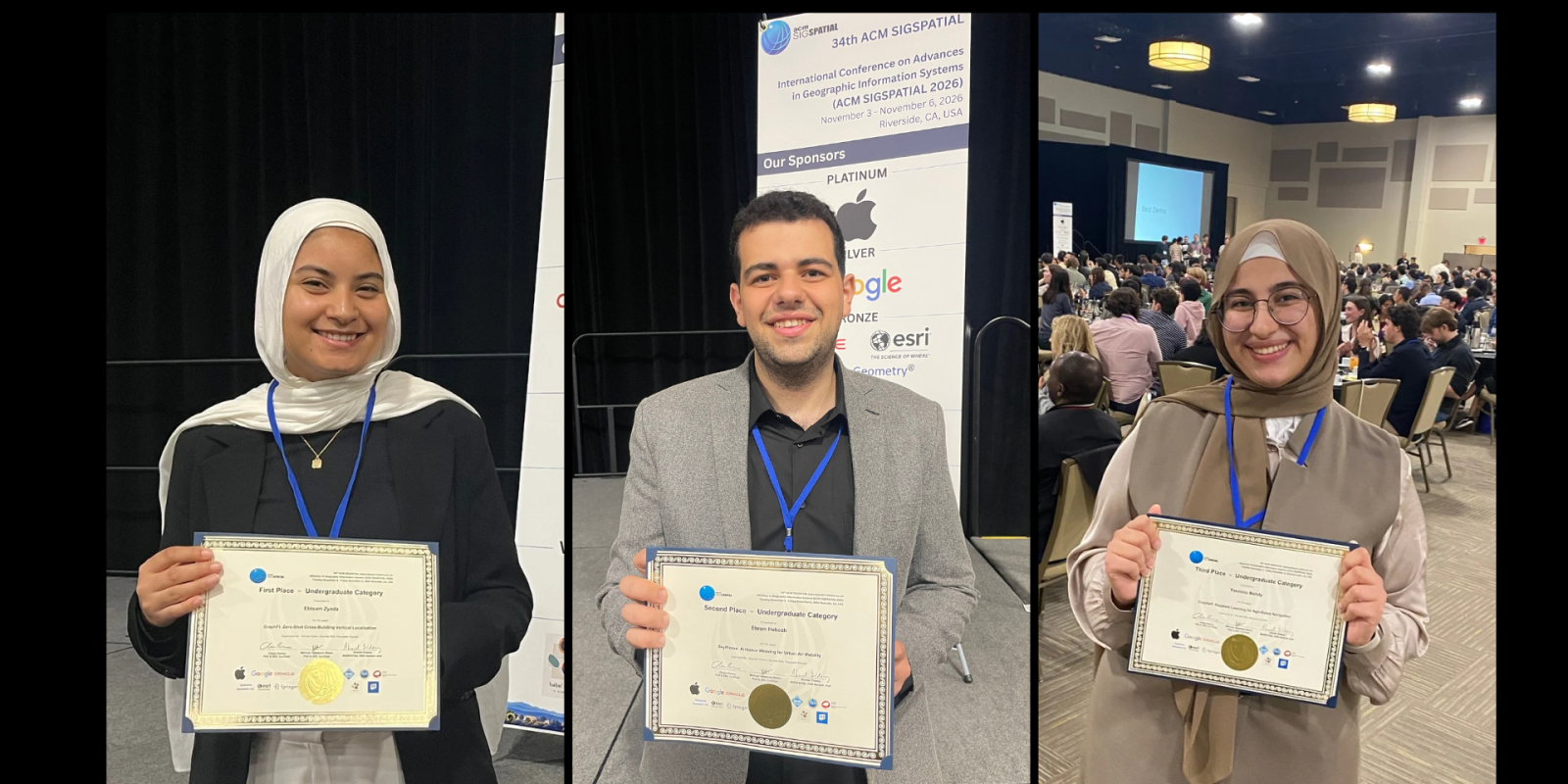
Taking first, second and third place, respectively, were the teams behind GraphFi, SkyWeave and CropSelf, represented by AUC undergraduates Ebtsam Zyada, Ebram Raafat Thabet and Yasmina Mahdy. All participating AUC students received research training at the University that was partially funded by Afretec.
“Seeing AUC take all three top positions was incredible,” said Mahdy. “Other researchers told us they had never expected all three winners to come from the same university, let alone the same research group. What fewer people know is that in the graduate competition, first and third place also went to AUC alumni who did their bachelor’s degrees here. It was a beautiful, heartwarming moment for all of us.”
The Association for Computing Machinery (ACM) SIGSPATIAL conference is a leading global forum for research in geographic information systems, spatial computing, location technologies and other related fields. As part of the conference, ACM hosts the Student Research Competition, with separate categories for undergraduate and graduate students, who present their research on topics related to spatial algorithms and systems. The competition provides participants a chance to meet other students and to get direct feedback on their work from academic experts, researchers and industry professionals.
The winning AUC students were supervised by Moustafa Youssef, professor of computer science and engineering and recipient of AUC’s Spring 2026 Excellence in Research and Creative Endeavors Award. Youssef also co-authored the paper, “Quantum Optimization in Spatial Computing: A Vision,” which received the conference’s Best Vision Paper award.
“This is the first time AUC achieved a clean sweep of the top three positions in this competition, building on our students’ previous successes in earlier editions,” said Youssef. “It demonstrates both the exceptional quality of these projects and the consistency and depth of undergraduate research at AUC.”
The projects went through a four-stage judging process, conducted both online and in person, and were evaluated by international researchers from leading universities worldwide. “This achievement is particularly significant given the rigor of the competition,” noted Youssef.
In addition to the monetary award and recognition, first-place winners advance to the ACM Student Research Competition Grand Finals, competing against first-place winners from other ACM conferences. A grand winner is then selected and recognized at the ACM Turing Award Ceremony, commonly known as the Nobel Prize of computing.
“This is the first time AUC achieved a clean sweep of the top three positions in this competition, building on our students’ previous successes in earlier editions."
First Place: GraphFi
GraphFi uses WiFi signals picked up by a smartphone to determine which floor a person is on inside a building, helping improve indoor navigation and emergency response in new buildings. Unlike current WiFi systems, which require new data and retraining for every building, GraphFi can work in buildings it has not encountered before. The team trained the system using data from just one building in Spain, and it successfully identified floors in new buildings, including one in Finland, without additional data or retraining. GraphFi achieved about three times the accuracy of existing systems.
Zyada presented her team’s project GraphFi at the poster session and gave a final talk at the main conference. “The questions and feedback I got from researchers there made me think about our work differently, and I learned a lot about explaining a technical idea clearly in just a few minutes.”
Beyond the technical aspect, the professional connections and exchange of ideas at the conference were especially valuable for Zyada. “One of the best parts was getting to talk with leading researchers in the field, people whose papers I had been reading, and hearing their thoughts on our work and where the field is heading,” she said. “I also met a lot of students and researchers from different countries, and those conversations were a big part of what made the trip special.”
Zyada credits the academic and research training students receive at the University for this achievement. “Seeing AUC take all top three spots made me really proud. It says a lot about undergraduate research at AUC and the mentorship we get here,” she said.
Second Place: SkyWeave
Thabet presented his team’s project SkyWeave, an AI-powered, air-traffic control system designed to manage the growing number of drones, air taxis and other aircraft expected to occupy urban airspace. “As cities begin using low-altitude airspace for delivery drones, emergency response and air taxis, the skies are going to get very crowded. SkyWeave is an intelligent air-traffic control system designed for the future of city skies,” Thabet explained.
“Sharing our work alongside top students and researchers from around the world pushed us to think deeply about the real-world impact of what we build."
Using a virtual 3D map, SkyWeave operates through two components: a Flight Controller, which adjusts the speed, altitude and takeoff timing for individual drones to prevent collisions, and a Fleet Supervisor, which monitors air traffic across a city. It can cancel non-essential flights to prevent congestion and can reroute flights around unexpected obstacles or restricted areas. SkyWeave resolves more than 98.9% of potential conflicts, such as collusions, while keeping flight cancellations below 3.3%, Thabet noted. Trained using data from New York City, the system performed just as well in completely different cities, such as Cairo and Tokyo, without the need for retraining.
Presenting the project to an international audience was especially rewarding for Thabet. “Sharing our work alongside top students and researchers from around the world pushed us to think deeply about the real-world impact of what we build,” he said.
The competition also helped Thabet strengthen his presentation skills and recognize the importance of communicating technical research efficiently. “One of our biggest takeaways is that effective presentation is a very powerful tool and really an entire area of study on its own. Being able to communicate a complex idea clearly so that anyone can understand its value is just as important as the technology behind it,” he affirmed.
Reflecting on AUC’s achievement, Thabet added, “Seeing AUC teams win all three top positions was really special and a huge source of pride for us. It shows how giving Egyptian students the right resources, mentorship and guidance can empower them to compete and excel at the highest international level.”
Third Place: CropSelf
Mahdy presented CropSelf, which focuses on developing a self-learning navigation system that allows farm robots to move between rows of crops without requiring people to manually label thousands of images to train them.
“Robots can do a lot of the work in the fields, from weeding to spraying pesticides, which can alleviate the tedious labor associated with farming. But before a robot can do any of that, it has to be able to drive between the crop rows on its own,” explained Mahdy.
Currently, training an AI model to perform this task requires people to go through thousands of camera images and mark by hand the location of crop rows and the paths the robot can navigate. “That work has to be repeated for every new field and every new robot,” said Mahdy.
“I believe this achievement is a strong testament to the value of investing in undergraduate research early in students’ academic journeys."
Through CropSelf, the farm robot learns from footage captured by its own camera and sensors that track its movement. The approach could make agricultural automation more broadly applicable, particularly in countries with limited technical infrastructure, since the system is lightweight enough to operate in such settings.
“What makes this meaningful to me is how widely it could be used,” Mahdy said. “After my presentation, I had a lot of fellow students and researchers coming up to me and saying how they thought my problem was a very important one to address.”
Mahdy is already excited about her next research opportunity. “I learned a lot, and it made me want to pursue research even more,” she said. “Going once isn’t enough for me. I want to go back, not just to this conference but to many more. This experience pushed me to aim higher. As I like to put it now: ‘The research world better watch out for me.’”
Building the Next Generation of Researchers
Youssef commended the “breadth and ambition” of the three winning projects. “They address challenges in indoor positioning across different buildings, the coordination of future urban air mobility and autonomous agricultural robot navigation. These are original research contributions addressing real-world challenges through advanced computing and AI techniques, rather than simply classroom exercises,” he said.
Youssef attributes this success to AUC’s strong undergraduate research training program, where students work closely with faculty mentors and engage in the full research process, from identifying meaningful problems to developing, implementing and communicating innovative solutions.
“I believe this achievement is a strong testament to the value of investing in undergraduate research early in students’ academic journeys,” said Youssef. “Afretec’s support has been particularly valuable in strengthening this research ecosystem and expanding opportunities for students.”
“I learned a lot, and it made me want to pursue research even more."
For Youssef, one of the valuable outcomes of this experience is the shift in how students approach learning, seeing themselves not just as consumers of knowledge, but as active contributors to it. “The goal is not simply to prepare students to win competitions. We are equipping them with the mindset, skills and confidence to become researchers, innovators and technology leaders who can contribute to solving important challenges in Egypt, Africa and beyond.”
The experience also opens new doors for students. “It gives them wider visibility and valuable connections within the global research community. It also strengthens their prospects for graduate studies, international research internships and future careers in academia and industry,” said Youssef.
Photo caption: Ebtsam Zyada, Ebram Raafat Thabet and Yasmina Mahdy won first, second and third place, respectively, for their team projects at the ACM SIGSPATIAL Student Research Competition
