
Home page
ع
Mental Health Initiative

AUC Launches Initiative to Support Community Mental Health, End Stigma

Devon Murray June 01, 2022
Civic Engagement

On Sunday, AUC launched its Mental Health and Well-being Initiative with a community workshop aimed at opening a discussion and offering a platform for participants to share their experiences and ideas for improving mental health on and off-campus.

Over the last two years, the coronavirus pandemic has impacted the mental health of millions around the world. Noted increases in anxiety and depression worldwide have heightened individual and institutional awareness of the need to address these challenges, AUC President Ahmad Dallal explained.

"We want to foster a culture of care on campus that will enhance our community's sense of belonging," he said.

According to Dallal, the yearlong initiative will include the formation of a task force over the coming weeks that will focus on evaluating AUC's current environment in terms of mental health and offering recommendations for improving services and policies, destigmatizing mental health concerns and strengthening intercommunity support.

The workshop was moderated by Hania Sholkamy '85, '89, associate professor at AUC's Social Research Center and included a panel consisting of Dr. Nasser Loza, president of the World Federation for Mental Health and director of The Behman hospital, and Fayrouz Ibrahim '21, social researcher and graduate student in AUC's sociology-anthropology program.

Loza and Fayrouz described current trends and challenges to ending mental health stigma and finding community solutions and answered questions and comments from the in-person and online audiences.

Students, faculty members and staff expressed their support of the initiative during the discussion, while also touching on issues such as confidentiality, wait times for accessing services and instances of stigma in and out of the classroom.

In closing, Dallal highlighted three fronts that the task force will be working on: changing AUC's culture around mental health through destigmatization campaigns, outreach and programs, increasing the University's level of mental health services and introducing improvements to its policies, protocols and training around mental health. 

"The key is to institutionalize our structures of support — whether through the services or the policies that we have — but at the end of the day, our hearts have to be in this," he said. "We will work on the institution, we will not shy away from our responsibility and hopefully, with your support, we will be able to accomplish much."

Due to time constraints, not all questions and comments from the online Q&A were addressed by the panel. Once formed, the task force will respond to these questions and comments.
Related stories

Commencement
June 16, 2026

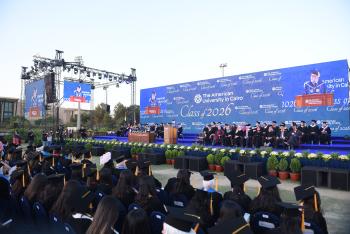
Class of 2026 Spring Commencement

Undergraduate Keynote SpeakerChase F. Robinson, Director of the National Museum of Asian Art (CASA '86)"Deep creativity, that is, originality, is improbable. It's unpredictable. It can't be outsourced. It's sourced from within. You have been educated not just for your sake but for society's good. Find your originality. Find yourself." Undergraduate Student RepresentativeRoshdy Mohamed Roshdy, BA in sociology and minor in linguistics"Before AUC, most of us had a plan. During AUC, that plan fell apart, was rebuilt, questioned, and reimagined. And after today, it will continue evolving."  President's SpeechAUC President Ahmad Dallal"Knowledge grows through people willing to push what exists further. No civilization, institution, or generation exclusively owns it. You have spent your years at AUC learning how to take part in this process. Sometimes in classrooms, sometimes over coffee. Sometimes in a conversation, that changed your mind when you weren’t expecting it." Graduate Keynote SpeakerMarwa Abbas '94, '98, ‏IBM General Manager and Technology Leader, North East Africa"Technology may change the world, but humanity decides where that change leads." Graduate Student RepresentativeKadria Abdel Motaal (MA '23), PhD in Global Public Health"The degree itself is not the reward. The reward is the journey that brought me here, the discipline, the discovery and the renewed conviction that life continues to offer opportunities to learn, to contribute and to become." 
University News
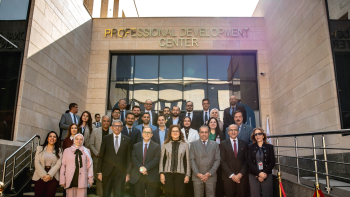
administrators standing in front of new professional development center
January 27, 2026

AUC Expands Professional Development Programs to Administrative Capital

AUC has signed an exciting new agreement with the Administrative Capital for Urban Development (ACUD) to bring academic and professional opportunities to the New Capital through AUC’s School of Continuing Education (SCE). Under this agreement, SCE’s Professional Development Center will now be located in the Administrative Capital, enabling professionals to continue developing their skill sets.“The opening of AUC’s School of Continuing Education Professional Development Center at the New Capital marks a significant milestone in SCE’s commitment to lifelong learning and extended education,” said Mahmoud Allam, dean of the School of Continuing Education. “Through this center, we aim to support the continuous professional development of government employees and professionals, while extending AUC’s impact beyond campus and closer to the institutions shaping Egypt’s future.”The School of Continuing Education has many partnerships with outside institutions, including the Ain Shams Medical School, Al-Azhar University and the U.S. Embassy’s Regional Language Office. The agreement with the Administrative Capital for Urban Development will be the latest in a growing cadre of institutional partnerships that connect Egypt’s diverse educational opportunities to AUC. As the Administrative Capital continues to develop and become the heart of Egyptian government, AUC hopes to continue strengthening institutional ties with ACUD. The Administrative Capital, which became the seat of the Egyptian government in 2024, currently hosts 14 ministries and can house up to seven million people. The development of the capital city is part of the wider development initiative Egypt 2030. “We are pleased to sign this agreement with the American University in Cairo, which not only aligns with our strategic mandate to position the New Capital as a regional beacon for knowledge but also presents a vital integration of urban development and academic excellence,” stated Khaled Abbas, chairman and managing director of ACUD. “ACUD is committed to delivering state-of-the-art infrastructure that meets international standards, providing the necessary foundation for the AUC to drive human capital development.”
University News
A group of people sitting around a table signing an agreement with the Egyptian flag in the background
December 30, 2025

AUC Leads National Initiative to Transform Egypt's Electronics Sector

AUC has been selected to lead the “Invest with Confidence-De-risking Tech Startups Alliance, part of the Ministry of Higher Education and Scientific Research’s Alliance and Development initiative. Spearheaded by AUC’s Center for Entrepreneurship and Innovation at the Onsi Sawiris School of Business and the Center for Nanoelectronics and Devices at the School of Sciences and Engineering, the initiative aims to accelerate innovation and enhance Egypt’s competitiveness in the electronic design and manufacturing sector.Over the past decade, Egypt’s startup ecosystem has experienced remarkable growth, fueled by national strategies like Egypt Vision 2030, a young and dynamic population, and increasing venture capital investments. Despite this progress, deep-tech startups face significant challenges, including high capital requirements, limited access to specialized equipment, and shortages of skilled talent and expert support. The DTS Alliance addresses these gaps by bringing together key stakeholders to create an integrated ecosystem, positioning Egypt as a regional leader in electronics innovation.Yehea Ismail, director of AUC’s Center for Nanoelectronics and Devices, noted that the project does not just focus on software development but addresses Egypt’s potential in designing and manufacturing hardware technology — filling a critical need in the local technology landscape. “We have been working with regional stakeholders on this scope, and now it is time to go full scale in our beloved country Egypt and support our private sector to compete globally and attract foreign direct investment,” Ismail said.“[This initiative] is the perfect opportunity to bring in different stakeholders from our network toward such a promising and strategic national objective."The DTS Alliance brings together nine local partners across academia, the private sector, public entities, investors and enabling organizations. These include AUC; Zagazig University; Elaraby Group; EMASS startup; Micro, Small and Medium Enterprises Development Agency (MSMEDA), Flat6Labs, Den Venture Capital, Startup Factory and Meska AI. Hala Barakat '98, director of AUC’s Center for Entrepreneurship and Innovation, highlighted the significance of this collaborative network. “[This initiative] is the perfect opportunity to bring in different stakeholders from our network toward such a promising and strategic national objective,” she said. “We formulated internal and external partnerships to ignite innovation in Egypt’s entrepreneurial ecosystem and untap academia’s potential in research commercialization.” “We have been working with regional stakeholders on this scope, and now it is time to go full scale in our beloved country Egypt and support our private sector to compete globally and attract foreign direct investment."The alliance focuses on strengthening the electronics sector by localizing design and manufacturing to promote import substitution, supporting export growth and building capacity to meet industry demands. It encourages innovation through hackathons, develops industry-aligned curricula, advances artificial intelligence applications in electronics, and facilitates intellectual property creation and protection. Additionally, it integrates startups into new markets, promotes research spinoffs and attracts foreign direct investment, driving sustainable growth and competitiveness across the industry.Egypt’s Minister of Higher Education and Scientific Research Ayman Ashour stated that the Alliance and Development presidential initiative reflects the nation’s commitment to innovation through collaboration between higher education and industry. He added that the initiative seeks to harness research and entrepreneurial potential to build competitive economic sectors, demonstrating the power of cross-sector partnerships in promoting sustainable development.
Science and Tech
Salima Ikram receiving Amelia Peabody award
October 19, 2025

AUC Inaugurates Amelia Peabody Professorship, Research Fund in Egyptology

AUC has established the Amelia Peabody Endowed Professorship and Research Fund in Egyptology — the first such professorship in the Middle East and Africa and one of few in the world.Thanks to the generosity of a donor who wishes to remain anonymous and with the support of the Fourmi Legacy Foundation, the professorship and research fund will provide expanded opportunities for teaching, research, fieldwork and excavations. “The purpose of this endowment is to advance fieldwork, research and teaching that deepen our understanding of Egypt’s past and strengthen the foundation for future scholarship,” said AUC President Ahmad Dallal.The inaugural professorship has been awarded to Distinguished University Professor of Egyptology Salima Ikram (YAB ’86), a world-renowned Egyptologist and field archaeologist. “I am honored and delighted to be the first incumbent of the Amelia Peabody chair in Egyptology,” said Ikram. “The generosity of the donor ensures that Egyptology will have a secure place at AUC. The professorship has been instituted in order to sustain and develop Egyptology at AUC, and I very much hope to continue fostering Egyptology at the University as well as exposing AUCians to the richness of ancient Egyptian culture and emphasizing its links to the present.”Ikram first came to AUC as a year-abroad student in 1985, when she “fell in love with Egypt,” and returned as a faculty member in 1995. She has helped shape AUC’s Egyptology department through her field work, partnerships with international stakeholders and commitment to public engagement. Ikram has published numerous articles and books on Egyptology and led field initiatives such as the North Kharga Darb Ain Amur Survey, the Amenmesses Project, the Animal Mummy Project and currently administers the Theban Mapping Project. Her research interests include animal mummification, funeral archeology rock art, the environment, diet and disease, with studies that have led to groundbreaking discoveries that changed scholastic understandings of daily life in ancient Egypt. Affirming the importance of Ikram’s work to the AUC community and the Egyptology field at large, Dallal said, “Dr. Ikram’s work exemplifies the purpose of this new endowment: rigorous scholarship that serves knowledge and society.”Through this professorship, Ikram will be endowed with the financial backing to continue her groundbreaking work and follow the footsteps of its fictional namesake: Amelia Peabody. Peabody is the star of a series of historical mystery novels set in the late 19th century that feature an unconventional and daring Egyptologist, fascinated by Egypt and eager to uncover ancient mysteries. Written by the New York Times best-selling novelist and Egyptologist Barbara Mertz (under the pen name Elizabeth Peters) and published between 1975-2010, the series inspired an entire generation to engage with the wonders of Egyptology. Curious and determined, the name of Amelia Peabody is meant to invoke this same passion for Egyptian history and culture in its awardees. “It is a matter of joy that the chair is named after a fictional optometrist, Amelia Peabody,” said Ikram. “The creator of the Amelia Peabody character was a very dear friend of mine, Barbara Mertz, one of the first women to earn a PhD in Egyptology from the University of Chicago. She popularized Egyptology, and we found that Amelia and I had many things in common, from our love of ancient Egypt to mysteries, and the handy belt meant for archaeology.”As a field, Egyptology is a cornerstone of the AUC community. Books on the subject remain among AUC Press’s all-time best sellers, including several by Ikram, such as Ancient Egypt: An Introduction, Death and Burial in Ancient Egypt, and Divine Creatures: Animal Mummies (as editor). Other Egyptology best sellers include Ancient Nubia: African Kingdoms on the Nile, Gods and Myths of Ancient Egypt, Nefertiti, Queen and Pharaoh of Egypt, and Ancient Egyptian Jewelry.Emphasizing the importance of Egyptology as a field, Ikram noted, “Teaching Egyptology at AUC is not only to create new Egyptologists, but also to expose Egyptian students to different aspects of their culture and history, to instill a sense of pride in their heritage and to make them more conscious of its value — not only to them and Egypt, but to the world.”
University News
Share