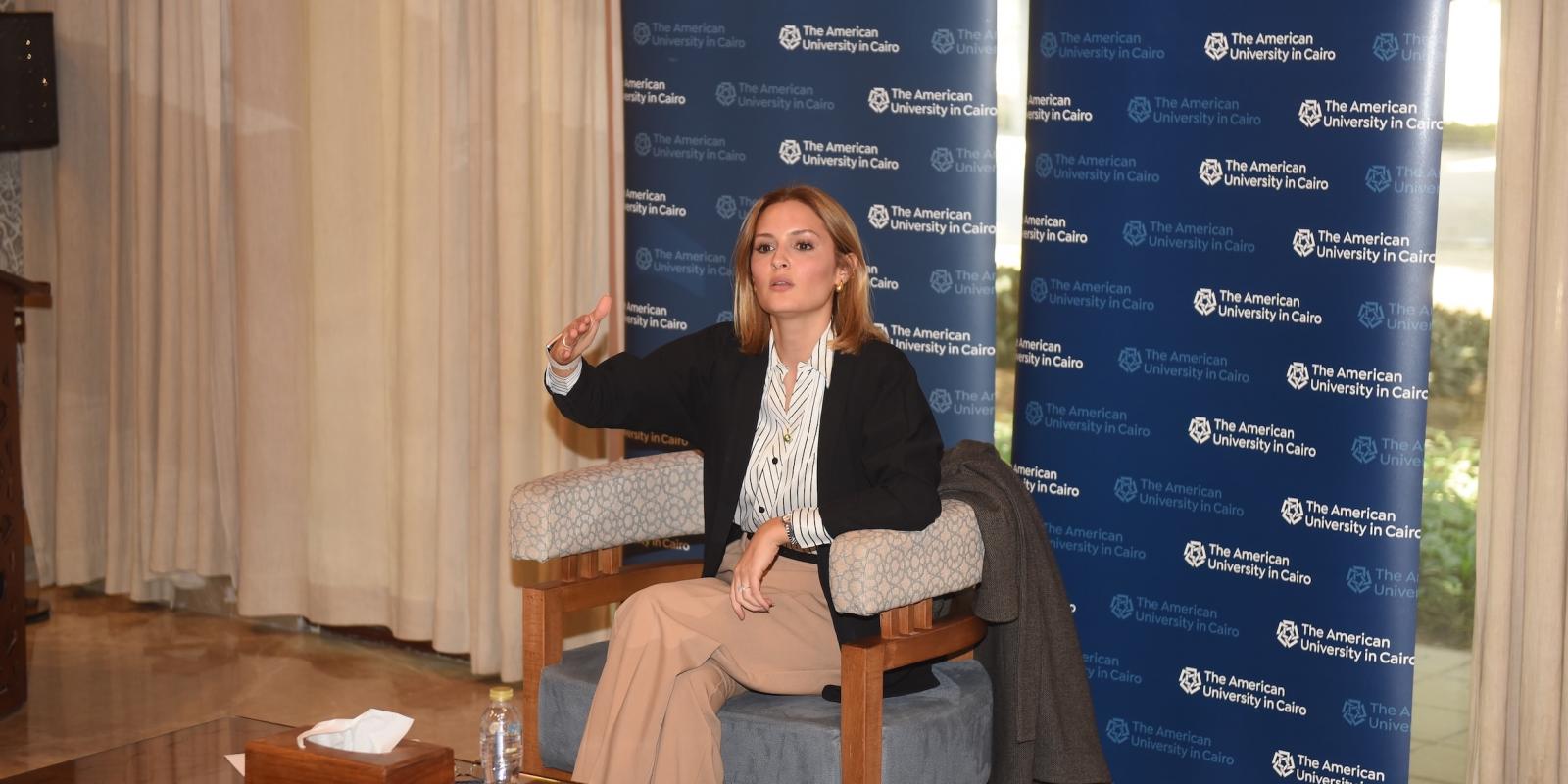
AUC Hosts Faculty Research Roundtable on Child Development
The American University in Cairo (AUC) hosted a media roundtable discussion featuring Seham Elmrayed, assistant professor at the Institute of Global Health and Human Ecology, as part of the “Faculty at the Forefront” series.
The series is an ongoing University initiative that highlights the expertise of faculty members whose innovative research drives global impact.
Seham Elmrayed, assistant professor at the Institute of Global Health and Human Ecology, discussed her research as part of the team who developed the latest Fenton Third-Generation Growth Charts. The research is part of a large-scale global initiative that drew on data from 4.8 million births across 15 countries to establish a new global benchmark for child growth. The session highlighted efforts to translate new international growth standards for preterm infants into tangible public health action that can benefit families across Egypt. Elmrayed emphasized that data alone cannot improve health outcomes; meaningful change requires active, strategic engagement with local stakeholders.
“Through my work at AUC, I am very intentional about ensuring that research does not stop at publication. I actively engage with Egyptian public and private institutions to translate global and national evidence into policies and programs that genuinely serve Egyptian families,” Elmrayed said.
Elmrayed's research is one of AUC's many initiatives committed to public service. The University has supported Elmrayed's research on the economic burden of child anemia, through the facilitation of partnerships between researchers, Ains Shams University Hospitals, Cairo University and government policymakers.
“Across all of these partnerships, the goal is the same: to adapt global and national research evidence to Egypt’s social, economic, and health-system realities, and to ensure that research ultimately improves the everyday health and wellbeing of Egyptian children and their families.”
"This work is done in collaboration with experts from the ministry of Health and Population and Egyptian university hospitals with the explicit aim of producing findings that are not just scientifically robust but also policy-relevant and actionable," Elmrayed said.
“Across all of these partnerships, the goal is the same: to adapt global and national research evidence to Egypt’s social, economic, and health-system realities, and to ensure that research ultimately improves the everyday health and wellbeing of Egyptian children and their families.”
AUC recently hosted the Advances in Preterm Care: Growth, Nutrition and Development conference. Organized by Elmrayed, the meeting convened neonatologists and experts from Egypt’s public and private sectors to meet and inquire directly how global evidence applies to preterm populations in Egypt. Dr. Fenton, Creator of the Fenton Growth Charts, attended the meeting.
"The aim is to build a large, high-quality national database that reflects Egyptian preterm growth trajectories and outcomes, so that future guidelines, clinical decisions, and policies are informed by Egyptian data."
This conference of high-level experts generated a shared vision for Egypt’s first national preterm database, which is now currently in its pilot phase. The initiative aims to aggregate data from hospitals across the country to establish a localized evidence base.
“The aim is to build a large, high-quality national database that reflects Egyptian preterm growth trajectories and outcomes, so that future guidelines, clinical decisions, and policies are informed by Egyptian data,” Elmrayed explained. “For me, this is what translating large numbers into real impact looks like, moving from millions of global data points to better-informed care for every preterm baby in Egypt.”
The session concluded with a clear message, which is that growth is not just a medical outcome.
“Genes may set the boundaries, but nutrition, household conditions, maternal health, education, and the environments in which children grow up determine where they fall within those boundaries. If we want to improve child growth in Egypt, we cannot rely on clinical care alone.” Elmrayed noted that policies must invest in early life (before pregnancy, during pregnancy, and in the first years of life). “Policies must also address nutrition, food affordability, caregiver knowledge, and supportive environments together,” she concluded.
