Home page
ع
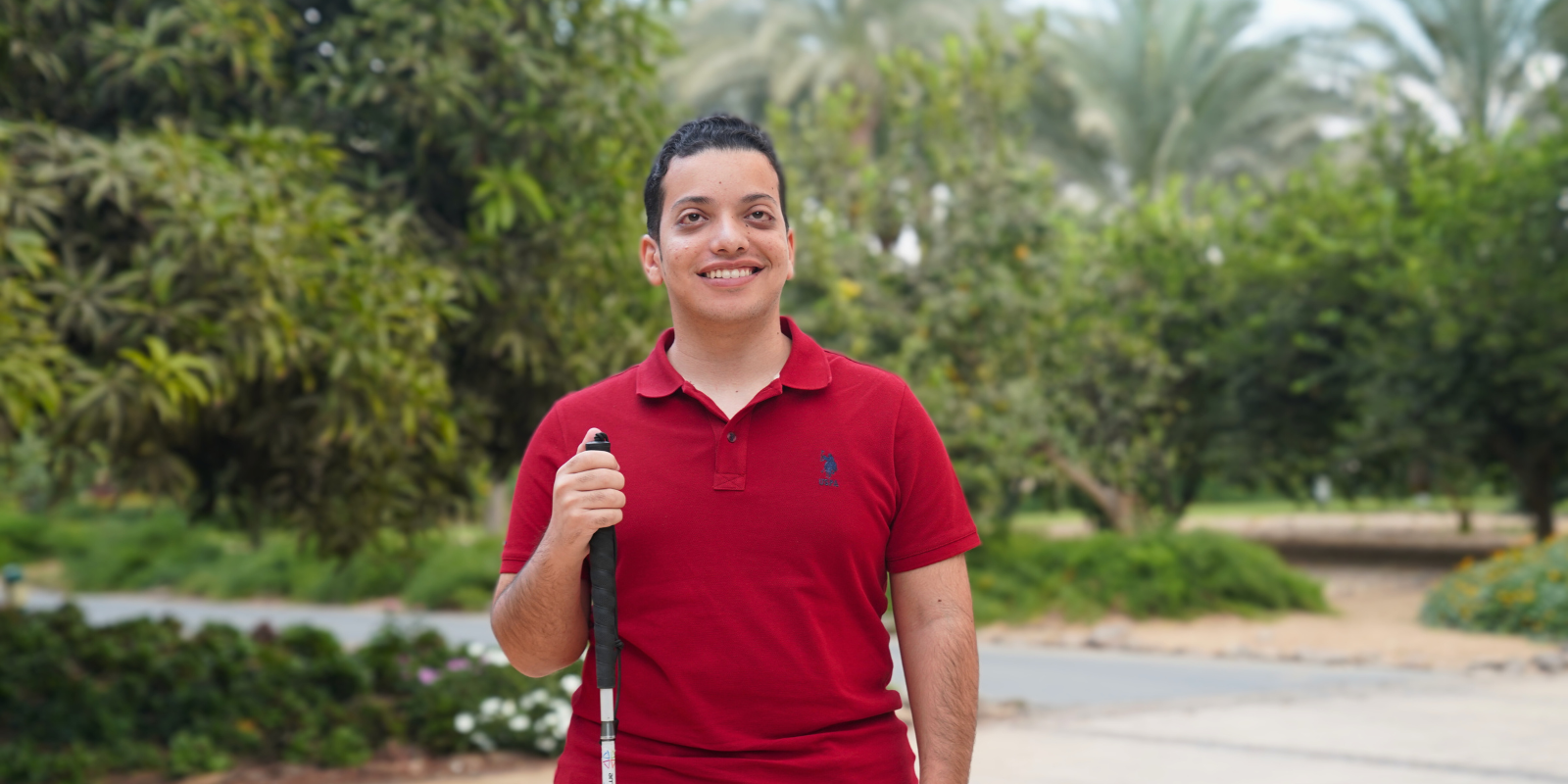
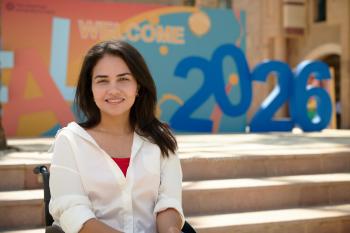
Mark Morad smiles in front of the AUC garden

AUC Freshman Develops ScribeMe App for People with Visual Impairments

Celeste Abourjeili November 20, 2024
Student Experience

Meet Mark Morad, the AUC freshman who’s creating a business to make the internet more accessible for people with visual impairments.

Three years ago, freshman Mark Morad, born fully sighted, lost his eyesight completely. His dream of studying computer science seemed to slip away as he struggled to navigate documents like PDFs, PowerPoints, images and graphs for his science courses. He relied almost entirely on explanations from other people to understand the figures.

“I didn’t like that someone always had to explain these documents to me. So I got the idea of creating an app to solve this problem,” said Morad, explaining that he wanted to reclaim his independence in navigating documents and visuals online.

Five months after the idea struck him, Morad published the first version of ScribeMe on the Microsoft Store. “ScribeMe can take PowerPoint affiliates, extract all the text in these files and give detailed image descriptions using AI. So if someone has a visual impairment, they’ll be able to know all the visual content inside these files,” said Morad.

His app is at an advantage because it is able to take a large file and analyze all the images at once, a quality that he describes as unique. “If a file has 20 images, ScribeMe will describe all the images in seconds, which is faster than doing it manually, by sending one image at a time to AI.” 

Morad’s programming was a feat in itself given the challenges he faced during the process. “I was programming blind using only a screen reader, and coding is even harder when you can’t see because if you miss even one comma in a code, the whole app won’t work.”

“I didn’t like that someone always had to explain these documents to me. So I got the idea of creating an app to solve this problem."

Since its launch, the app has received a strong reception from the public, gaining users across 52 countries and winning several prestigious awards. Many foundations in the United States are also collaborating with ScribeMe to make their content more accessible.

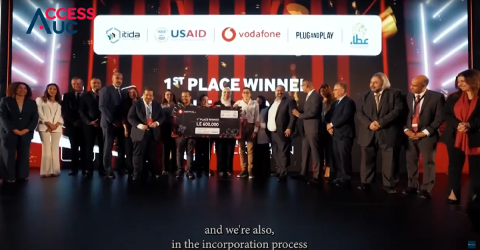
The first contest Morad attended was the USAID-sponsored Vodafone AI Assistive Tools Hackathon, where 200 teams competed for EGP 900,000 in funding. “I was the youngest person in all of these teams,” said Morad. “My first impression when I went there was that of course we’re not gonna make it first, but at least we’re gonna try.” Morad was shocked when ScribeMe was announced as the first-place winner the next day. 

Since then, ScribeMe has gone on to win more awards. At the Empowering Inclusion in Employment competition by GIZ, ScribeMe was selected for a nine-month incubation program, with funding for the app and employee salaries provided to Morad’s team.

Morad has big hopes for ScribeMe’s future: “We’re creating a company built on ScribeMe, and we’re hoping to publish the app soon on the App Store and Google Play.” Morad is additionally undergoing the incorporation process and will soon seek investors and employees. “We’re working on improving the app and making the best possible product to help people with visual impairments be more independent,” he said.

Morad hopes to major in computer science and is enjoying his first semester at AUC, where he says the people are extremely nice and supportive. A guiding principle for Morad is to “never give up, never back down.”
Related stories

Students participating in the simulation with "stepping into the shoes of others" on the board
December 3, 2025

Stepping Into Others’ Shoes: AUC Students Run Accessibility Simulation

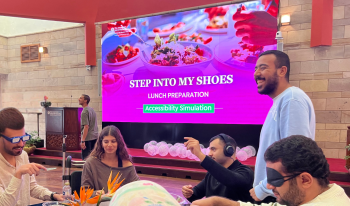
To honor the International Day of People with Disabilities, the Psychology of Inclusion and Exclusion in Egypt undergraduate class set up an accessibility simulation, bringing together students and faculty from across the AUC community to gain a new perspective on what life is like with a disability — stepping into the shoes of others. The event, hosted by the Center for Student Wellbeing and Student Accessibility Services, started with each attendee being assigned a disability. Some were assigned visual impairments and given eye masks. Some participants were designated audio impairments and wore noise cancelling headphones. Others were given various mobility restrictions, such as being paralyzed from the waist down or having limited mobility in their hands. Together, the participants had to work together to make a salad, a task that might seem simple but had many added challenges. Participants worked together to navigate cutting vegetables, reaching across a wide table and communicating through the challenges that come with audio and visual impairments.The simulation showed participants the ways people with disabilities have to go about their daily lives as well as how they can support each other. Participants had to rethink their typical teamwork processes to play to their strengths and accommodate gaps. Those with mobility impairments could help coordinate visually with those with audio impairments and auditorily to those with visual impairments. The experience showed how important accommodation, support, grace and understanding are to people with disabilities.“The event was a focused, high-impact simulation designed to foster empathy and build awareness among participants regarding the challenges faced by individuals living with various disabilities,” explained Alexandra Gazis, associate director of Student Accessibility Services at AUC and course instructor. “The primary goal is to provide attendees who do not have a disability with a short, experiential understanding of how simple, everyday tasks can become exclusionary, especially when various barriers are present.”The purpose of this simulation was to help raise awareness of the ways that disabilities impact daily life and the ways that the AUC community can think through necessary accommodations by being conscious of what it's like to live with disabilities.“The simulation was a great way to raise awareness of the realities of living day to day as a student with a disability,” shared Grainne Condron, one of the students in the class. “I see this collaboration between staff and students as making strides toward real change.”Additionally, AUC will be lighting the plaza and Bassily Auditorium in purple on December 3 to celebrate the International Day of People with Disabilities. AUC will be the first institution to light its buildings purple for this occasion in Egypt, marking once again its commitment to accessibility and visibility. 
Student Experience
Heba Kotb doing field research
December 3, 2025

AUC Psychology Professor Aids WHO Funded Study on Autism Care Training in Egypt

As researchers and psychologists work to improve the lives of those with autism around the world, the need for country-specific support networks and training has become clear. Heba Kotb ‘84, associate professor of practice in psychology, helped to develop an Egypt-specific autism training program in partnership with the World Health Organization and international universities. “It’s critical that we tailor autism care to specific cultural environments, which is exactly what this research developed," Kotb explained. “The importance of this program comes not only from the context-specific research, but also the ability to share it with families who need the support.”Autism care in Egypt has been heavily concentrated in major urban areas, with limited access to support for those outside of Cairo. This study — which was in partnership with AUC, the University of Maryland, McGill University’s Montreal Neurological Institute-Hospital, Egypt’s Ministry of Health and Population, Autism Speaks and WHO — sought to train families to care for the needs of youth with autism. The study sent out 16 Master Trainers to conduct five-day intensives in rural areas, with the intention of providing caregivers — mainly mothers — with the knowledge to support their children. Kotb worked with the international partners to design the training for the Egypt-specific program. “Egypt has a very different societal context around caregiving than, say, the United Kingdom,” Kotb affirmed. “It was essential that we consulted on this context so that Egyptian families could best access the support they needed.” Kotb also helped to assess the effectiveness of the program after it was concluded, interviewing eight mothers in Upper Egypt and 10 in Alexandria. She then provided thematic analysis on the data, which was published into a paper last August, concluding that programs like the country-specific master training do have a strong impact.“The interviews were really eye opening; I couldn't believe the impact of the program. Families don't get many services, especially for children with disabilities. In many cases, they are neglected,” Kotb said. Reflecting  on her experience within the study, Kotb said that parents shared with interviewers that their children couldn’t speak and would spend all day at home doing nothing until this program began training them how to better interact with their kids.. “The parents described it as a miracle,” Kotb said. “The children were suddenly speaking and playing, and became toilet-trained. They started to learn that they can actually do anything.”    Kotb has been specializing in researching children with disabilities for over 30 years. After getting her bachelor’s in psychology from AUC, she worked as an educator in a school for students with disabilities before eventually pursuing her PhD in education from Leeds University in the United Kingdom. Since then, she has been researching how to make schools accessible for all students. “I found working with children with disabilities to be incredibly rewarding. All my research has been in the area of disability studies, and it’s such satisfying work.”Ultimately, Kotb hopes that this study will serve as a pilot program that will lead to many other training programs like it. Now that the study is concluded, WHO and Egypt’s Ministry of Health will potentially work together to expand the training. Kotb is eager to continue helping. “I think the training program should be spread to all cities. Children with autism are everywhere. Many people don't realize that children with autism can be educated and trained, and can become productive members of society. We need to continue working to provide support.”
Civic Engagement
visual impaired person guided by someone
October 20, 2025

Tips on Navigating Inclusivity

Debunking myths, Farid shared firsthand tips on the do’s and don’ts of engaging with people with visual impairments:Face to FaceDon’t assume we need help. Ask first.If we do need help, it will only relate to visual impairment. We don’t need help with everything.Communicate with us on how we would like to be assisted so there is mutual respect for each other’s space. Don’t ask someone to lead us out of a place. Speak to us directly on how we would like to be guided.Offering help is thoughtful and appreciated, but don’t go out of your way to accompany us wherever we go. Sometimes giving directions is all we need.Don’t treat us differently than people around us. If we’re standing with a group, there is no need to grab a chair for us or get us coffee. Don’t give us front-row seating. These are nice gestures from well-intentioned people, but they make us feel uncomfortable.You don’t need to raise your voice to speak with us. We only lost our eyesight; our other senses are not affected.If two people, including a person with a visual impairment, are talking to you or asking a question, address them both. Don’t just speak to the sighted person. We can sense it.The tools we use are not toys for others to fool around with. My cane is indispensable for my safety and existence.Avoid grabbing or pulling someone’s cane, even if you’re trying to help that person move around. It’s dangerous and invasive. You can ask to hold one end of the cane while we hold the other.Don’t scream “Be careful” or honk at us when crossing the street. It distracts rather than alerts us.
Student Experience
Zaydan family receiving degrees at graduation
September 22, 2025

'AUC Saw Beyond Labels'

“I want to take this moment to express my deepest gratitude for welcoming Omar and me and for creating an environment where Omar can thrive not despite being autistic, but through it,” said Hala Ibrahim Zaydan, parent of Omar Sharaf El Din ’25, as she accepted an honorary Doctorate of Humane Letters at the June 2025 commencement ceremony, during which Sharaf El Din graduated. Though the family originally worried about Sharaf El Din’s adjustment to university life, with the help of AUC’s accommodations, Sharaf El Din graduated with a Bachelor of Science in mathematics. His mother was awarded an honorary doctorate for her dedication to her son’s studies and commitment to promoting inclusion at AUC.“[Zaydan] worked closely with AUC faculty, administrators and the Center for Student Wellbeing to strengthen support systems for students with disabilities,” reads her honorary degree citation. “Her efforts have not only guided her son’s academic success but also extended to assisting other students on campus, reflecting her commitment to empathy, collaboration and community. Her contributions exemplify the values of accessibility, integrity and inclusion that AUC upholds.”"Her contributions exemplify the values of accessibility, integrity and inclusion that AUC upholds."With the help of AUC’s accessibility initiatives, Zaydan was able to accompany Sharaf El Din to classes as his aide. As his mother, Zaydan knows her son’s specific needs and has been shadowing him since Grade 5, ensuring he received a quality education. She left her profession as a dermatologist to help Sharaf El Din in school and advocate for disability support.With inclusion as one of its core tenants, AUC ensured both Sharaf El Din and Zaydan were thoroughly supported. The Center for Student Wellbeing worked with the family to provide standard accommodations for his course load, note-taking and exams. “AUC believed in him and saw beyond labels,” said Zaydan. “The University was incredibly flexible and brought out the best in Omar without unnecessary pressure. The mathematics faculty were also very supportive and made every effort to respond effectively to Omar’s needs. They are providing guidance and support to help him find a suitable job.”“AUC believed in him and saw beyond labels."For Zaydan, learning math alongside her son was a departure from the material she was used to studying, but she was dedicated to providing Sharaf El Din with total support. She appreciated the English classes required of AUC as well as the liberal arts curriculum. Zaydan’s favorite class was ancient Egyptian studies, to which she joked, “Maybe I’ll do a master’s next!”
University News
Share