AUC's Advanced Manufacturing Research Provides MIT Students with Hands-On Experience
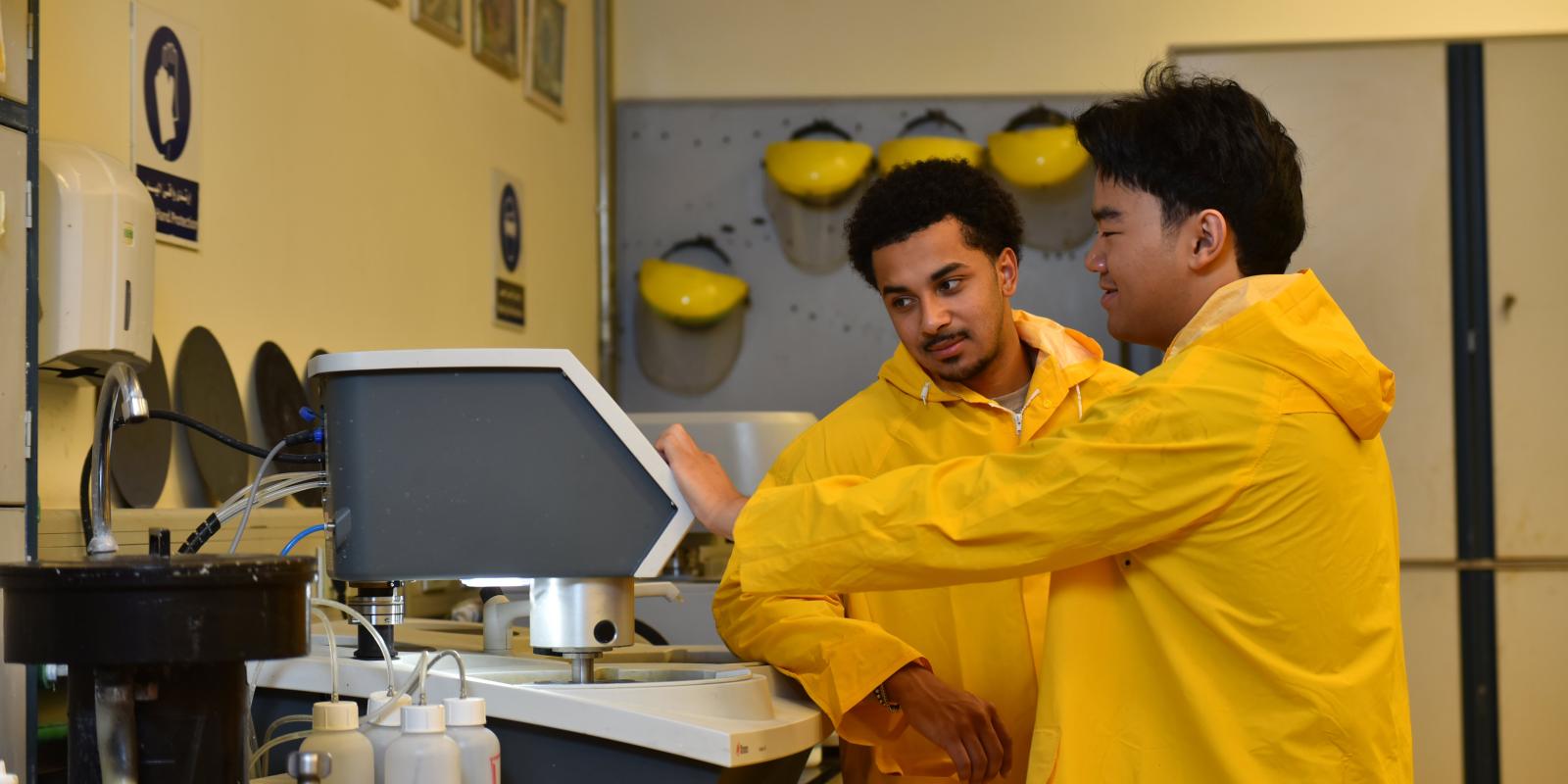
The American University in Cairo (AUC) recently hosted two Massachusetts Institute of Technology (MIT) mechanical engineering students for a three-month research internship at its Additive Manufacturing Centennial Lab (AMCL). Through the MIT International Science and Technology Initiatives (MISTI) MIT-MENA program, the students gained hands-on experience with AMCL’s robotically controlled additive/subtractive manufacturing platform, an advanced smart-manufacturing system capable of producing complex parts and components at high manufacturing rates while significantly reducing material waste and carbon emissions compared with conventional manufacturing processes. Their internship explored applications of 3D printing in digital manufacturing of jet engine blades and healthcare-optimized products, including material-efficient production and the development of prosthetic devices.
“Hosting talented MIT interns at AMCL is a significant milestone for our lab, the mechanical engineering department and AUC. It strengthens our global academic and research engagement through international collaboration and knowledge exchange, while bringing fresh perspectives to our ongoing research.” said Hanadi Salem ’83, ’87, professor of mechanical engineering and founder and director of AMCL
At AMCL, part of AUC’s Department of Mechanical Engineering, the students worked on research involving wire arc additive manufacturing (WAAM), a 3D-printing technology that uses metal wire to produce components. Their work gave them hands-on experience in advanced manufacturing, robotics, process modeling, materials characterization and mechanical testing, while allowing them to examine how manufacturing processes affect material structure and performance.
Anthony Nguyen examined whether technology could offer a more efficient way to produce turbine blades, testing 3D-printed blades and comparing their performance with conventionally manufactured ones. “I identified a research gap in the literature regarding wire arc additively manufactured turbine blades, so I’m looking to test those in a wind tunnel and compare that to traditional manufacturing,” said Nguyen.
Yusef Primus explored how the same technology could be used to develop components for prosthetic legs, designing and testing a potential solution based on gaps he identified in existing research. “We’re going to design using software at the Mechanical Engineering AMCL and CAD labs and then print it and do some testing to see if it actually is a good product,” said Primus.
The internship was part of MISTI MIT-MENA, which since 2017 has connected MIT students with internship and research opportunities at leading universities and institutions across the Middle East and North Africa.
Maye Elqasem, program administrator for the MISTI MIT-MENA program, said the initiative complements MIT students’ academic training by giving them the opportunity to gain research experience in different international environments. She added that the MISTI MIT-MENA program hopes to expand its collaboration with AUC to include additional AUC programs and a larger cohort of MIT students. “AUC is a leading institution when it comes to research, when it comes to innovation, and we are very happy and proud of this collaboration between our program and this amazing institution,” said Elqasem.
This collaboration also benefits from the advanced engineering educational facilities available at AUC, which enable students and researchers to pursue applied research through specialized facilities, including Eltoukhy Learning Factory for Innovation and Entrepreneurship, the first facility of its kind in Egypt, brings together students, faculty, entrepreneurs and industry to develop and test solutions to real-world challenges, complementing the specialized engineering facilities across the School of Sciences and Engineering and supporting the translation of research into practical applications.