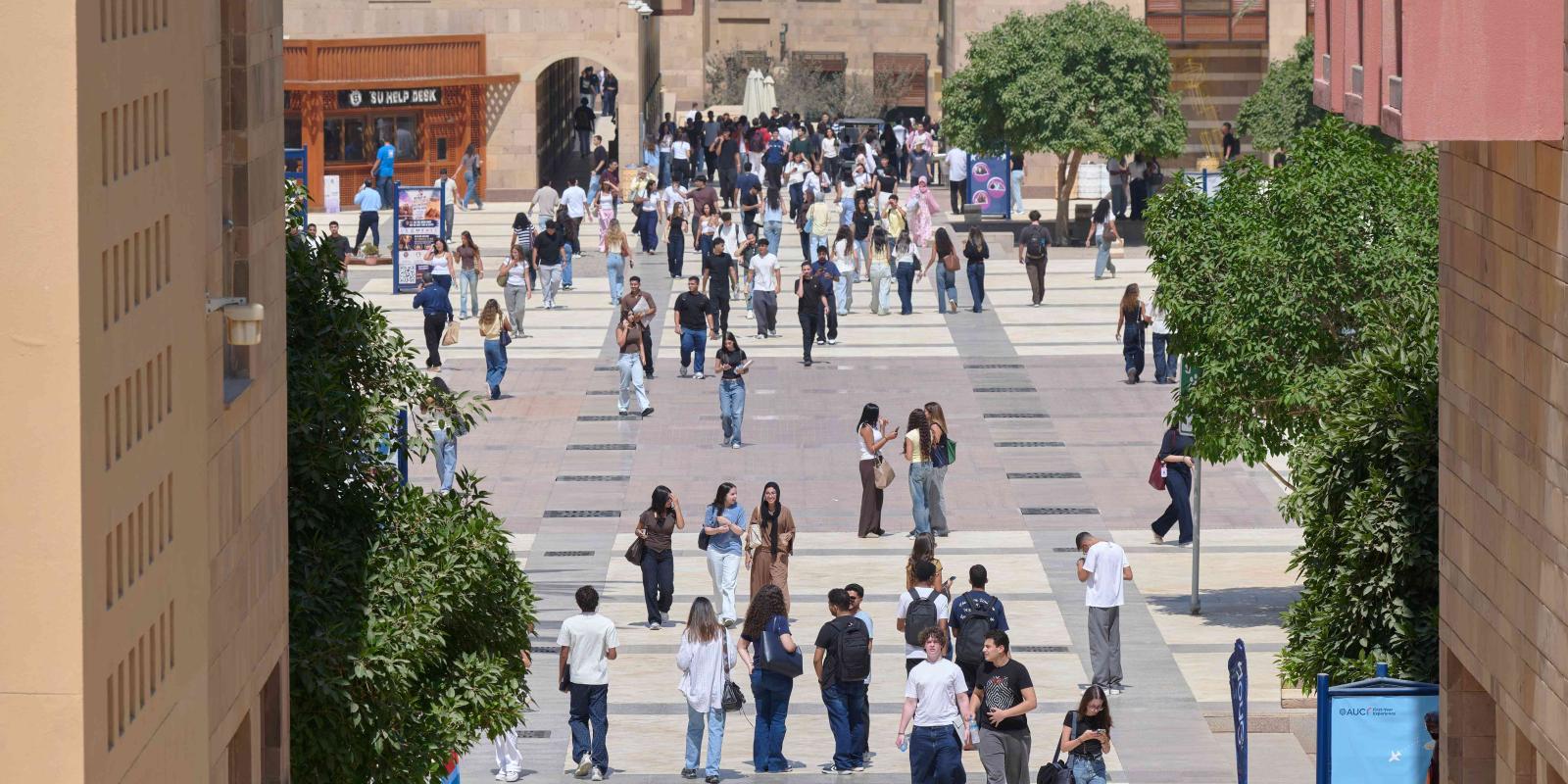
AUC Welcomes New Students and Faculty as Major Initiatives Get Underway
The American University in Cairo (AUC) kicked off the 2026–2027 academic year this week, welcoming 1,445 new students, including 73 international students representing 22 countries, and approximately 53 new faculty members from more than nine countries. The year ahead will also bring new academic leadership, the implementation of the University-wide artificial intelligence strategy, the formal inauguration of three major campus projects, and continued work toward the reaffirmation of the University’s accreditation by the Middle States Commission on Higher Education (MSCHE).
“This fall, we had our strongest recruitment cycle in the past four years, breaking last year’s application record,” said AUC President Ahmad Dallal in a message to the AUC community marking the start of the academic year. “We not only met our recruitment targets, but we also became more selective with an increasingly qualified pool of applicants competing for spots at AUC.”
Dallal also highlighted this year’s scholarship recipients, sharing the caliber and number of students who will benefit from AUC’s scholarship programs. “Now in its fourth year, the Excellence Scholarship Program continues to ensure we attract top performers, including Egypt’s highest achievers in IB, IG, and thanaweya amma, as well as students from all other diplomas and international students,” said Dallal.
He also added that AUC awarded scholarships to more than 530 students, with 292 top achievers receiving full-tuition coverage. “We also awarded more than 290 First-Year Achievement Scholarships to high-performing students. These students, along with other outstanding scholarship recipients on campus, represent almost 40% of our student body,” he emphasized.
New Faculty and Academic Leadership
AUC welcomed approximately 53 new faculty members this year across more than 13 disciplines and from more than nine countries, including the United States, United Kingdom, France, Germany, Greece, Canada and Egypt. The new faculty bring expertise across a broad range of fields, including rhetoric and composition, economics, management, public policy and administration, arts, political science, psychology, architecture and mechanical engineering.
The University also introduces new leadership in two schools. Maurice Pomerantz, a scholar of classical Arabic literature and former executive director of the NYU Abu Dhabi Institute, becomes dean of the School of Humanities and Social Sciences. Mohamad Al-Ississ, a development economist who previously served as a faculty member and associate dean at AUC and holds four degrees from Harvard University, becomes dean of the School of Global Affairs and Public Policy. Al-Ississ brings a decade of senior government and policy experience in Jordan, where he served in several ministerial and senior advisory positions, including minister of finance and minister of planning and international cooperation.
President Dallal announced that in May 2027, AUC will formally inaugurate three major projects at its New Cairo campus, each designed to support a different aspect of the University’s academic mission and student experience. The Technology, Research and Innovation Lab (TRI-Lab) will provide interdisciplinary research and innovation, bringing together faculty, students, researchers and industry partners to develop real-world solutions. The Extended Education Hub will expand AUC’s continuing and executive education offerings, creating opportunities for lifelong learning and professional development in Egypt and the region. The NextGen Student Living and Learning Spaces will introduce new residential facilities designed around integrated living and learning, providing students with spaces for studying, collaboration, social interaction and community engagement.
Following the formation of a University-wide AI task force last year to develop a comprehensive strategy, AUC is beginning to implement the strategy this academic year. Throughout the year, AUC will advance initiatives focused on building AI literacy, encouraging innovation and promoting the responsible use of the technology across teaching, learning, research and work. As AI technologies and their potential risks continue to evolve, the University will also assess and adapt its approach while maintaining its commitment to responsible and ethical use.
The University will continue its reaffirmation process for U.S. institutional accreditation by the Middle States Commission on Higher Education (MSCHE). As part of the 2024–2027 process, a university-wide effort has produced a draft self-study report, providing an opportunity for AUC to reflect on its achievements, assess its effectiveness, identify areas for improvement and reaffirm its commitment to its mission, values and aspirations.