AUC Students Claim All Three Top Spots In Prestigious Global Research Competition
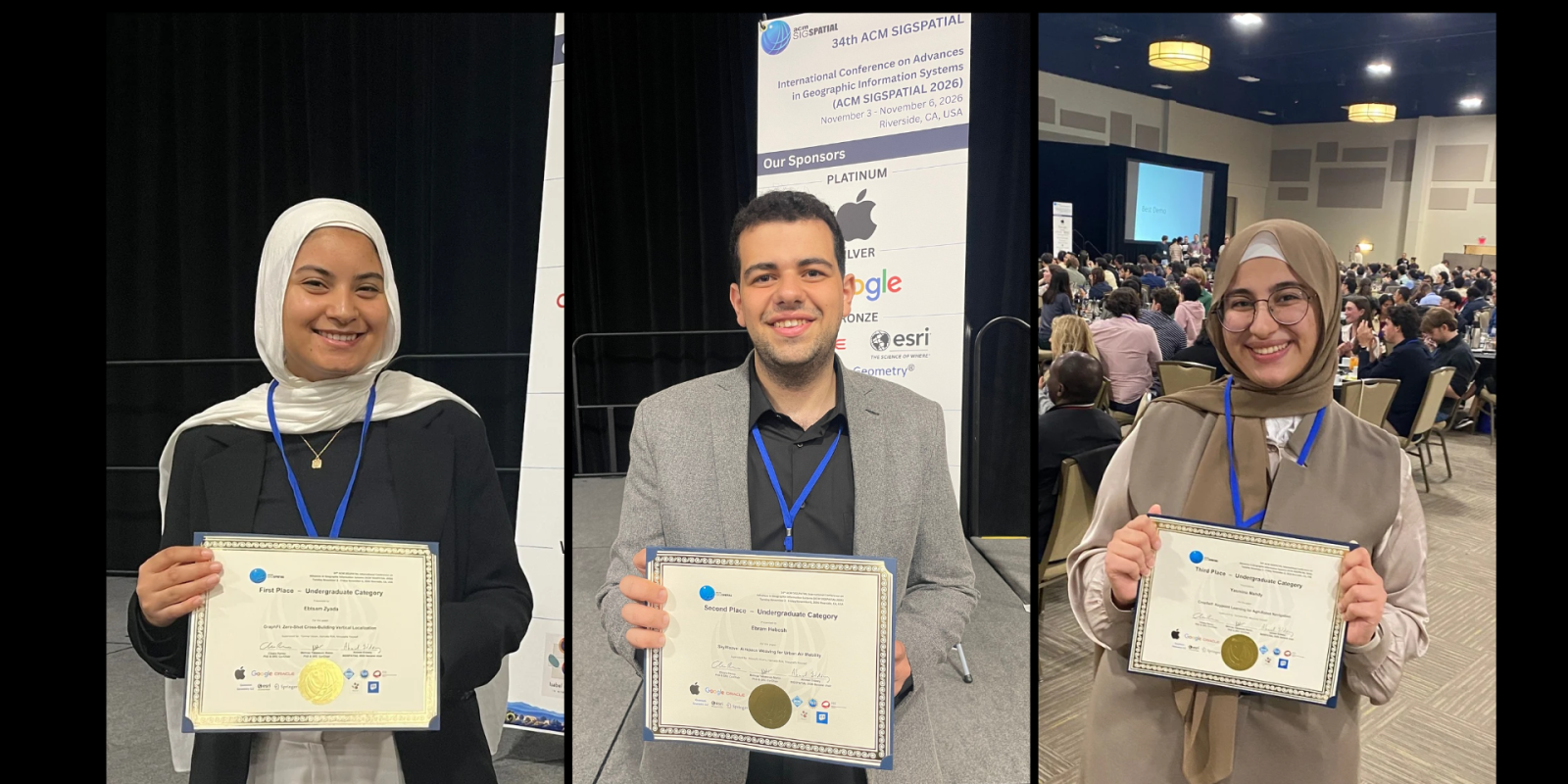
Cairo, November 24, 2026 – In a remarkable international achievement, three teams of undergraduate students from The American University in Cairo (AUC) have claimed first, second and third place at the 2026 Association for Computing Machinery (ACM) SIGSPATIAL Student Research Competition, marking the first time the University has swept all three top positions in the prestigious global competition. The winning projects showcase innovative research conducted by AUC students, applying advanced computing and artificial intelligence (AI) to address real-world challenges in indoor navigation, urban air mobility and agricultural automation.
The winning teams were represented by computer science and engineering seniors Ebtsam Zyada, who presented GraphFi and secured first place; Ebram Raafat Thabet, who presented SkyWeave and won second place; and Yasmina Mahdy, whose project, CropSelf, earned third place. The students were supervised by Moustafa Youssef, professor of computer science and engineering at AUC and recipient of the University's Spring 2026 Excellence in Research and Creative Endeavors Award. Youssef also co-authored the paper, “Quantum Optimization in Spatial Computing: A Vision,” which received the conference’s Best Vision Paper award. All participating AUC students received research training at the University, partially funded by Afretec.
"This is the first time AUC has achieved a clean sweep of the top three positions in this competition, building on our students' previous successes in earlier editions," said Youssef. "It demonstrates both the exceptional quality of these projects and the consistency and depth of undergraduate research at AUC."
The achievement extended beyond the undergraduate competition, with AUC alumni who completed their undergraduate studies at the University also securing first and third place in the graduate category. The projects underwent a rigorous four-stage judging process, conducted both online and in person, and were evaluated by international researchers from leading universities worldwide.
The three winning projects address distinct challenges through innovative applications of computing and AI. GraphFi, which won first place, uses WiFi signals picked up by a smartphone to determine which floor a person is on inside a building, helping improve indoor navigation and emergency response in new buildings. Unlike current WiFi systems, which require new data and retraining for every building, GraphFi can work in buildings it has not encountered before. The team trained the system using data from just one building in Spain, and it successfully identified floors in new buildings, including one in Finland, without additional data or retraining. GraphFi achieved about three times the accuracy of existing systems.
Securing second place, SkyWeave is an AI-powered air-traffic control system designed to manage the growing number of drones, air taxis and other aircraft expected to operate in urban airspace. “As cities begin using low-altitude airspace for delivery drones, emergency response and air taxis, the skies are going to get very crowded. SkyWeave is an intelligent air-traffic control system designed for the future of city skies,” Thabet explained.
Using a virtual 3D map, SkyWeave operates through two components: a Flight Controller, which adjusts the speed, altitude and takeoff timing for individual drones to prevent collisions, and a Fleet Supervisor, which monitors air traffic across a city. It can cancel non-essential flights to prevent congestion and can reroute flights around unexpected obstacles or restricted areas. SkyWeave resolves more than 98.9% of potential conflicts, such as collusions, while keeping flight cancellations below 3.3%. Trained using data from New York City, it also demonstrated comparable performance in other cities, including Cairo and Tokyo, without requiring retraining.
Third-place winner CropSelf focuses on autonomous agricultural robotics, developing a self-learning navigation system that enables farm robots to move independently between crop rows. “Robots can do a lot of the work in the fields, from weeding to spraying pesticides, which can alleviate the tedious labor associated with farming. But before a robot can do any of that, it has to be able to drive between the crop rows on its own,” explained Mahdy.
CropSelf eliminates the need for manual image labeling by allowing robots to learn from footage captured by their own cameras, along with data from sensors that track their movement. This lightweight approach could make agricultural automation more accessible, particularly in countries with limited technical infrastructure.
Commenting on the significance of the achievement, Youssef highlighted the breadth and ambition of the three projects. “They address challenges in indoor positioning across different buildings, the coordination of future urban air mobility and autonomous agricultural robot navigation. These are original research contributions addressing real-world challenges through advanced computing and AI techniques, rather than simply classroom exercises,” he said.
Youssef attributes this success to AUC’s strong undergraduate research training program, where students work closely with faculty mentors and engage in the full research process, from identifying meaningful problems to developing, implementing and communicating innovative solutions. “I believe this achievement is a strong testament to the value of investing in undergraduate research early in students’ academic journeys,” said Youssef. “Afretec’s support has been particularly valuable in strengthening this research ecosystem and expanding opportunities for students.”
In addition to the monetary award and recognition, first-place winners advance to the ACM Student Research Competition Grand Finals, competing against first-place winners from other ACM conferences. A grand winner is then selected and recognized at the ACM Turing Award Ceremony, commonly known as the Nobel Prize of computing.
The Association for Computing Machinery (ACM) SIGSPATIAL conference is a leading global forum for research in geographic information systems, spatial computing, location technologies and other related fields. As part of the conference, ACM hosts the Student Research Competition, with separate categories for undergraduate and graduate students, who present their research on topics related to spatial algorithms and systems. The competition provides participants a chance to meet other students and to get direct feedback on their work from academic experts, researchers and industry professionals.
The achievement reflects AUC's commitment to developing students not only as recipients of knowledge, but also as active contributors to research and innovation, equipped with the skills and confidence to address pressing challenges in Egypt, Africa and beyond.