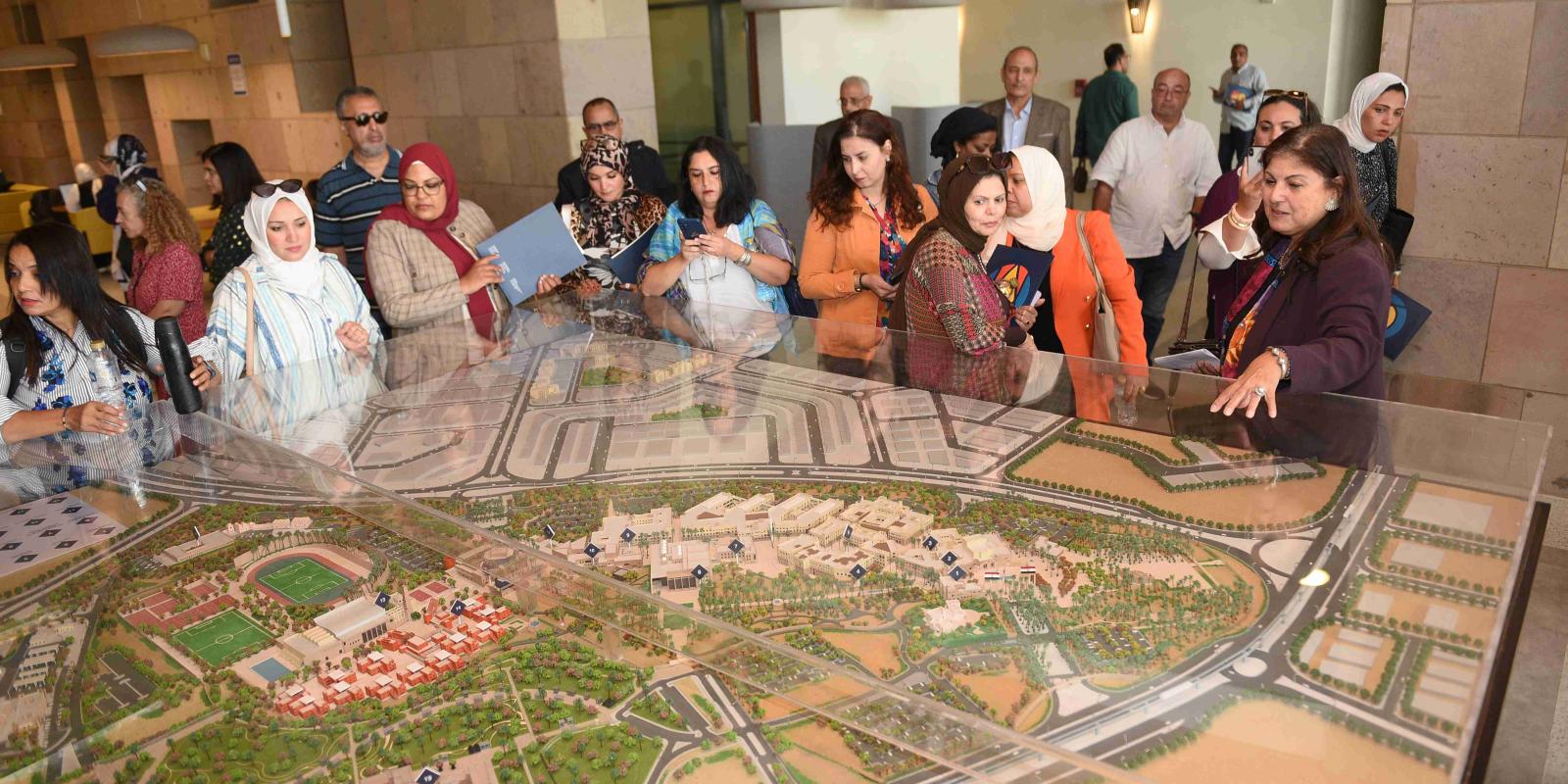
AUC Library Unveils Renovated Learning Commons, Marking the Capstone Project of University-Wide Learning Spaces Strategic Plan
The American University in Cairo (AUC) Library has reopened for the Fall 2026 semester following a major transformation of its plaza and garden levels into a Learning Commons designed around how students study, work together and engage with technology today. The redesigned spaces provide more opportunities for collaboration and active learning, introduce new accessibility resources and feature a permanent exhibition space for the Rare Books and Special Collections Library (RBSCL), bringing the University’s rare and special collections into greater view. The renovation is the capstone project of the University’s seven-year Learning Spaces Strategic Plan, a broader effort to transform learning environments across campus, including classrooms, outdoor learning spaces and the library terrace.
The Library’s newly redesigned Learning Commons includes new furniture, flooring, lighting and technology as well as upgraded networks, modernized study spaces and a state-of-the-art Accessibility Hub. The renovation also creates a new exhibition for the RBSCL on the library’s plaza floor. Its location makes the rare collections visible to a wider audience and encourages students to explore them firsthand. The RBSCL features extensive rare and contemporary book and periodical holdings, and archival and manuscript collections reflecting Egyptian social, political, cultural, and intellectual life.
The changes reflect a broader shift in how students use academic libraries, explained Lamia Eid, ’88, ’92, dean of Libraries and Learning Technologies. When the AUC Library was designed in the late 1990s and early 2000s, the emphasis was largely on individual study and access to information, with a large computer lab and desktop computers arranged around circular tables. Today, students use library spaces differently. They bring their own laptops and devices to work in groups, exchange ideas and collaborate in ways that better support how they learn.
“Academic libraries around the world have responded to this shift by moving from the traditional Information Commons Model toward Learning Commons that support collaboration, interaction and active learning,” Eid said. “The current renovations at the AUC Library build on that change. It is not simply an update to the existing spaces, but a rethinking of how the library can support students today.”
The renovation also recognizes that students do not all learn in the same way. It places a strong emphasis on accessibility and diverse student needs through the new Accessibility Hub, which provides resources and technology to support students with diverse learning needs and enable them to work more independently. Moreover, the library has kept quieter and more traditional study environments on the first and second floors, as well as the 24/7 study rooms. “The Learning Commons offers more opportunities to study and work together, while the rest of the library continues to provide quieter spaces for focused study. The renewed AUC Library brings these different needs together, giving students more choice in how they use the space and how they learn,” Eid said.
Launched in 2019, the Learning Spaces Strategic Plan aims to create next-generation learning spaces that place learning at the center of the campus experience. It has transformed a small active learning pilot into a portfolio of 43 innovative spaces across formal and informal settings. Starting with three pilot classrooms and a Faculty Innovation Lab (Sandbox) on the New Cairo campus, the initiative expanded to include 14 Active Learning Classrooms at New Cairo and Falaki, 14 Flexible Classrooms, informal learning spaces and the Library Learning Terrace. The renovation of the Library Garden and Plaza Level marks the culmination of the plan’s first phase.
“At AUC, we believe that the learning environment plays an important role in shaping the educational experience. Our goal is to create spaces that inspire curiosity, encourage students to engage actively with ideas and one another, and support different ways of learning and teaching. By rethinking how our spaces are designed and used, we are creating an environment that enables students and faculty to explore new possibilities for learning, discovery and innovation,” said Hoda Mostafa, professor of practice and director of the Center for Learning and Teaching at AUC, who has co-led the Learning Spaces Strategic Plan since 2019.