AUC Launches Tuesdays In Tahrir Initiative, Transforming Historic Tahrir Palace Into Experiential Learning
The American University in Cairo (AUC) has launched Tuesdays in Tahrir, a new initiative transforming the historic AUC Tahrir Square campus into an active field site for undergraduate coursework. The initiative encourages students and faculty to integrate the downtown campus into academic life, applying the University’s vision of "One University, Two Campuses." Drawing on the Tahrir Square campus's architectural heritage and its proximity to key cultural and policy centers, faculty are transforming the 150-year-old palace into an experiential learning environment for courses ranging from creative writing and political science research to theatre and arts, allowing students to explore the University's oldest building through diverse lenses.
AUC President Ahmad Dallal has placed the initiative within a broader institutional and national context, noting that the campus has spent more than a century at the center of Egypt's civic and intellectual life — hosting landmark events, influential lectures and movements that shaped the country. "Historic Cairo is undergoing a cultural transformation. We believe in it and we are, at its heart, revitalizing the campus in Tahrir to serve the national ambitions and visions much more efficiently," Dallal said.
As part of this new initiative, Rabab El Mahdi '96, associate professor of political science and founding director of Alternative Policy Solutions (APS), is using the Tahrir Square campus to anchor a hands-on policy research experience within her Introduction to Development course. Her students completed a five-week practicum at APS, contributing to policy-focused projects in collaboration with researchers and engaging with key public-sector perspectives on issues such as debt swaps and the Grand Egyptian Museum.
"AUC didn't sit beside history; it hosted it," El Mahdi comments on the historical significance of the Tahrir Square campus. “There‘s a different energy here than in a classroom. Students apply concepts to real challenges, working alongside researchers and government stakeholders,” she added.
Students in the practicum have described the setting as raising the professional stakes of their work. Political science junior Omar Fahim said working within an institution that advises government officials makes the quality of his output feel consequential: "APS talks directly to ministers. It makes me realize our work could reach officials. It motivates me to give my all." His classmate Laila Mamdouh added, "The aesthetic of the office, with Tahrir Square outside, pushes me into the mindset of doing quality work. It's not just a class; it feels like a responsibility."
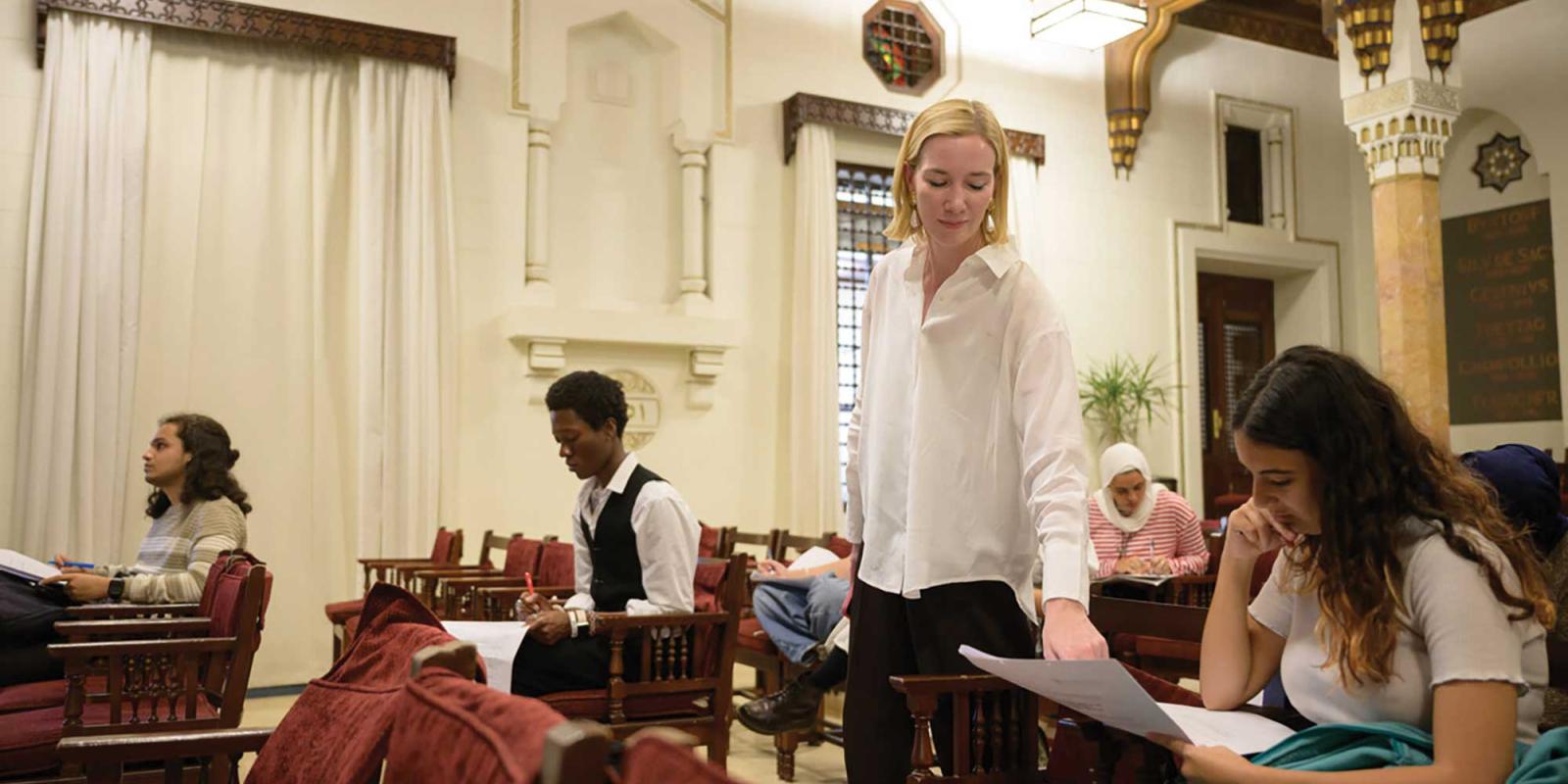
Nina Ellis, assistant professor of English and comparative literature, is another professor who conducts her Creative Writing class inside AUC Tahrir, Oriental Hall, where students draw on the palace's architecture as primary material for their writing. Ellis directs students to engage with the space through close observation, treating the building itself as a pedagogical instrument. Students have written from balconies overlooking downtown Cairo traffic and from within the hall itself, responding to the textures and atmosphere of a space that has stood for over 150 years. "Dazzled is the word," Ellis said of her first encounter with the hall. "It continues to serve Cairo and the community. And I think it's really important that these students return to this campus. I say return because it is part of the history of their identity as AUC students."
Jillian Campana, theatre professor and associate dean for undergraduate studies and research in the School of Humanities and Social Sciences, also regularly uses the Tahrir Square campus for classes and describes the effect of the environment on students in terms of historical continuity. "It's a very powerful thing to be a young person walking around and looking at the storied halls and spaces like Ewart Memorial Hall or Oriental Hall. It's almost like they're being held up by all of the people that have come before them," Campana said.
The Tahrir Square campus has one of the richest histories of any university campus in the Arab world. Khairy Pasha Palace, built in the 1860s, became AUC's first home in 1920, welcoming 142 inaugural students. Over the following decades, the campus expanded with Ewart Memorial Hall and Oriental Hall — both designed in the neo-Mamluk style that has defined Cairo's architectural identity for over a century. The campus admitted its first female student in 1928, decades before many Western universities, defended academic freedom during protests in the 1930s and has served through the years as a center of civic and intellectual life. Its halls have hosted figures including Umm Kulthum, Taha Hussein, Helen Keller, Martin Luther King Jr. and Edward Said.
By embedding undergraduate coursework within the Tahrir Square campus across disciplines - from public policy to the arts - AUC is positioning the initiative as a model for how research universities can integrate urban environments and historic spaces into the texture of academic learning.