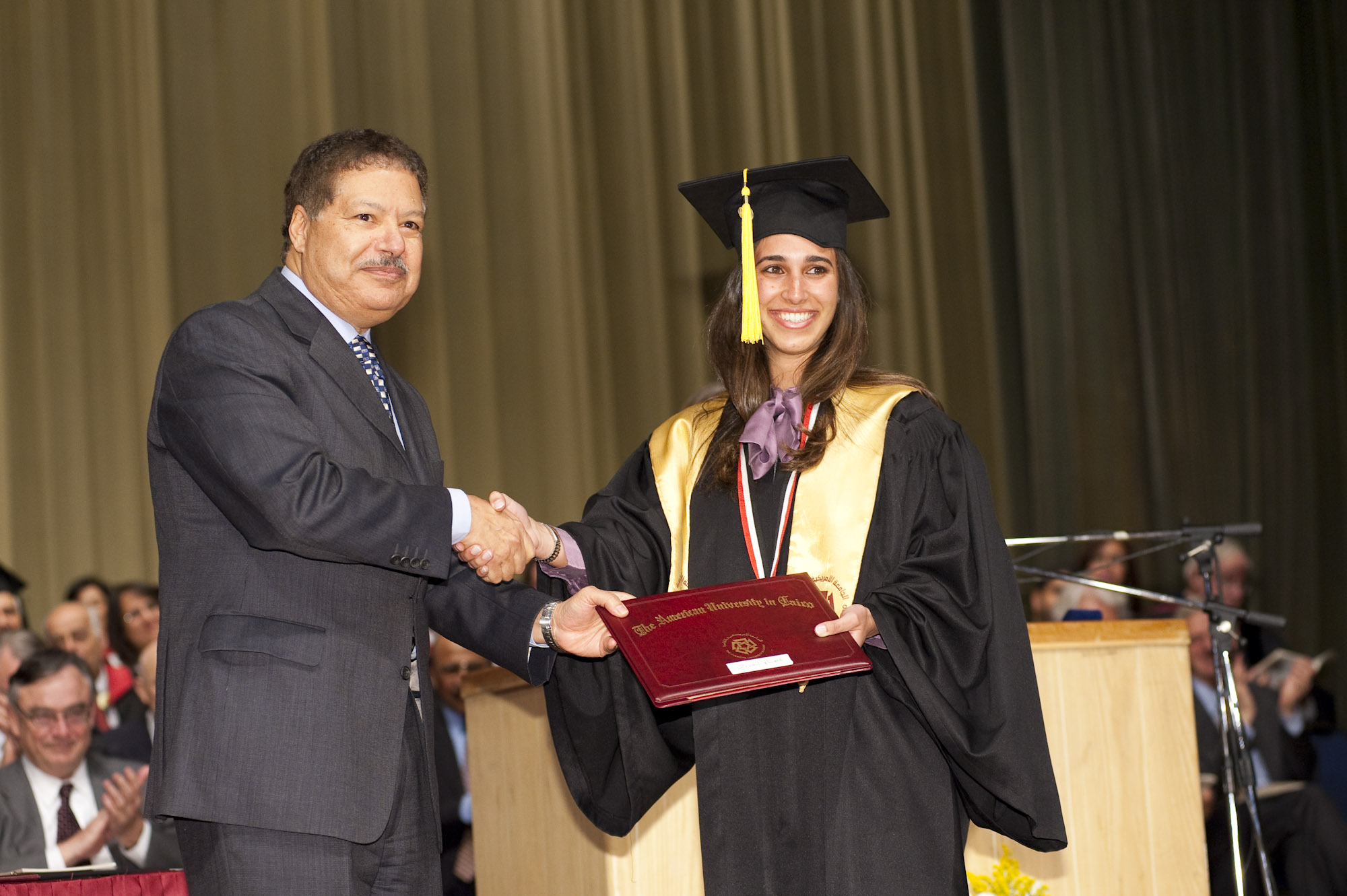
The Ahmed Zewail Prize
The prize embodies Zewail’s belief that Egypt’s future development depends on progress in the physical, biological, and social sciences, the development of world-class technologies, and a deeper understanding of the relationship between science, technology, and society. It was first awarded in February 2001, and winners are recognized at each AUC commencement.
Application
If you are eligible for the award, you will receive an email from zewailpr@aucegypt.edu containing a link to a form for submitting your essay, along with the submission deadline. Participants should submit their essay, along with their CV, in either Google Docs or Word format.
Eligibility
- The applicant must be an AUC student in the final semester of undergraduate study
- The applicant must achieve an overall grade point average at the honors level (GPA must be 3.4 or above), as determined in the term preceding the semester graduation
- It is preferable that the applicant’s CV show their involvement in extracurricular activities at AUC or beyond
Selection Criteria
A faculty committee from across the disciplines evaluates applicant submissions based on their submitted essays. Participants must write an original 1,500 to 2,000-word essay written especially for the prize on a science and humanities topic. Applicants must write on one of the following two topics:
- An original essay on any science and humanities topic that transcends the rigid boundaries of traditional academic disciplines and reflects a multidisciplinary perspective on the chosen topic
- An original essay on a topic drawn from within the student’s own area of specialization that explores new ideas and possibilities and reflects the applicant’s own work and intellectual interest
The panel will judge the essay on:
- Quality of thought, development and expression, including logical reasoning, identifying hidden assumptions and justifying arguments using multiple credible sources
- Critical engagement as evidenced by questioning authority and established knowledge, interrogating one's own thoughts and biases and exploring alternative worldviews
- Originality of ideas
- Multidisciplinary sophistication
- Appropriate personal connection and self-reflection
It is both appropriate and essential that the candidate reflects the breadth and depth of the academic reach and rich diversity of perspectives at The American University in Cairo, by including personal stories or reflections on their experience as students at the University that influenced their choice of topic.
Guidance on Citation Formatting
Ensure in-text citations and references are correctly formatted and all cited sources have been reviewed. The following sites offer guidance and citation generation for:
APA style: https://www.scribbr.com/apa-style/
MLA style: https://www.scribbr.com/category/mla/
You may also ask for support from the AUC Writing center.
AI Statement
The expectation is that the ideas in students’ essays will be original, the students’ own, but students may use AI tools to check grammar and help with outlining. Applicants are expected to include a reference list at the end of their paper and attribute their sources accordingly, and will be asked to upload their papers to Turnitin.com eventually. Applicants will also be asked to include an AI statement after their reference list, showing where and how they have used AI in their paper.
Interview for shortlisted applicants
Applicants whose essays are shortlisted will be invited to participate in an interview for the applicant to share their ideas with a panel of faculty members to and respond to questions about the essay.
Terms of the Award
The prize will be awarded at each commencement. Recipients will be given a Commendation for Excellence certificate, a cash award of EGP 5,000, and a medal. Winning essays will be published on the prize page on the AUC website.
2026 Award-Winning Essay
Terrorism’s Unsolved Puzzle: Why Understanding Political Violence Demands More Than One Discipline
Merna Soliman, Spring 2026 (Winner)
When Numbers Meet Suffering: The Ethics of Humanitarian Data Science
Omar Moustafa, Spring 2026 (Runner-Up)
Beyond Evidence: What It Actually Takes for Truth to Break Through
Mariam El Ghobary, Spring 2026 (Runner-Up)
The Eternal Constant: Human Nature Expressed Through Media
Nour Mohamed El Badawi, Spring 2026 (Runner-Up)
What the Model Cannot See: Rethinking Structural Design in the Age of Artificial Intelligence
Ehab Ibrahim Ezzat Aziz, Spring 2026 (Runner-Up)
When Cheap Scans Cost Lives: Building AI That Sees What Doctors Cannot
Ahmed Jaheen, Fall 2025 (Winner)
Patterns of Perception: The Mathematics of Memory and the Chemistry of Emotion
Jomana Eldamanhoury, Spring 2025 (Winner)
Between Firewalls and Faith: The Architecture of Trust
Malak Ashraf Zeerban, Fall 2025 (Runner-Up)
The Architecture of Value: The Logic of Waste and the Art of Regeneration
Farida Aboul Seoud, Fall 2025 (Runner-Up)
Rigor, Care, and the Spaces Between: An Autoethnography of Learning That Matters
Yasser Tamer Atef, Fall 2025 (Runner-Up)
Learning Inequality: International Law as a Professor in Disguise
Perihan Elsheikh, Fall 2025 (Runner-Up)
From Fuzzy Games to Foreign Policy: The Role of Uncertainty in Decision-Making
Lina Tarek Elsehelly, Spring 2025 (Runner-Up)
AI and the Human Condition: Redefining Empathy in the Age of Automation
Shady Iskander, Spring 2025 (Runner-Up)
The Silent Revolution: Governing Quantum Power in a Divided World
Yaseen Ahmed, Spring 2025 (Runner-Up)
Applications of Egyptian Extremophiles
Omar Helal, Spring 2025 (Runner-Up)
The Neuroscience of Storytelling: How Narratives Shape Memory, Empathy, and Identity
Salma Bayoumi, Spring 2025 (Runner-Up)
Yasmine Amr Abulfadl, Fall 2024 (Winner)
Tamer Ahmed Osman AbdelFatah, Fall 2024 (Runner-Up)
The Growing Decline of Creativity and Critical Thinking in the Age of Artificial Intelligence
Farah Kabesh, Fall 2024 (Runner-Up)
Ethical Implications of Artificial Intelligence in Education
Salma Ahmed Aly, Spring 2024
Artificial Intelligence in Mental Health in Egypt: from Challenge to Opportunity
Sara Younis Soliman, Fall 2023
Hana Mortada, Spring 2023
Rethinking Inclusive Education: Diversity As A Strength Not A Burden
Sara Tadros Mourad, Fall 2022
Artificial Intelligence Advertising: An Innovative Leap or a Dangerous Threat?
Ahmed Ibrahim Ahmed, Spring 2022
The Influence Music Therapy Can Have on Mitigating the Stigma Surrounding Mental
Georgenia Bassily, Fall 2021
Mostafa Sherif Sedky, Spring 2021
Post COVID-19 Development in the Middle East: Why Environmental Sustainability Matters
Farah Fawzi Ali, Fall 2020
How Egypt Can Capitalize on the Coronavirus Pandemic and Transform its Economy
Yusra Mostafa Salama, Spring 2020
Digital Epidemiology: Utilizing Social Networks and Data Science for Health Applications
Dina Gamaleldin Mahmoud, Spring 2019
Islam Faisal Abdelrasoul, Spring 2019
The Biggest Event in Human History
Lobna Dawoud, Fall 2017
Ibn Khaldun’s iPad: Towards Interdisciplinary Collaboration Between Social and Computer Science
Lara Assem Ahmed, Spring 2017
Engineering and Philosophy: The Universal Man
Ola Gamal Elsaid, Fall 2016
Using Science as a Philosophy and a Source of Morals
Haitham A. Kandeelm Spring 2015
Taher El Moataz Bellah Farghaly, Spring 2014
Nada Yasser Sharkawy, Fall 2013
A Civically Engaged Student Body…Changing the Future of Egypt
Dalia El Serafy, Spring 2013
The Key Entity to a Reformed Egypt
Farida Ahmed Monsef, Spring 2012
Redefining the Scope for Development Through a Creative Lens
Hadeel Salama, Fall 2011
Neuroeconomics: A New Understanding of Taxation
Yosra Bedair Metwally, Spring 2011
Karen Beshay, Fall 2010
Dahlia Abou-Azama, Spring 2010
Salma Medhat Soliman, Spring 2009
Maha Khalil, Fall 2008
Egypt’s Pharmaceuticals – Tripping Over TRIPS?
Farida H. Mortada, Fall 2008
Hend Wagdi Nashaat, Spring 2008
Egyptian Revival Through Perseverance and Knowledge
Youssef Gamal El Din, Spring 2007
May Koura, Fall 2005
Hussein Fouad Tarek Abou Bakr, Fall 2004
The Magic Wand: Can Genetically Modifies Crops Offer a Solution for World Hunger?
Fatemah Hermes, Spring 2004
Shahdan Arram, Fall 2003
The Unexplored Territory of Consciousness
Sara Mitri, Spring 2003
Towards Understanding of a Shared Humanity
Beate Ulrike Sayed, Fall 2002
Khaled Adel Harras, Spring 2001
Maha Ayham Bali, Fall 2000