December 16, 2012
After
the war, over dinner, I’d used the word hurriya
(freedom)—but before I could finish a local girl proudly working at one of the
large international NGO’s (INGOs) interrupted me: “Don’t say that: you will remind
us we are under occupation.” It’s a stunning statement that reveals the
delicate mind games that middle-class and more fortunate Palestinians in Gaza
get to play with themselves. Their wealth enables them to push realities to the
side; their newfound international wasta (connections)
means their futures may lay outside of Gaza. It’s an ideology that the
apolitical environment of an INGO inadvertently nurtures. Water cooler talk of
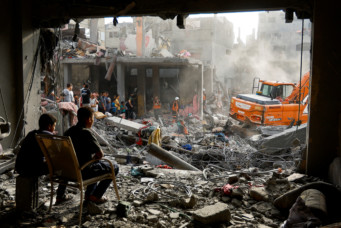
the occupation is at best frowned upon. Meanwhile, the rest of Gaza celebrated
the last few weeks with an authentic departure from the alternate reality of
INGO life.
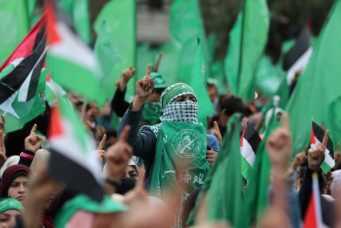
Khaled
Meshaal’s visit
to Gaza—on the back of what is widely conceived of as a triumphant couple of
weeks for Hamas—brought the community out for a day of celebrations. A smattering
of kids dressed up (albeit in resistance regalia), stalls selling hot nuts,
roads cordoned off for pedestrian use only and ludicrously-sized missiles.
The speeches of Meshaal and Haniyeh were to be broadcast on Hamas’s Al Aqsa TV.
Feigar, the middle-aged women who provides an extra, part-time, pair of hands
in our home, was sitting on quite literally the edge of her seat watching from
home Khaled Meshaal’s speech at the Kateeba,
Gaza’s prime demonstration space. I was
surprised given how she’s never broached politics with me.
It
does not take an in-depth interview to understand the emotions swirling around
the everyday Gazan and their nascent re-connection with Hamas. The gist right
now is that Gaza—for once—managed to fight back. That’s enough for most people
to understand and process what just happened. Whether Hamas is any better
placed to end the occupation than Fatah is not dwelled on: both parties are
flawed, both appear hopeless. But what Hamas, unlike its West Bank rival, is
able to offer, almost by default, is both pragmatism and hope—and, once in a
while, a little courage. Hope by way of the party’s Islamic nature, which it
can always fall back on as a tactic in and of itself; pragmatism through
Meshaal’s ability to converse on more than equal terms with the likes of CNN’s Amanpour;
and courage by not taking it lying down.
But
also at the heart of the last months events is that top representatives of not
just one but three Arab and regional Muslim states came to Gaza during
Operation Pillar of Defense: Turkey, Tunisia and Egypt. At the same time Western
states who are heavily invested in Palestine only come during times of peace,
and at times of war muster phrases like: ‘all parties must show restraint’.
Feigar
tells me: “We didn’t feel alone.” Western nations and their people appear to
not grasp the importance of this. Feigar, struggling to make ends meet, does
not see any of the millions of dollars of relief aid that come to Gaza, nor
does she shake hands with the diplomats who turn up to smooth-talk Hamas; and
she would not be able to tell you what the donor backed ‘civil society’ does.
That world is completely unknown to her. What she knows is that tomorrow she
may have nothing: no house, no job, no family and no one to support her. Her
reality is immediate, her fate is
Gaza’s fate. When the Turkish foreign minister comes to Gaza and sheds tears
with its people, she ‘gets’ that. When Hamas police arbitrate on her side
during a traffic incident she ‘gets’ that; and when Hamas make Israel feel a
little uncomfortable, she ‘gets’ that, too.
She
is not Hamsawi, she never voted for
Hamas, she acknowledges their corruption—seemingly every state has trust issues—but
Hamas are Gazans: she recognizes them. Walk into the Bank of Palestine (a
Fatah bulwark) in Gaza and try connecting with the teller whose gelled hair and
watch glisten under the lights. Fatah, even to the untrained eye, appears to
have it all. And that’s precisely their problem.
Pervasive
insecurity and perpetual defeat does not necessarily ferment fundamentalism.
Gaza is just not like that, yet. What this impoverished, and deeply religious,
environment needs is the occasional Pyrrhic victory to make people feel
something, anything, else. Feigar is not about to dress her kids up in the
clothes of the muqawama (resistance),
nor is she going to wave a green flag from her door. She is going to pin a
little of what’s left of her hope on the belief that Hamas may, with the help
from their new Arab friends (and Allah), do a little bit more for Gaza than the
absent, but well-endowed, Fatah and their international partners. Who, to their
credit, have done their best to humanize Palestine to the world and create a
slither of wealth for Gazans—but little else to give Palestinians in Gaza the
political agency they so desperately desire.
Wasseem El-Sarraj is a writer
and activist living in the Gaza Strip.