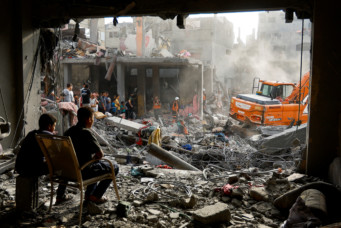
The Dalai Lama consoling tsunami orphans, Ishinomaki, Japan, Nov. 5, 2011. Mariko Ishizuka/Jiji Press/PANA
February 10, 2013
China needs Japan,
Japan needs China,” the 14th Dalai Lama declared, with immovable
conviction, as I listened to him in a sunlit conference room in Yokohama last
November, a great Ferris wheel turning outside and a jungle of high-rising grey
skyscrapers presiding over the blue bay. “Every nation on this planet needs
others. So a small disagreement or division of interests should not affect
basic relations. Of course Chinese people must love their nation, their
culture: that is good! But it’s too extreme. It’s almost as if they’re
suggesting that, across the planet, Chinese culture is the best. When we were
in Tibet, we had some of that same kind of view: ‘Tibet is the best!’ That’s
wrong! Too much emotion involved. Too short-sighted.
“In the past, I was
sometimes telling people Buddhism was best. But after meeting with different
people, from other traditions, now I feel you cannot say one religion is best.
It’s like with medicine. In order to administer medicine, you have to look at
the individual illness. For each body, according to its circumstances and
natural conditions, a different system of medicine may be best.”
The absolute
insistence on reason—which is unwavering as the laws of gravity and lasting and
objective, as emotions are not—and the readiness to stress his own mistakes and
those of his culture, while acknowledging the strengths of its longtime
oppressor, the People’s Republic of China, reminded me that I was in the
company of an unusual presence who thinks in unexpected ways, and all but
remakes the political domain by rewriting its assumptions. For years now, the
world has, understandably, concentrated on the Tibetan leader’s belly laughs,
his warm charisma, his humanity, and all are compelling indeed, and inspiring;
even when I ride with him in an elevator in a shopping-mall in Yokohama, he
clutches the elbow of the beaming elevator operator, to give something personal
to their brief interaction. Yet all the emphasis on his undeniably kind and
tolerant heart often obscures what is to me his most singular quality,
especially in the context of history and geopolitics: the clarity of his mind,
and his unswerving emphasis on realism.
For
each of the past seven Novembers, I’ve spent several days traveling across my
adopted home of Japan with the Dalai Lama as the lone journalist in his small
entourage. We’ve ended up at roadside convenience-stores where the disarming
monk in red robes stands at the door with a can of “hot milk tea” and greets
every surprised truck-driver with a smile and an outstretched hand. We’ve gone
from fishing villages laid waste in the wake of the 2011 tsunami, where he
consoled the recently orphaned, to lunches in central Tokyo filled with figures
from the world of fashion; from the tropical graveyards of Okinawa to ninth century temples not far from the Peace Park in Hiroshima.
Almost as soon as the
Tibetan leader came into exile in India in 1959, my father, a professional
philosopher, sailed back from Oxford to meet him, and so I’ve been visiting the
Tibetan leader in his home in Dharamsala since 1974, when I was in my teens.
Now, as he goes through his working day in Japan, at once sharing Buddhist
teachings with what remains the world’s most powerful Buddhist nation, and
speaking for those in Tibet who can’t speak much for themselves, I sit in on
almost every one of his private audiences—with politicians, with regular
Tibetans, with friends of the Emperor and with long-haired Japanese heavy-metal
musicians, who have somehow decided that they want to make Buddhism their
message. The more I’ve watched him, the more I’ve come to see that his
sovereign qualities are often the ones you don’t see on CNN or in newspapers,
which concentrate on his contagious smile: a razor-sharp memory, a deeply
practical commitment to something deeper than gestures or words, and a much
more rigorous and tough-minded approach to the world than many might expect. As
he said at a peace conference in Hiroshima, in 2010, “I don’t believe peace
will come through prayer. Peace must come through our actions.”
Beyond Religion
The story of how a
small boy born to a farmer’s family in a cowshed was discovered to be the
fourteenth Dalai Lama at the age of two, enthroned in Lhasa at the age of four
and then given full political leadership over his people as the troops of Mao
Zedong flooded into Tibet when he was fifteen, is so colorful and exotic that
it’s easy to overlook its hard-core heart: the fact that, from the time he was
in kindergarten, the Dalai Lama was put through a grueling, eighteen-year
doctoral course specializing in logic and dialectics. And even more than most
monks who emerge from that training, he likes to stress that the Buddha—his
“boss,” as he calls him—was a scientist, a physician (of the mind), and a
regular human being who relied only on empirical data.
“The
Buddha himself told us we should not accept his word on faith, or through
devotion,” I heard the Tibetan say in November. “We should investigate even his
own words and come to an independent conclusion.” Like a Harvard philosopher,
the Dalai Lama takes words apart and demands absolute precision: for a teaching
in Yokohama on an eight-verse poem, he spent an hour on two words at its
beginning, “May I,” to see what the “I” really is. And over and over, ever more
as the years go on, he stresses “secular ethics based on scientific findings.”
If his most evident passion is the lab research he’s been following and
encouraging at M.I.T., Stanford, Emory University, the University of Wisconsin,
and many other major universities, it’s because it offers a verifiable,
universal measure of how much meditation, say, can lead to happiness, health,
and peace of mind. The most recent book by one of the world’s most visible religious
figures is called Beyond Religion, and argues that religion is a useful
luxury in life, like tea, but what all of us most need is an everyday sense of
kindness and responsibility, which lies outside the domain of religion, but
remains as indispensable as water.
In the realm of
politics, this means that the Dalai Lama is always taking seemingly
counter-intuitive positions, based not on ideology but logic, and refuses to
toe the line of his more woolly-minded admirers or even the most well-intentioned
idealists. When he lived in Lhasa, he’s been telling me (and the world) for
more than thirty years, he and his culture were too isolated; exile has, if
nothing else, forced him and his people to shed certain illusions and “be more
realistic.” People from other traditions should not become Buddhists, he said
again in Tokyo last November; they may have much to learn from Buddhism—from
everyone—as Buddhists and everyone can learn from them, but it’s “much better,
much safer” to keep to their own traditions. As he delivered a talk on an
eleventh century Tibetan Buddhist text (and urged those followers in the
audience to be “twenty-first century Buddhists”), he said, “Now is the time for
scientists to take the lead. Not people like me in robes.”
The essential feature
of the Dalai Lama’s life, I often think, is the one fact that so many of us,
won over by his charm and unpretentious humility, overlook: he was a
full-fledged political leader, in one of the most difficult situations in the
world, for 60 years until he effectively deposed himself, and passed all formal
political leadership of his people to a democratically elected leadership, in
2011. Opposed and derided by the largest nation on earth, outnumbered by 200 to
1, and unable to visit his homeland or most of his people for more than half a
century, he’s never been in a position to entertain romantic or wishy-washy or
abstract “spiritual” answers. Pragmatism, what works in the here-and-now, is
all that matters for him, as for the Buddha.
When I saw him in November,
many were eager to ask him, inevitably, about the tragic rash of
self-immolations that had left more than 50 Tibetans dead in recent months;
even as he spoke, four more were taking their own lives, some of them as young
as fifteen. True to his emphasis on realism, and his commitment to his monastic
vows, the Dalai Lama could not endorse suicide even as he pointed out that
people would act so desperately only if there was a serious problem in their
lives. “Whether the Chinese government admits it or not,” he said, “there is a
problem in Tibet. That is good for neither Tibet nor the Chinese government.”
Force would only aggravate the problem and, he pointed out, since the
self-immolators had not gone the way of suicide bombers or tried to take Chinese
lives, they were clearly devoted to non-violence, yet ready to do anything to
convey their hopelessness to the world.
In Okinawa, when
locals came up to him and asked how he could help them get rid of U.S. bases on
their soil, confident they’d find a supporter in a Nobel Peace Prize laureate,
he (subtly and sympathetically) pointed out that without the bases, Okinawans
might face even more violence. In the world we live in, systems of defense and
even weapons can be instruments of peace more than of war. The important thing
was to take a wider perspective—see the larger, global picture—and not look for
short-term solutions. When the results of the American election came through
while we were in Tokyo, he declined to say anything himself, but asked an American
nearby what he thought, and said, “That is the most informed response. For an
American election, we should ask an American elector.”
Again
and again the leader of the Tibetans stresses that Tibetans are and should be
grateful that the People’s Republic has brought them so much in the way of
much-needed material and modern resources; but China, he says, may have
something to learn from Tibet when it comes to more inner resources. China and
Tibet will always be neighbors, dependent on one another, so whatever helps
Tibet will help China, and whatever hurts China will hurt Tibet; to try to see
them as opposed to one another makes about as much sense as telling your right
hand to punch your left arm, or vice versa.
It reminded me of when
Beijing was building a high-speed train to Lhasa a few years ago. Nearly every
Han Chinese person I heard saw this as proof of the magnanimity of the People’s
Republic as it “liberated” Tibet and brought the remote and impoverished area
closer to the modern world; while nearly every Tibetan I knew saw this as part
of the “destruction” of Tibet, a way of flooding it with Han Chinese. The Dalai
Lama was the only one I met who said that, now the train was being built, it
couldn’t be unbuilt; the only important thing to consider was not the vehicle,
but the motivations behind it. If compassionate, it could indeed be a great
blessing for Tibetans; and if exploitative, it would be unforgivable. But it
made no sense to concentrate on just the external vessel.
As I travel with him,
this commitment to realism and universal human logic, outside all ideologies
and religions, often takes me aback. One day, as we were riding a train towards
Nagoya, I mentioned to him a book I’d just read about in which Mao Zedong had
written, “I am the universe… small is big, the yang is the yin, up is down,
dirty is clean.” His word, in other words, was everything, and logic be damned!
Instantly, the Dalai Lama grabbed my arm, and told me not to criticize the man,
only his actions, even though Mao was the man who had worked so strenuously to
obliterate Tibet. Actions, after all, are to be held against a universal
standard of truth, and are behind us; actors—the people who commit
actions—deserve our compassion as fellow human beings, and can always be turned
towards more enlightened action.
In the political
domain, where most leaders are thinking about the next election and are
determined not to antagonize their core constituency, it’s bracing to see
someone bring such non-partisan openness and impartial analysis into the White
House, the back-rooms of Beijing, and the European Parliament. Even in his
teens, in 1954, the Dalai Lama decided to go to China, over the protests of his
fearful people, in order to see the land first-hand, to meet in person Mao
Zedong and Zhou Enlai, and to observe objectively what was being achieved by
the revolution; the many months he spent traveling across the People’s Republic
then have made him a much more precise and informed commentator on the subject
than he would have been otherwise. And as he stressed again in November, “In
terms of social or economic thinking, I am a Marxist. Lenin was too interested
in power; but Marx, with his emphasis on equality and the rights of the people,
was offering something wonderful.” Sometimes, with his characteristic mischief,
he even suggests that he is more of a socialist than the men in charge of
Communist China.
A Doctor of the Mind
This unbudging
pragmatism is the reason the Dalai Lama has not much heeded the suggestions of
well-wishers and agitators within the Tibetan community for purely physical
ways to resolve the impasse between Tibet and China. Is a proud nation with a
history of resisting suggestions from abroad really going to be turned around
by a peace march or a petition, or even a handful of Tibetans knocking out a
power station or a road? Such acts may win the world’s headlines for a few days
and then lose the world’s good will forever. And they’re likely only to harden
Chinese oppression. The Dalai Lama always says that the resolution to this
issue, and to many others, may not come in his lifetime, but will come in time,
because circumstances always change: centuries ago, Tibet all but controlled
China, and at other points in history, China has almost destroyed Tibet. All we
can do is work hard so as to be ready for when an opportunity arises.
He
says this, of course, as the only Dalai Lama in history to have traveled to
Belfast and Jerusalem, to have been at the Berlin Wall at the time it was
coming down and to have followed the news with an acuity and attention that
puts me and many of my fellow journalists to shame (seventeen years ago he told
me he was “addicted” to the BBC World Service broadcast he listens to every
morning at 5:30 a.m. during his first four hours of meditation; and it’s true
that his talks are always spiced with references to the day’s news and the most
current and topical issues). He’s seen his comrade and fellow cleric Desmond
Tutu help bring an end to apartheid and build a free (though still troubled, of
course) South Africa; he’s seen another close friend, Vaclav Havel, be
unanimously voted to the presidency of Czechoslovakia eight weeks after he left
prison.
The heart of the
Buddhist vision is two-fold: it suggests that everything is impermanent—and so
we should always be ready to adapt, to work with, even to embrace change—and
that everything is interdependent (a view that the global economy, the
planetary environmental situation, and the so-called “butterfly effect” all
bear out every day now: what happens in Beijing is felt in Washington within
hours, and vice versa). I’m not a Buddhist myself, but in an accelerating and
fast-globalizing order, these ideas grow ever harder to challenge; you don’t
have to be a Tibetan wise man to see that what happens in the political
hallways of Beijing will be felt in New York and Washington minutes later.
One byproduct of this
thinking is, of course, that, far more than just China and Tibet, the Dalai
Lama is trying to offer concrete suggestions that may be helpful across our
divided world—in places like the Middle East (or his adopted home for
fifty-four years, India), where violent religious differences go back
centuries. For forty years now, he’s watched Japan, parts of Europe, even India
develop more and more materially and then wonder why money and opportunity
haven’t brought them happiness. It wasn’t surprising to me, the last time I
flew to Tibet, to find that many of the passengers on the plane from Chengdu
(90 percent of them Han Chinese) were traveling to the remote area not just as
sightseers, but as pilgrims, eager to visit Tibetan temples, to seek out
Tibetan lamas, to bow before the holy places. If Americans and French people
and Australians have turned to Tibetan Buddhism for the sustenance they feel
they can’t get at home, it’s hardly strange that Chinese people, denied any
spiritual life for sixty years, are gratefully recalling that they have a rich
and ancient tradition within their current borders.
Insofar as the Dalai
Lama can be seen as a “doctor of the mind”—the Buddha, after all, stressed,
like any physician, simply finding the source of our suffering and then coming
up with a cure—the image explains many of the features of his thought. A doctor
isn’t infallibly right, and he can never protect his patients forever; at some
point, he’ll always lose them. He cannot judge his patient on the basis of her
nationality or religion or position in the world; the diagnosis should be the
same regardless of externals. His is not the only possible response to any situation;
another doctor would come up with a different prognosis. And ultimately, a
doctor is dealing simply with universal, unvarying scientific laws; he is only
as good as his ability to dispassionately assess conditions and then suggest a
practical response.
The day after I heard
the Dalai Lama address China’s recent differences with Japan in Yokohama last
November, I watched him devote two full days of discussions to scientists in
Tokyo. Aware of the monastic nature of their visitor, many of the Japanese scientists,
often from Tokyo University and the nation’s leading institutes of higher
learning, spoke about spiritual healing and ritual trances, about The
Tibetan Book of the Dead and the worship of plants. Characteristically, the
Dalai Lama seemed a bit put out by this, refusing to hold that plants have
minds, and stressing that when some people come to see him because they think
the Dalai Lama has “some kind of miraculous power, that’s nonsense!” When
people ascribe healing powers to him, he said, he asked them why, if that were
the case, he could not heal the itch in his own neck, and the problems he’s
been having with his knee.
“Generally,
I don’t believe in healing powers and those kinds of things,” he said, “though
of course in special cases it may be possible.” He also made clear that we
shouldn’t get caught up in talk and thought of spirits or oracles or the like;
Buddhism is about analytical philosophy and working hard to transform the mind.
When a scientist spoke about happiness during trances, the Dalai Lama responded
that happiness based on “sensory consciousness” was as impermanent as
everything; the only true happiness consisted in that peace of mind that is not
dependent on circumstance.
At the end of the
discussion, a Shinto priest—the vice-chief patriarch of a prominent shrine in
Okayama who happened to be sitting next to me—leaned over, and, with a hearty
laugh the Dalai Lama might have appreciated, pronounced, “The most scientific
person on this panel of scientists is the one in monk’s robes. The only one who
isn’t speaking about religion is the religious leader!” True enough. It only
takes logic—and far-sightedness and empiricism—to see that Beijing has much to
gain from loosening up on Tibet and everything to lose, world-wide, from
pushing it down; and that whoever succeeds the Dalai Lama is likely to have
less first-hand knowledge of China, less experience, and probably less
forgiveness and sympathy in his heart than the Tibetan leader we’ve long known.
“Once things are open and more information is available in the People’s
Republic,” the Dalai Lama said in Yokohama, “these complicated matters can be
solved more easily. In the meantime, frankly speaking, even if I make some
comment, it’s no use. Nobody listens.”
Not “nobody,” I
thought, but perhaps what we were really listening to was something that had to
do with something much larger than China or Tibet: the way each person and each
nation might try to deal with opposition and suffering.
Pico Iyer,
an essayist and novelist, has written
on world affairs for TIME since 1982, and is a regular contributor to the New York Times, Financial Times, New York Review of Books, and many other
publications. Among his ten books is The
Open Road, an examination of the Dalai Lama’s
work in the world from the perspective of a non-Buddhist journalist. His most
recent book is The Man Within Me, a study of Graham Greene.