November 20, 2012
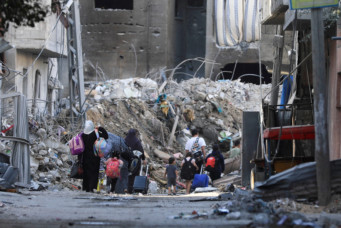
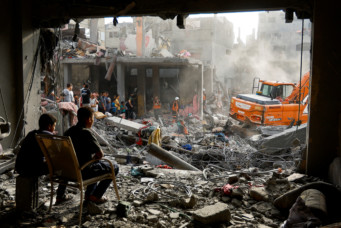
After five consecutive days of intense
Israeli bombing and Palestinian rocket launches, Ebaa Rezeq, a young activist
from Gaza known to be an outspoken critic of the Hamas government, appeared on
Israel’s Channel 2 television for an interview.
Knowing Rezeq’s record of opposition to
Hamas, Israeli journalist Ilana Dayan demanded, “Are you able to say it right
now, that Hamas is leading nowhere, that there is no future to the Palestinians
living in Gaza under Hamas regime?”
Rezeq replied, “I have to say that I do
publicly criticize Hamas, as a regime, as an authority, as a political authority,
as a political party. But at times like this, when we are targeted, and every
single place, and every single individual is a target in the Gaza Strip, we all
stick together.”
“In times like this,” she said, “Hamas
is Gaza, and Gaza is Hamas.”
“I believe that in times like this we
all support what they [the armed Palestinian factions] do, we all support the
armed resistance, because eventually I think Israel is leaving us no choice. No
choice whatsoever,” she added.
Passionate and articulate, Rezeq
perfectly fits the profile of the revolutionaries who participated in the Arab
uprisings that began in 2011. I met Ebaa in Gaza just before those revolts, at
the end of 2010, after Hamas security forces broke up a protest she participated in.
Rezeq was one of the activists who
joined the March 15, 2011, demonstrations in Gaza and the West Bank demanding
national unity and democratic elections to the Palestinian National Council.
The protests failed to spark a full-scale uprising, but they served as a
reminder that both the Fatah-dominated Palestinian Authority and Hamas faced
publics who are upset about corruption, failing economies, and above all a lack
of a plausible long term liberation strategy vis-à-vis Israel.
The 2011 uprisings placed Hamas in the
awkward position of attempting to align itself with a wave of popular revolts while
simultaneously clamping down on protests in Gaza. But despite the domestic
crackdown, Hamas managed to emerge from 2011 in a stronger regional position.
Having cut ties with the regime in Syria, Hamas attracted political backing from new
governments in Egypt, and Tunisia, while mitigating the loss of Iranian funding with
revenue from the smuggling tunnels and investment from Qatar.
The regional arena is transformed, and
the military equation is changed (with apparent new capabilities smuggled from
Iran and Libya). Hamas has reactivated a pre-2011 narrative of armed resistance
to Israel, a political framework that further marginalizes the Palestinian
Authority and quiets domestic criticism.
Rezeq’s interview should give pause to
anyone, including the interviewer, who holds the notion that major military
action in Gaza will separate Hamas from its base of political power.
On the other hand it would be a mistake
to assume, at this early juncture, that the current Israeli campaign will have
any linear effect on popular support for Hamas. Though they might hold off for
now, activists like Palestinian movement activists like Rezeq will continue to
criticize the Gaza government, as will their comrades in the West Bank. No
doubt many ordinary Gaza residents will continue to be disillusioned with the leadership.
It would also be a mistake to think of Hamas
as a monolith. The movement is vast, encompassing political and military wings
in the West Bank and Gaza, civilian charity intuitions, and political leaders
incarcerated in Israeli prisons and exiled outside of Palestine. The group’s
leadership is, in the words of seasoned Hamas observer Mark Perry,
“embroiled in a difficult debate” between Prime Minister Ismail Haniyeh and his
allies in Gaza “who believe that the movement should align itself more closely
with Iran and take a harder line on reconciliation with Fatah” and Political
Bureau chief Khaled Meshaal who “has a more internationalist vision—and one
that takes account of the shifts inside the Arab polity, and inside the
movement itself.”
It is too soon to say how these
internal divisions and the surrounding regional dynamics will play out amidst
the violence on the ground. But going forward, we should not assume that
Israel’s policies will have the desired effect on Palestinian politics. Nor
should we assume that groups like Hamas, or the Palestinian public at large,
think with one mind. Regardless, Hamas is not going away. The Israeli military
leadership, who negotiated a prisoner swap and a series of ceasefires with
Hamas in recent years, is aware of this fact.
Jared
Malsin is a graduate fellow in journalism and Near Eastern studies at New York
University. He previously worked as the chief English editor of the Palestinian
news agency Maan. On Twitter: @jmalsin.